
Translated material
The island of bad luck
Cyprus, where 50 thousand people speak Russian, usually lives news from Russia. But last week everything was exactly the opposite: a lot of people in Russia lived with news with Cyprus, and Russian private jets began to land at Larnaki airport one after another. What happened in offshore paradise, where billions of Russian money lay down, - the correspondent of The New Times observed
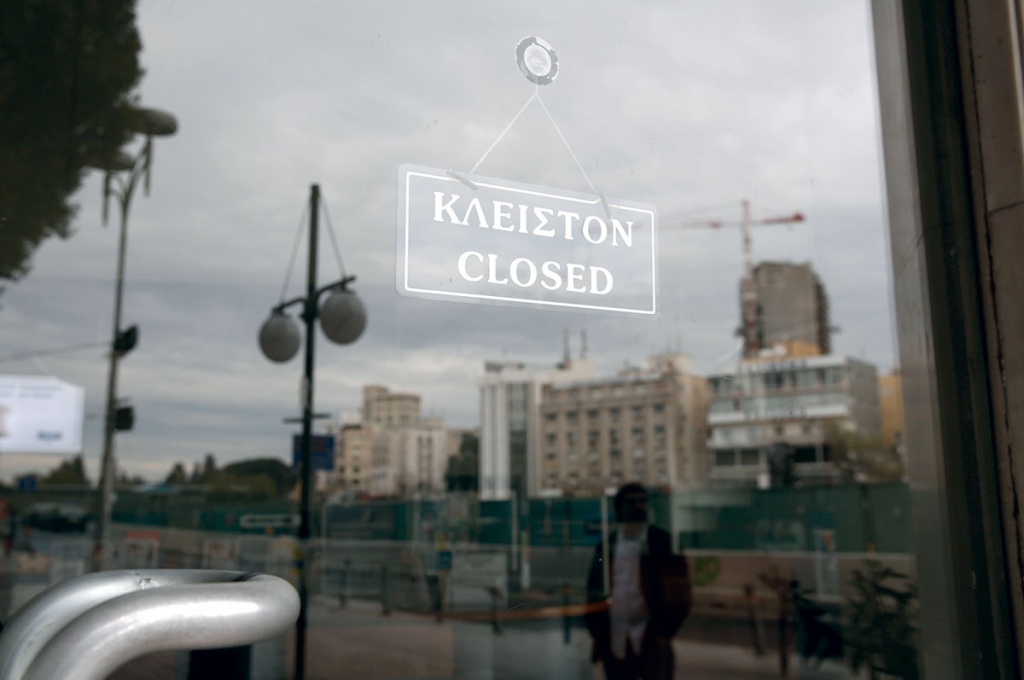
“Closed” - written on the door of the Branch of Cyprus Bank in Nicosia. The same - everywhere
| *EU, the European Central Bank (ECB) and the International Monetary Fund (IMF). |
“Troika”* - away from Cyprus! ”,“ Cypriots woke up, and Cyprus is sold, ” - well -dressed men and women of different ages - from students to pensioners. Events take place on the evening of March 19 in Nicosia, the capital of the island state. The five -thousandth crowd blocked the approaches to parliament, where at that time the deputies re -decide: whether to fulfill the European “Troika” requirement on the introduction of a lump -sum deposit tax, as well as an increase in corporate income tax from 10 % to 12.5 % in exchange for a loan of € 10 billion. The angry sea of heads, raised hands, posters with fascist com. glued from the stars of the European Union, and an angel Merkel with a mustache A la Hitler. Visible in the crowd and Russian flags. The picture is completed by a traffic light unnecessary at that moment, angrily changing light from green to yellow and then red. But a wave passed along the crowd - deputies of one of the opposition parties left the parliament building. Representative men in suits without ties approach the crowd, from which they are fenced out by metal fences, and here the real fraternity begins: the protesters hug with the deputies, hold their hands, scream.
The most important poster
“Don't let them rob us! Please, we believe in you, we voted for you, do not let the bicoper die, ”the thirty -year -old woman screams in fashionable glasses, clinging to one of the deputies. Screaming and crying. The deputy says something in response, and tears are also rolling across his face. He breaks out finally, leaves, wipes his face with the back of his hand and guiltily looks at the cordon of police with plastic shields, who, too, seem to be ready to burst into tears: Cypriots love the Greek drama.
The Russian tricolor, as it turned out, the demonstrators are holding over their heads for a reason. “If the Cyprus needs money, we are ready to sacrifice our own,” says the new Times, the Cypriot Cypriot, an employee of the banking sector, “just do not touch the Russians, there will be no Cyprus without them! You are our brothers! "
“The fact that the Troika started is a attack against Cyprus and against Russia,” lawyer Simmos confidently mints. “It is quite obvious that Germany wants to weaken Russia's positions in Europe and just chose Cyprus as a tool to annoy Putin.” But why is the border the gap the gap? “It's not about our banks! - Simmos insists. - In Luxembourg, the share of the financial sector in relation to GDP is even more than ours - and nothing. We are simply made by scapegoats. ”
The same thing in different ways is repeated by everyone with whom they manage to talk in the square: lawyers, professors of the University of Nicosia, bank employees, accountants ... there are demonstrators and Russians. One of them is Marina, a graphic designer, for eight years has been living in Nicosia. “My parents have a construction business in Tyumen,” she says, “they transferred a rather large amount of money here so that I could get a residence permit, then there were plans to buy an apartment at sea. Why does the Cyprus government want to rob us? "
Marina went to the demonstration with the poster "I Love Cyprus, and Cyprus fell in love with Vaselin." “Raise higher,” advises Marina in Russian, although with an accent passing by Cyprit, “this is the most important there should be a poster here.”
At half past eight in the evening a new wave rolled through the crowd: the parliament did not accept the deposits tax. People in the square begin to hug each other, cry, and even a traffic light, it seems, begins to blink somehow in a new way, joyfully: "Saved."
Are they saved?
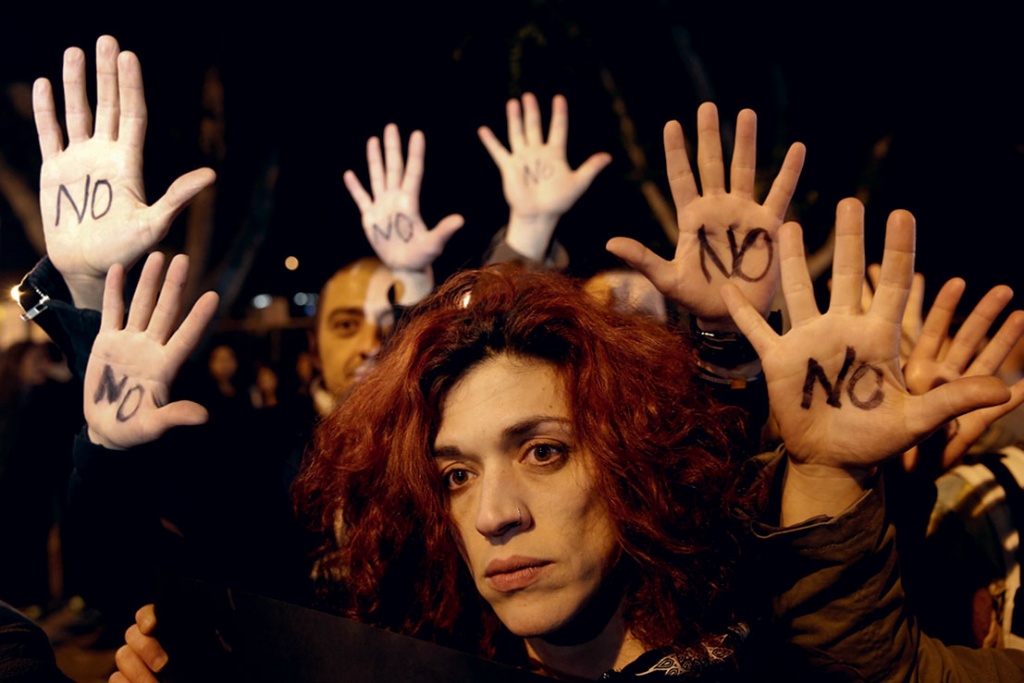
Demonstration by the building of the Cyprus parliament. People demand from the deputies to say a tax on the deposits "no"
Carnival lump
 |
Last week, flights from Moscow to Cyprus were crowded, the airports of Larnaki and Paphos accepted the record number of private jets, and in the restaurants of Primorsky Limassol it became crowded, as in May. The New Times correspondent had to fly through Dubai, and even on such an uncomfortable docking, when instead of 3.5 hours you get 12, a lot of Russians flew to Cyprus. “This is the end of the Cyprus as an offshore zone, and the Germans are to blame for this,” a familiar investment banker from Moscow named Stepan confidently said on an airplane. - And they do not do it for the first time! The last time they confiscated the money of Jews in the 30s, now we decided to confiscate ours! ”
Thunder struck on Saturday March 16, when it became known that President of Cyprus Nikos Anastasiadis agreed with the requirements of the Troika. The island, meanwhile, celebrated apocryria - Cyprus analogue of Shrovetide. Friday March 15 was a short day, and many Cypriots left out of town: almost every family has a house in the mountains or a village. “Pure Monday” (the first day of the great post) in Cyprus is a day off, it is customary to spend it on a picnic, it is no coincidence that it is called “Green Monday”.
In the cities, colorful carnivals were held in the cities: the townspeople, with the support of municipalities, sewed costumes for themselves and decorated platforms for the main definition. “The holiday, of course, was spoiled, everyone was in shock,” the former Muscovite Aida, who is now teaching Russian, tells The New Times. “But many Cypriots could not quickly return to the city, moreover, few people at all believed that this was possible - the confiscation of part of the deposits, everyone hoped for parliament.” In Nicosia, the ATMs immediately lined up. In Cyprus, as in many European countries, there is a daily restriction on cash withdrawal, moreover, money at many ATMs quickly ended. “There were problems in the city center,” says Aida, “but on the outskirts we shot calmly. Some stores stopped accepting cards - it was not clear whether the tax would affect new receipts. The Russians were better oriented: we are used to such matters, so that everyone immediately began to exchange information where the ATM works, where not. ”
However, the new tax was not at all news at all: according to rumors, a few days before the crisis that broke out of the country, € 5.5 billion was withdrawn from the country. Banks were closed on holidays, but their employees did not rest on picnics at all. “We should have worked because we have a check on the part of the ECB,” says Maria, a Russian -speaking employee of one of the largest Cypriot banks, “but on Saturday the entire client department called, the whole leadership was on the spot.”
Mary and her colleagues immediately began to break the phones of clients from around the world, for the most part from Russia, and already on Sunday - and come. “We did not know what to do, all the information came from newspapers and the Internet,” says Maria. -At first it was said that, they say, the tax would affect only urgent deposits, then it was discussed all the positive remains in the accounts ... A friend from another bank told me that one Russian client-stoomillion came with the bandits. What should they say? We tried to reassure, convince that as soon as information appeared, we will act according to the situation. ”
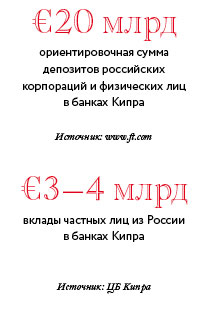
In Cyprus accounts lies about € 68 billion. Of these, € 43 billion belongs to Cypriots (€ 26.2 billion - to private individuals and € 9.3 billion to companies), and about € 18–20 billion, and, according to various estimates, € 3-4 billion of them are deposits of private individuals. However, the amount of supposedly purely Cypriot money is doubtful. As the owner of one of the Cypriot legal companies explained to The New Times, it is impossible to trace who really is behind this money. The company can be registered in Cyprus, but its real owners are again in Russia. The same with private capital: many millionaires, including Russians, have dual citizenship and they work not in Cyprus, but in Russia.
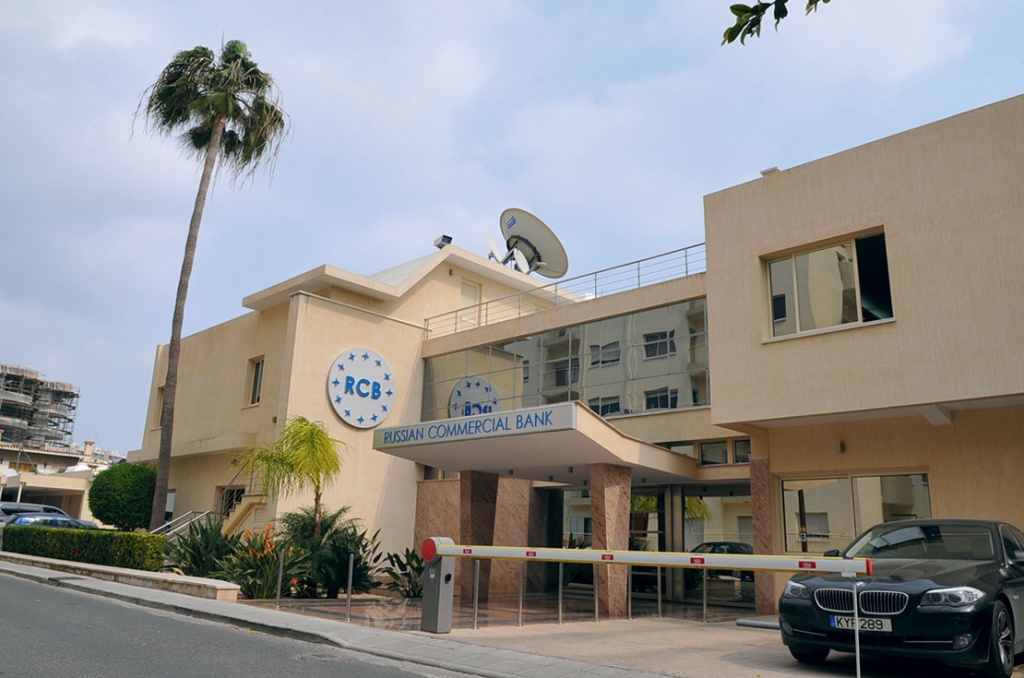
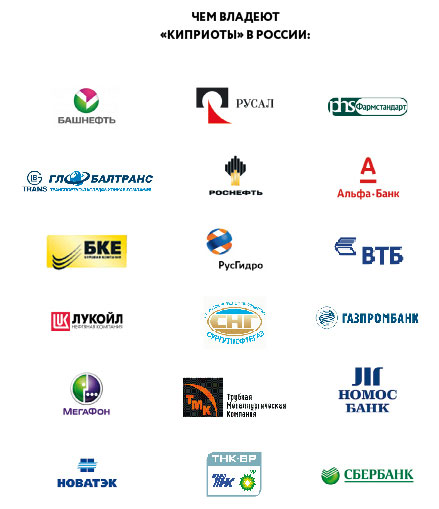
Employees of the Russian Commercial Bank, the Cyprus "daughter" of VTB, has an occasion to think about
Russian enclave
"How Much?" - I ask at the entrance to the bus. A driver who looks like Nicholas II looks the correspondent of The New Times in the eyes and in pure Russian replies: “One euro, please.” In the bus itself, an advertisement for the international network for transferring money is in Russian and English, and the inscriptions about the fact that you need to hold on to the handrails, in three languages: Russian, English and Greek. We are in Limassol, the seaside capital of the Russian Cyprus. Thirty of the fifty thousand Russian -speaking residents of the island live here, and in the summer the Russian -speaking population increases many times: in 2012, Cyprus visited 470 thousand Russian tourists. In addition to emigrants engaged in the service sector, many families of Russian businessmen constantly live here, visiting their family on weekends. There is a menu in Russian in almost every restaurant, as well as Russian -speaking waiters, sellers in stores and, as it turned out, bus drivers.
The bus travels along the road along the sea, on the one hand there are palm trees and acacia in color, behind which you can see a narrow strip of beach, on the other - Russian supermarkets and medical rooms, Russian hairdressers and bookstores, Russian kindergartens and brothels under the guise of night clubs and massage institutions, real estate agencies, schools, travel agencies and tankmen, and an office, an office, an office The Russian radio station (there are two of them in Cyprus), as well as Russian shops in which Russian newspapers are sold-not only brought from Russia, but also local ones: if you wish, you can live in Limassol without saying a word either in English, or even more in Greek.
 |
“It is convenient here,” says Tatyana, the owner of the company that supplies building materials from Europe to Russia, “is good for business and for life.” The entire infrastructure of the country is sharpened for the maintenance of foreigners, service in the field of financial, legal, accounting consulting accounts for up to 45% of Cyprus GDP. Although Cyprus legislation has been brought to pan -European norms in terms of combating money laundering, banks often look at the origin of funds through their fingers. It is as simple to open a fictitious company as an account in any bank: the nominal director costs € 500 per year, the nominal secretary - € 100–150.
Cyprus is good for those who are simply looking for comfort. When buying real estate in the amount of € 300 thousand, you can get a residence permit - first temporary, then permanent, giving the opportunity to travel without visas to other EU countries. “The standard of living here is completely different, not like in Russia,” Aida is innocently admitted. - Not only is the sea, but also all fresh - vegetables, dairy products, cheeses. The meat here is eaten only by the steam room, which is cut in a shop with you. And stagnation for a week with such products costs € 35–40 maximum. ” In addition, owners of a residence permit can use all the benefits of Cyprus socialism: free medicine and education, which in their quality do not lag behind the pan -European ones.
Invasion
It was to Limassol that Russians who were frightened for their money flew. The city was flooded with the leased Bentley, at the Four Seasons hotel there suddenly became a lot of men in black suits. “There are more protection than guests. If they do not give them money, they will shoot everyone here, ”says Igor, the owner of a chain of clothing stores. Only Russian speech is heard in the cafe, but they speak mainly about the household: the first shock, apparently, has already subsided. But if the Greeks are sitting, then in their speeches every two words - “meal” (which means “bank”), it seems, the natives are much more worried about everything that happens than the rich Russian customers.
In the oyster restaurant, Pueesta in winter is usually a little bitter, on weekdays in the evening a maximum of 10-15 people. However, now the restaurant is full: at least a hundred visitors. Many of them can be seen in Moscow institutions: well -groomed men in sweaters over shirts with young beautiful girls, dressed expensive, but discreet. But there is clearly not Moscow: women in leopard dresses, men in bright shirts with dragons or roses, threading belts for plaques on jeans - specially so that the letters D&G are visible.
But the very strange company, as if having come out of the film about the dashing 90s: an elderly person who speaks with a strong Georgian accent is dinner with his codium partner. He is in a black business suit, Georgians - in old worn jeans and a cooked sweater. At the same table, seven young strong guys with southern, but obviously not Greek features are sitting at the same table: gold chains, golden dark glasses (at ten in the evening), faces that do not give out any emotions. Everyone is silent, only Georgians speak Russian, and one of the guys hardly transfers to broken English toasts and sebaceous jokes. Cyprit, apparently, understands little, but still laughs every time. “Here they are, our main investors,” Igor smiles, looking at the company.
In response to the question, why all these people have arrived at Cyprus now, Igor shrugs: “Ask them, they yourself do not know. My friends say that it’s somehow calmer when closer to your money per minute is such a hardships. And so everyone is just waiting for what will happen when banks open. ”
Exodus
Cyprus banks closed in the middle of the ill-fated Friday of the 15th, when President Nicos Anastasiadis did not negotiate to Brussels. After that, their opening was constantly transferred until it was scheduled for Tuesday March 26 (Monday, 25th, in Cyprus-a day off).
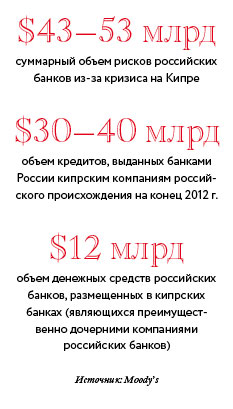
On March 21, the ATMs of the Cyprus People’s Bank (Marfin Laiki Bank) lined up again: the news was held in the news that Laiki, contrary to the multiplying rumors, would not be bought by the Russian commercial bank (Russian Commercial Bank), owned by the Russian VTB. In some ATMs, the cash has ended, the situation of the last weekend was repeated. The country without working banks is twisted as they can: if citizens for the most part can withdraw cash, then business has to postpone payments to suppliers or write out checks that cannot yet be cashed out. Operations and foreign companies are frozen, many of which use Cypriot accounts for operating activities.
“This, of course, is a disaster,” says Andreas, an employee of one of the banks. - We persuade local customers to wait and endure, international, thank God, for the most part have accounts not only in Cyprus, but also in other countries. But if the banks do not open next week, everything will rise here. It’s good that all this did not happen at the beginning of the month and there is no need to pay salaries. ”
Local lawyers and bankers surveyed by The New Times do not lose optimism, expect that they will be able to convince customers: the danger has passed, Cyprus again became a quiet offshore vest. In addition, many banks already offer customers the so -called fiducial deposits - when the bank places the client’s money in a third -party bank, including in another country. The interest on such deposits, however, can strive for zero, but there are more guarantees, moreover, with such a deposit, a third -party bank does not receive information about the owner of the account.
But the non-conduct specialists do not share these hopes. “Until last Friday, Cyprus was a stable banking system,” says banker Stepan. -Only two large banks-the bank of Cyprus and the Cyprus People's Bank experienced difficulties due to involvement in the Greek crisis. True, there is not so much foreign money in them. But now the situation has changed. There is no longer a single stable bank in Cyprus. Moreover, almost all de facto banks will become bankrupt on the very first day after the opening. ”
On March 23, President of the Cyprus Bank Andreas Artemis proposed contrary to the position of the parliament “without delay” to accept a proposal for a one -time tax on deposits over € 100 thousand. “What a trick! - Stepan is indignant. -After all, Artemis perfectly understands: it will not be his robbery-his bank is on the verge of bankruptcy, but depositors of other banks! "
With Stepan, Tom Kin, partner of the law firm Keen Vzhenopulu, partially agrees. “I think, after the opening of banks, most of the Cypriots will try to pick up their savings,” he explained The New Times. - After the government tried to deprive citizens 7% of their savings, confidence in banks was undermined. But the most dangerous is of course corporate accounts. It is difficult to name some figures, but, I think, 25-30% of corporate money will leave Cyprus as soon as possible. ”
“In Cyprus, there will definitely remain those who have nowhere to withdraw money, because this is dirty money,” Stepan continues, “there are many of them, but they will not be able to make up for losses. Germany thinks that all Russian money in Cyprus is dirty, and this is not at all. Most of the Russian capital can calmly change jurisdiction. ”
When asked where Cypriot money will go, most Cypriot interlocutors The New Times replied: most likely, beyond the EU. “It will be either Malta, interesting from the point of view of tax legislation, or England, as one of the most reliable countries,” Tom Kin says. “Perhaps some of the capital will go to Latvia and Lithuania.”
However, such a scenario is possible only if the Cyprus will display. If the country does not find money, then she simply will have nothing to pay with creditors.
Not fraternal
 |
19 марта, когда кипрский парламент решал, что делать с идеей налога на депозиты, киприоты с надеждой смотрели на Москву и готовы были носить на руках каждого встречного русского: «У нас есть газ — вы можете его забрать», «Пусть русские забирают наши банки — они знают, как делать деньги», «Надо выйти из Евросоюза и разрешить русским построить у нас военные базы», — говорили The New Times кипрские граждане, собравшиеся на площади напротив парламента. Но к 22-му числу киприотам стало понятно: московская миссия министра финансов Сарриса провалилась, помощи ждать бесполезно. Настроение у людей резко изменилось.
В небольшой таверне рядом со средневековым замком в старом городе Лимассола народ уставился в висящий над барной стойкой телевизор. «Тройка — трапеза — Медведев», — говорит в который раз диктор и греки-киприоты разочарованно качают головами. «Ничего не понимаю, — говорит пенсионер Димитрис, — сначала нас предал этот подлиза Анастасиадис, за которого я голосовал, но готов теперь руки себе отрезать вот так, — и Димитрис показывает, как он по локоть отрезал бы себе руки, — а теперь и русские туда же? Что происходит-то, скажи, ты же русский! Вы можете купить этот остров и мы будем только рады — лучше быть под братьями православными, чем под немцами!» К Димитрису присоединяется его приятель Акис: «Вот мы до последнего надеялись, что русские купят этих мошенников в Laiki, но никто нам так и не помог! Я сегодня простоял полчаса в очереди к банкомату, чтобы снять свою суточную норму, но отдадут ли мне остальное?. Почему вы нас забросили?»
Сейчас если кто и продолжает надеяться на лучшее, так это проживающие на Кипре русские. «Знаете, здесь такие люди держат деньги, — говорит, понизив голос, экспортирующая стройматериалы Татьяна, брат которой, как выяснилось, тоже работает в кипрском банке. — Такие люди! Я вам не буду называть фамилии, а то вы еще меня опубликуете… В общем, они не дадут этому острову утонуть».
фотография: Reuters, Julia Avanessova