
Translated material
Goodbye, Cyprus. Hello ... Hong Kong?
Nicosia could not agree with Moscow on financial assistance
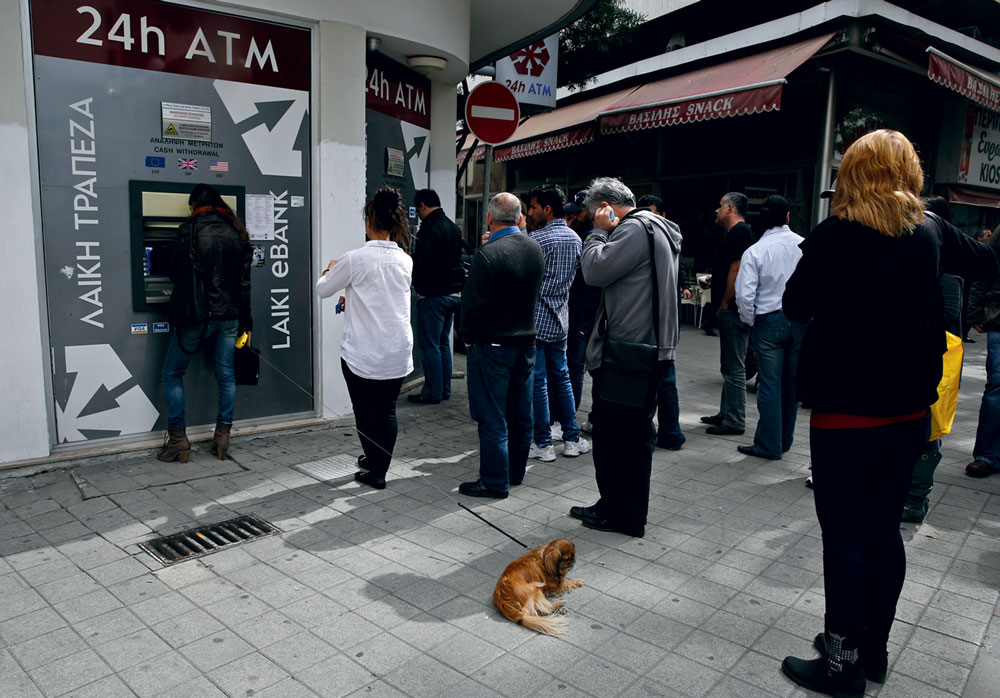
The queue for the Laiki Bank ATM in Nicosia. March 21, 2013
The paralysis of the Cyprus banking system may cost Russian business expensive. The Swiss Management Company LGT Capital Management has stopped brokerage operations with Russian Alfa Bank and Renaissance Capital, but there may be other victims. Among companies that most likely have accounts in Cyprus are called giants such as Gazprom, Lukoil, Bashneft, Rosneft, TNK-BP, Surgutneftegaz and many others. Their losses can amount to billions of dollars due to penalties under unfulfilled contracts.
Therefore, the Russian side, like no one else, is interested in ensuring that the banking crisis in Cyprus is resolved as soon as possible. Even the Prime Minister Dmitry Medvedev laid on March 21 on a difficult situation: “We have a large number of open public structures through Cyprus, they now have money blocked for unknown reasons, because the source of this money is obvious, this money is presented everywhere. These are government agencies. ” But for Europe, Cyprus is primarily a giant laundry, where dirty money is laundered. Up to 30% of all deposits in Cyprus are Russian deposits. It is clear that Europeans have a reasonable question: “Why should we save Russian money? Let Russia pay for their salvation. ”
Cyprus asks for saving the economy, or rather, € 17 billion for recapitalization of banks and filling out the budget. For Europe, this is not so much money. But Germany, the largest economy in Europe, insists that € 5.8 billion Cyprus receive due to deposits tax. Why are the Germans so fundamental in this matter? Firstly, the less German taxpayers pay, the better. Secondly, in September 2013, the parliamentary elections will be held in Germany, and the election period is always characterized by tightening political rhetoric. Finally, the obvious benefit is the destruction of the powerful offshore zone, which accumulates large flows of “dirty” money. However, the negative effect of such a scenario - undermined trust in European banks - was clearly not taken into account.
"
With a high probability of Cyprus - Sodom and Gomorrah of Finance - ceases to exist as a banking power. Russia will lose its main "laundry"
"
Cyprus is our everything
Cyprus offshore is so popular among Russian companies because of a number of advantages. The first is the simplicity of registering a Cyprus company. The second is a comfortable tax system. The income tax rate is only 10% (for comparison: the main rate of income tax in Russia is 20%). For holdings registered in Cyprus, there is no consolidation tax. There are no taxes on internal or external dividends, for the growth of capital, there is no tax from the sale of securities. In addition, Russia has entered into a double taxation agreement with Cyprus. And finally, another important reason is a high level of confidentiality: Cypriot companies disclose only the names of nominal shareholders and directors, and information about the true final beneficiaries of the Cyprus company remains a secret behind seven seals.
As a result, the microscopic on a European scale of Cyprus (its GDP in 2012 amounted to only $ 22 billion) turned out to be the largest source of investment in the Russian economy. According to the International Monetary Fund, the volume of direct investments received in the Russian Federation with Cyprus amounted to $ 128.8 billion in 2011.
The price of the issue
The losses of the Russian side in the case of unfavorable scenarios - default or moratorium on external payments - can be huge. According to the Moody's rating agency, deposits of Russian corporations in Cyprus banks in 2012 are $ 19 billion, and the volume of loans issued by the banks of the Russian Federation Cyprus companies in Russian descent - $ 30–40 billion. The “Domino effect” can arise, capable of causing a liquidity crisis.
What Russian banks have “substituted” the most? Probably VTB. In Cyprus, his “daughter” of the Russian Commercial Bank (Cyprus) Ltd. The VTB press service issued a very optimistic press release: “Even with the most unfavorable development of events, the bank’s losses can be several tens of millions of euros.” Which is doubtful, since already in 2011 the assets of the Cyprus “daughter” of VTB reached $ 13.8 billion.
The fate of Junastrum Bank causes anxiety - after all, he is the “daughter” of Cyprus Bank, the largest Cyprus bank. Its assets as of March 1, 2013 amounted to 84.5 billion rubles, while loans received from non-resident banks (and probably here we are talking about the maternal bank), amounted to 15.3 billion rubles.
Under the blow, and many other Russian companies listed at the beginning of the article.
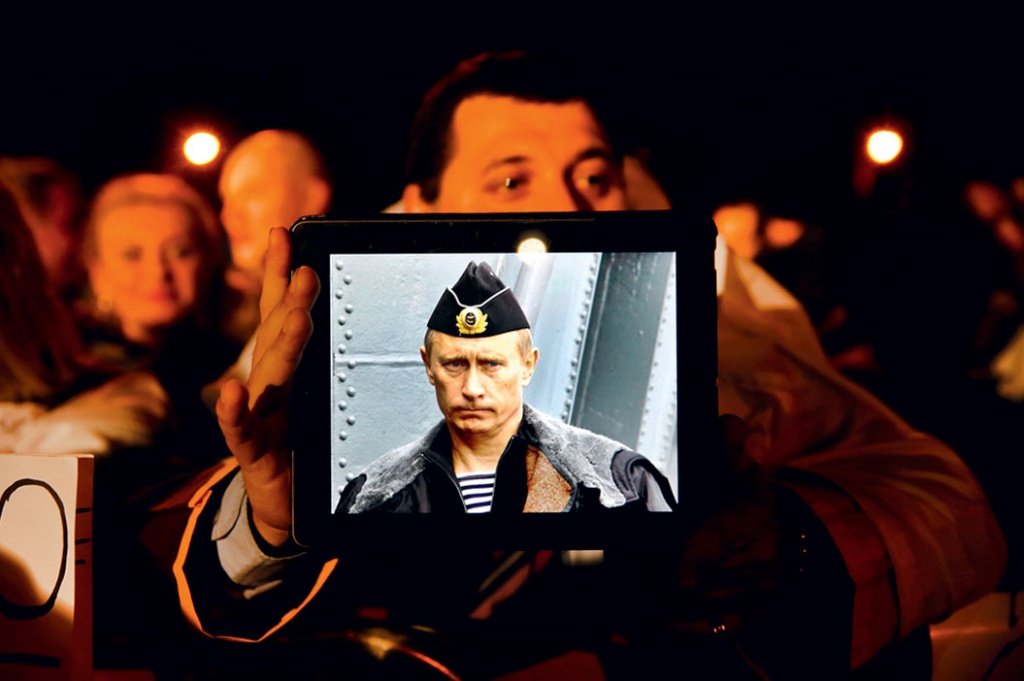
This Russian living in Cyprus hopes only for President Putin
Gas argument
On the evening of March 21, there were reports that Cyprus abandoned scandalous deposits tax in favor of an alternative scenario - creating a special fund as guarantees for financial support for the EU. However, this in itself does not remove the severity of the situation. To get € 10 billion of the EU, Cyprus will have to fill this fund € 5.8 billion of its own funds. And it is necessary to do this as soon as possible, otherwise the country may well not get any money at all, and then the default will be inevitable. For the Eurozone, this will not be a blow - the share of the Cyprus economy is only 0.1% of the total EU GDP. But for Russian depositors, this will be a quiet Armageddon. After all, deposits tax can ultimately transform into their complete loss.
How to be? There is no question of direct financial assistance from the Cyprus from the Government of the Russian Federation. Firstly, it will be an unpopular measure: they say that the oligarchs are saved at the expense of the people. Secondly, what the Cyprus delegation led by Minister of Finance Mikhalis Sarris was proposed during a visit to Moscow-shares in Cyprus banks, participating in the development of gas fields in Cyprus shelf in exchange, the Russian side did not attract. Rosneft and Gazprom were not interested in the proposals of Cypriots, ”a source in the Russian government commented on the situation for RIA Novosti. Why? Our giants allegedly considered that it is still difficult to assess the profitability of Cyprus deposits. But the other is obvious and the other - the reason: Moscow clearly does not want to nervous Turkey now, which does not recognize Cyprus sovereignty over hydrocarbons. Therefore, the negotiations of Sarris in Moscow ended in nothing.
Nevertheless, the fact of negotiations was caused by the dissatisfaction of the German Chancellor Angel Merkel. In addition, the EU leadership, contrary to the fundamental German position, also arrived to negotiate with the Kremlin. So, perhaps, the true goal of Cyprus in this intrigue is to play on the contradictions between Russia and Europe and thus achieve mitigating the conditions for the receipt of European assistance.
Deofshorization?
No matter how this story is resolved, the mass raid of depositors to Cypriot banks is very likely. Of course, Cyprus can extend the bank holidays, but this will only be an extension of agony. With a high probability of Cyprus - Sodom and Gomorrah of Finance - ceases to exist as a banking power. Russia will lose its main "laundry". Offshores in the Russian economy have a most important role - after all, in them with the help of a mechanism of transfer pricing settles the profit from the sale of raw materials resources.
And although President Putin has repeatedly stated the need to dehofshorization of the Russian economy, it is unlikely that the “Cypriot haircut of deposits” will contribute to this process. The hopes that Cypriot capital will flow into Russia are unlikely to be justified. There are many offshore zones in the world, and Russian money with Cyprus can smoothly bake into Liechtenstein and Luxembourg, not to mention Hong Kong.
Gas reserves on Cyprus shelf can be, according to various estimates, from 1.7 to 3.4 trillion cubic meters. At a price of $ 400 per 1 thousand cubic meters, the cost of these reserves is $ 0.68–1.36 trillion. In December 2012, Cyprus refused the consortium, which included the Russian Novatek, in the development of deposits on his shelf.
Photo: Reuters