
Translated material
Waiting for the bridge

The PS correspondent visited the village of Klimovka, in the area of which it is planned to build a new bridge.
Two and a half hours - and you are on the right bank of the Volga, in the Shigo district. The closer to the river, the worse it sat down. More abandoned houses and voids. In one of the villages where we drive, the baby is lying carefree in the middle of the road, playing with courtyard dogs. The cars are rare here. The finish line for Klimovka designated itself simply - the old asphalt and the lack of cellular communication.
The village met frowning: the only store closed at a two -hour lunch and an orphan announcement that today in a local recreation center will be accompanied by the winter. On the contrary - abandoned management of the collective farm, nearby - stela to the dead in the Great Patriotic War. There is not a soul around. Failing into melt snow, which under the white cover is fraught with cold water, we went in search of people.
And in the first allery they realized that they knew the enterprising Togliatti, the communal holder and just deputy Viktor Popov. It turns out that he had already managed to redeem the collective farm shares from local residents.
“They heard about the bridge,” the man who came across in the alley reluctantly continued the conversation. - There are a lot of conversations, but you yourself see - they have not yet been built.
The recreation center turned out to be a shabby building made of white brick, in which the library, the club, the first -aid post and, when necessary, are now located, a local polling station. We were late for the feast of winter wires, but the group of adolescents here was still to be found. They heard about the bridge, but in the eyes it is clear that they do not care if he will be.
“Somewhere half of the houses in the village is empty,” shared twelve-year-old Volodya, who volunteered to be our guide and guide on the village. - Summer residents come in the summer - the village comes to life.
First of all, Vova dragged us to the embankment, where most houses belong to the "city", and from a steep cliff the impressive view of Togliatti opens.
“There is no more than an hour to the outfit on the ice,” says Vova. - Sometimes we walk. The ice is strong, this year no one has failed.
A little at a distance you can see tower cranes and divers, swarming on the shore. Near Klimovka there is a trunk gas pipeline, which is now being repaired by Gazprom. Despite the proximity of such an important pipe, stoves will still be drowned in the village with wood. In Klimovka there is not only gas, but also mail with the school, the buildings of which are now abandoned opposite each other. The rickety blue hut with the lattice windows once accepted postal items and issued pensions to the elderly. Next to her lonely and stupidly is an orange taxophone brought by snow. Mail for the sake of saving funds moved to the house to the only postman.
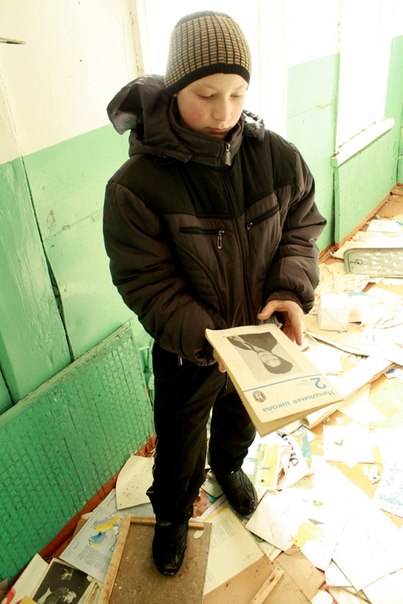
“The school was closed three years ago, when a primary school teacher left,” Vova said, leading us inside an abandoned, but still strong and solid building, where the school was once located.
On the floor, textbooks and methodological manuals, children's drawings and notebooks are scattered. Part of the desk, apparently, was stolen, and the rest were broken. The glass was knocked out by local hooligans, but not so long ago, because the paint on the walls had not yet managed to peel away.
Another winter - and the building will settle and become unusable. Now all Klimov’s children (and there are no more than 20 of them) are forced to study in a neighboring village. Every morning a bus carries them there. The architectural ensemble of devastation is completed by incomprehensible ruins from bricks, adjacent to the former mail and school. On the skeleton we can assume that the building was rather big.
“Once it was a store, but then it was broken,” explains Vova.
With this phrase, you can describe the whole story of Klimovka. It was already the best one better here. Here was a large collective farm-militone named after the 40th anniversary of October, famous for its high milk yield. The collective farm had more than 300 heads of cattle and about 200 pigs.
A large sawmill and kindergarten worked. In the 80s, a small cottage village for visiting collective farmers and refugees was even built. But this is where good times are over. Only the rusty cabs of tractors remained from them, scattered in a chaotic manner along the village.
Now the Klimovsky focus of civilization has faded. The river is nearby, but there is no pier. There is a road, but for a long time regular buses have not come here. The old -timers are enthusiastic about those fertile times when Meteors and Omiki molested, thanks to which every summer the village was flooded with tourists. But in connection with economic difficulties and high prices for tickets, the marina was removed.
Administratively, the village of Klimovka, apparently, does not exist. The only broken road leads to the village. The freshly established pointer embarrassed the name Limovka. Nearby it became clear that a self -adhesive film began to get off him. The road ended with a concrete stop of public transport that once existed here. Then there were only directions.
“Half of the village drinks, and half works on farms,” says our young conductor. - Two farms. One is my grandmother, cows are raised there, and sheep is bred by the other.
Sanya works on one of the farms. He is a little over 30, he is from Tolyatti. He says that he worked at a vase, but was tired and wanted freedom. Swanked and invested in livestock. Now works for itself. He had an apartment in the city.
“I don’t regret anything,” Sanya shared with us. - It’s good here, only with the locals you need to find a common language.
Now it’s hard to imagine that after some five years a wide track will pass here, along which heavy trucks will go in an endless stream and day and night. Perhaps, over time, in this new suburb of Togliatti the earth will rise in price, life lovers will appear away from dusty cities. Some, like a deputy and communal person Viktor Popov, have already been betting on an investmently attractive tomorrow today.
“I won’t leave here anywhere,” Vova said saying goodbye to us. - I like here. I will, like a grandmother, deal with a farm.