
Translated material
Mosa scale for journalists-2
In society
 Mosa scale for journalists-2
March 27, 2013 Igor Yakovenko
In the first part of these notes, I settled on the problems of reputation in the journalistic workshop. We do not have such an institute. TEFI in ruins. “Golden Featers” are decorated with Maxim Shevchenko and Mikhail Leontyev. The law of the Omert is in the journalistic environment no worse than in the Sicilian mafia. Only representatives of the hostile media clan can be criticized. Hence the Manichaean design of the journalistic world: you are either an angel or a devil. Manichaeism is prone to inversion, to turning: today you are an angel, tomorrow is the devil.
The main problem of journalism erosion is its suppleness to influence by the authorities. Power corrodes journalism as rust metal.
Therefore, the idea of the scale arose, by analogy with the scale of the hardness of the minerals Friedrich Moos. Firmness for stone is the ability to withstand the penetrating external influence, not to allow you to destroy your surface. For a journalist, this is the ability to maintain a journalistic content, not to turn under the pressure of power or business into a propagandist, into an assistant political or economic party.
Why is such a mineralogical analogy? Firstly, simple and clearly. And secondly, there was a temptation to use Lamarck’s ladder for the analogy, but many are offended by zoological comparisons. Therefore, let there be minerals.
So, the scale of Moos for journalists.
1st hardness: talc. The softest and most suppressed mineral in nature. Used for children's updates. The same supple softness has graphite that can be written anything. Today is one, tomorrow the exact opposite.
The standard of “talco-graphite” hardness in journalism is Ekaterina Andreeva, who worked for 22 years on the first television channel of the country, of which 15 years were the face and voice of the main program “Time”. The Ostankino needle during this time several times changed the owners and the direction of the slope, and Ekaterina Sergeevna continued to hold the occupied height. A student of the legendary dictator Igor Kirillov, she led Putin's direct broadcasts with the Russians. In an interview with Echo, she said that, standing nearby, she scanned the leader of the nation and understood two things: 1. That he has a wonderful memory and everything he says is deliberately; 2. He loves his dog very much. When I read this interview, I remembered Marshak's rhyme: “Where were you pussy today? - The queen, with English. What did you see at court? “I saw a mouse on the carpet.”
Ekaterina Andreeva is a reference representative, perhaps, the most mass detachment of Russian journalists who do not care what to say, if only their speaking face was in the frame. Or the signature was in the strip. Well, accordingly, the figure in the statement. The main advantages of this group are diction and decent appearance.
2nd hardness: gypsum. It is used for the manufacture of gypsum dressings that provide immobility. GIPS is a typical sedimentary rock, that is, it is formed from skeletons of creatures that previously former living. Journalistic gypsum is formed from the remains of former journalists.
The largest reference piece of journalistic gypsum is Evgeny Revenko. Gypsum is three times harder than talc. Revenko, unlike Andreeva, always has a firm position. Andreeva reads the text, Revenko reports his personal position. Until 2000, during the work on NTV, it was a clear civil position: he distinguished himself in 1995, having interviewed Basayev in Budenovsk, in 1999 he received TEFI for the best reporting work, sharply critical of the authorities. In 2000, exactly on the eve of the NTV capture, he woke up the statesman. He switched to VGTRK, in 2005-2007, he went to the government’s press service for 2 years, then again VGTRK, where Dobrodeev rose to the 1st deputy. The criticism of the views evaporated. Reporting was enriched with carefully and devoted intonations, resonating with each step of power bodies. A feature of gypsum journalists - they always hold a general line of the party, adhering to its very middle. At the same time, they do it exhaustively and convinced.
3rd hardness: calcite. The mineral is beautiful, there are large transparent crystals resembling ice floes. It has an amazing variety with an admixture of hydrogen sulfide called “Smelty Spatty”. Touching with your hands and sniffing is not recommended.
In modern Russian journalism, there are a lot of analogues of the “smelly spar”, but Arkady Mamontov is undoubtedly a reference model. The native, of course, with NTV, then, again, a sudden sovereign enlightenment in 2000, the transition to Russia, and then the well -deserved glory of the country's main govnotmet, which came after films about spy stone, about Pussy Riot and the opposition. Mamontov, as the largest block, is bulging from a large array of “smelly sparks”, which include Mikhail Leontyev, Sergey Dorenko, Elena Yampolskaya, Vitaly Tretyakov, Andrei Karaulov, etc. What is the fundamental difference between journalists of this category of hardness. They are much stronger and brighter than the “gypsum” Revenko, not to mention the Talkova Andreeva. These are preachers. Missionaries. They do not just have their own views, but protect and preach them violently and aggressively. Moreover, often these views may not be in the middle of the party line, but on its edge, or even go beyond it, proceeding to criticism of individual fractions of power. The “smelly spar” can play and jump out by the flags, starting to criticize the wrong ones. So it was with Dorenko and Karaulov. But the power by the smell defines the “smelly spar” as its own and takes it back into its bosom, unless, of course, he played too much.
4th hardness: fluorite. Translated from the ancient Greek "fluid". Those who first see fluorite, thinks that in front of him is a precious stone, so beautiful his large transparent crystals that are purple, green, blue, and even black. But for jewel, fluorite is too flexible and is generally quite useless.
Not at all in journalism, where fluorite fluidity and deceptive shine are very in demand. The standard of this level of journalistic hardness is Leonid Radzikhovsky, who until recently was published in the ten media of the opposite orientation, managing to be his own at the same time for the audience of the Rossiy newspaper and Hedgehog, Echo and Channel One. The fundamental difference between the “fluorite” and the “smelly spar” is that the latter is not pretended to objective and equivalent. Mamontov and Leontyev do not depict a pose over the fight. They are in its very thickest, and always on the side of the winner, that is, power. Radzikhovsky plays cool equidistance. The main tool for acquiring a pose over the fight is irony. But irony, with a tip always aimed at the opposition, which always turns out to be stupid, ascend and thief than power. Facts do not matter. Constant errors in forecasts exactly the opposite are left with soft intelligent irony and good Russians.
In addition to Radzikhovsky, Vladimir Solovyov, who performs in the specific genre of the “playing referee”, belongs to the group of “fluorite hardness”. More precisely, beating. Moreover, as a rule, from behind. The catastrophic lack of public dialogue in the country is of interest in such tricks as the Solovyovsky “to the barrier” and “duel”, in which the skill of the leader is manifested in the guaranteed achievement of the desired result.
It is enough for some to see a “fluorite” journalist a couple of times to understand that this is not an emerald and, moreover, not diamond. But someone today perceives Radzikhovsky and Solovyov as journalists.
5th hardness: apatitis. Translated from the ancient Greek "deceives." Such an offensive name is due to the fact that in nature this mineral is often confused with precious stones, beryl and tourmaline. Crystals are very similar in shape and color. But the hardness is not the same. Yes, and shine, if you look closely, dull. But in general, the stone is useful, used as a raw material for fertilizers.
The standard of the journalist "Apatite Hold" is Alexander Minkin. Externally looks like a brilliant journalist, scouring the vices of power and ulcers of society. Some letters to the president are worth it. But, if you figure it out, then this one -sided correspondence reproduces two classic matrices: a daring jester under the king and the Kholuic scheme "The king is good, the boyars are bad." Both schemes support the autocracy and this particular autocrat. Such a corridor permitted by the owner of MK Pavel Gusev, with whom Minkin is associated with long -standing and almost inextricable symbiotic relations. Periodically, publications appear confirming the reputation of Minkin as a “drain tank” and a custom journalist. This was written by Tatyana Tolstaya, and Andrei Malgin, and Viktor Shenderovich. Nevertheless, both Minkin and his master Gusev have much greater journalistic firmness than, for example, Radzikhovsky, Soloviev, not to mention Evgenia Revenko. Minkin and Gusev are much cooler. They are allowed, or rather, they themselves can afford much more. For example, now MK has been on the tip of the conflict with the State Duma, almost with a whole branch of power. The branch, however, flimsy, does not pull on a rotten knot. But still power. Moreover, I repeat the forecast made in the first part of these notes: the State Duma and “USRO” about “MK” teeth will break off. The reason is that Gusev and MK, whose most important resource is Minkin, is no less rooted in power than the State Duma. Putin is easy, with a click of fingers can replace the arrow, Isaev, and almost any deputy. “MK”, which has hundreds of thousands of readers and Minkin, whom these hundreds of thousand take for a journalist of the highest sample, is almost unrealistic to replace. At least the technologies available to Putin's team. While Gusev and Minkin, fighting with the Duma and officials, support Putin, they are indestructible. This quality is called strength. It should not be confused with firmness. Diamond can be broken by sledgehammer. From a piece of rubber, the sledgehammer bounces.
6th hardness: orthoclase. One of the most common minerals in the world. Together with his counterparts from the Field Shpat family, he forms the main rocks: granites and Gneys. Used in industry. In general, such a strong workhorse, without complaints about a feature.
The journalistic analogue of the hardness of Ortoklaz is Vladimir Sungorkin, the chief editor and publisher of Komsomolskaya Pravda. The basis of the 6th level of journalistic hardness is cynical honesty. Without showing off. Sungorkin does not pretend to be a critic of power. He honestly and openly serves her. But in free time from the main classes. In the main, main lesson, in the Media Business, Sungorkin tries to adhere to some rules. KP, among the first in early 1999, began to print an honest circulation and a circulation audit of the national circulation service was held. For comparison: a number of publications of the ID MK and today are many times overstated to the reasons for unfair competition. For several years, Komsomolskaya Pravda has stopped publishing an advertisement for brothels, which is still a significant share of MK. Sungorkin should be corporate agreements, Gusev wanted to spit on everything and on everyone ... Well, except for those who can destroy it. And there are very few of them in Russia. If we draw an analogy with the world of crime, then Vladimir Sungorkin is “the right thief living according to concepts”, and Pavel Gusev is “scumbag”, “belonged with crowbar”. For Media market, Sungorkin is much more useful. For journalism (if you keep in mind the space of freedom within the editorial office), Pavel Gusev creates more favorable conditions. Therefore, journalists, comparable in brightness and severity with Alexander Minkin or Julia Kalinina, are not observed in KP.
The 6th level of hardness is not only boring orthoclase, but also one of the most beautiful precious stones, and at the same time the most soft, noble opal. Having the same level of hardness as Ortoklaz, noble opal does not look like his plebeian neighbor on the Moos scale. He is bright and deep, shimmers with all the colors, and sometimes shines with moonlight. The largest journalistic opals are Vladimir Pozner and Leonid Parfyonov. Great journalistic talent and skill allow them to both have a fairly high level of autonomy from both the authorities and from the media owners. Posner practically introduced the term “Gosdura” into the official public turnover, and Parfyonov, when awarding the award, made a speech in the style of Kasparov. At the same time, each of them knows for sure that, having run around the clean field, he will certainly return to the stall and will play according to the rules of the power that his front was directed. He will not speak, keep silent, pretend and face. In short, play the game, and if rude, then twisted with his soul and do indecent acts, as Leonid Parfyonov, for example, did, who quickly crossed the side of the authorities from the drowning NTV. Opal is not a diamond, and due to insufficient firmness it needs careful care, for the frame, to be constantly worn, it was cherished and cherished.
7th hardness: quartz, mountain crystal. The stone is good for everyone, but it does not slightly do not reach the jewelry of the first category.
In journalism there are persons who, in terms of talent and ability to remain fidelity of the profession, are worthy of the first row. And they hold a distance with the authorities, and they are able to win the audience. But something limits our delight. The applause is present, but not stormy and not very long. Savik Shuster and Evgeny Kiselev. Both limits in the ministry of journalism a huge and all -winging love. Schuster has a love of football. Kiselev has a love for himself.
8th hardness: topaz. A precious stone of such beauty that it is called a Russian diamond.
I would venture to bring a journalist that has left us as a standard. Egor Vladimirovich Yakovlev. A journalistic block, which hung with its influence over the 40 years of Russian journalism: from the end of the 60s of the last century to the mid-zero. With his professional, political and simply personal scale and weight he pushed both Soviet and post -Soviet censorship. But there was a type of censorship, before which he always stopped, bowing his head. Before censorship of friendship and corporate-clan solidarity. If Yegor was friends with Primakov, then not only a critical, but also a cool-objective word addressed to a friend could not appear in the newspaper. And yes, played games. Political. But they perceived politics as a team game in which friendship should be inside the team. And this gave rise to another barrier for impartiality.
9th hardness: corundum, sapphire, ruby. Precious stones of the highest category.
In the journalistic hypostasis, these are Mikhail Osokin, Vladimir Kara-Murza, Marianna Maksimovskaya (as a host of the program, and not as the deputy chief expense of the canal), Stanislav Kucher, Lev Rubinstein, Viktor Shenderovich. Power cannot put pressure on them. I tried it, it didn’t work out. They work for money, but are not sold. Bidd with manuscripts, not inspiration. The censorship of friendship and corporations in most of them is present, but not to the same extent as that of the great Yegor. The reservation on Maximovskaya means that today this level of hardness and maintaining the autonomy of his journalistic essence can only be afforded by an ordinary journalist who is only responsible for itself and for his program, his text, his picture. No editor can afford such autonomy. Since each of them is a team, dozens of people, the whole media, audience, money. In a word, there are too many protruding items for which power can grab and bent the editor.
10th hardness: diamond.
Journalistic analogues in Russia are unknown to me.
Here is such an extremely subjective media-mineralogical analysis.
It remains to answer one trifle question: what the hell did I generally start all this arrangement of journalists in some categories? Why do you need this scale and some standards?
I will answer this and some other questions in the third, final part of the cycle.
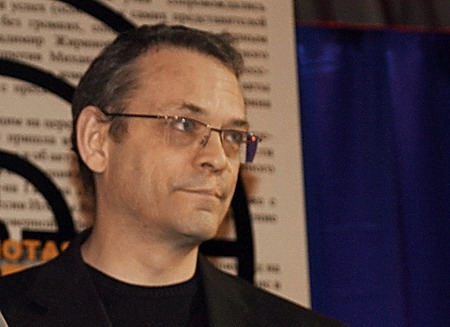
Photo by ITAR-TASS/ Grigory Sysoev