Date
Author
Source

Preserved copy
Translated material
Pelevin as Radzikhovsky
In society
 Pelevin as Radzikhovsky
April 1, 2013 Mikhail Berg
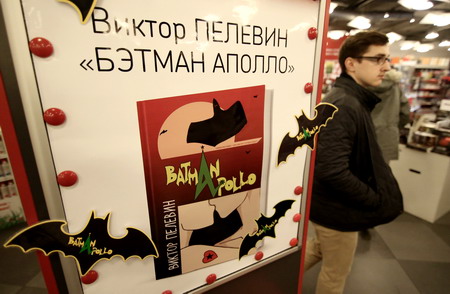
Pelevin’s last novel “Batman Apollo” has already managed to scold anyone. Boring, which is most likely fair, Dima Bykov called him, unjustly clarifying that Minaev could write him, that is, the Kremlin propagandon notebook. I could not. Yes, and would not dare. Negative and disappointing reviews were also placed by some liberal publications such as Kommersant, where the novel was again called boring and protracted . This is so. But the most important thing was complained of ideological discrepancy and deception of expectations: Pelevin in the novel scolds the liberal intelligentsia, interpreting its activities in Russia as complicity in a Chekist regime. And here it makes sense to understand in more detail.
Of course, Pelevin’s novel differs from his previous things by the absence of an ordinary artistic ingenuity for the author, the plot stretches lazily, official, repeating in many ways already well -known Pelevine techniques and moves. However, in essence, the last novel gravitates to a completely different genre than the previous ones-it is no longer so much a mystical or Buddhist parody drugwall, but even a philosophical novel a la “my confession” of Tolstoy or “confession” of Rousseau. Naturally, with stupid mystical delirium in half. Although he looks more like Tolstoy, for the author of Batman Apollo, as, indeed, the “mirror of the Russian revolution”, once panicky was scared of death, and a thick thing rolled about this.
The fear of death gives himself almost hysterical cries of the meaninglessness of the human, especially Russian, life. And I advise you to simply accept this for granted: yes, the author has become scary, life seems to him today completely meaningless, walking in a circle, like that of Ekklesiast. Neither fame, nor faith, nor creativity, nor social activity, so to speak, Pelevin’s fad, help, help from this pointlessness. And this, I must say, is the most spacious topic in the novel and, of course, the most uninteresting, for deeply secondary.
The topic of disappointment in Russia and the Russian social space is slightly more entertaining, although here Pelevin is also far from the first and not the last. True, he sometimes really piercingly speaks of the abomination of Russian life. And about her shameful repeatability. “What is the whole great Russian classic about? About the absolute unbearable of Russian life in any of its aspects. And all. There is nothing more there. And the world haws. And he asks again ... For them, this is a short injection of happiness. For five minutes they believe that hell is not with them, but with us. But hell is where human thought beats. Not one Russia is suffering, Rama. All being suffers. We just have less hypocrisy and PR. ”
The last statement is partly true: Russian life is really more merciless and more cynical than any other; Hypocrisy and hypocrisy here are perhaps in bulk, but it is precisely ruthlessness to themselves and to others (especially others) that there is no such thing in other cultures. Or much less. Politeness, conventionality (which is actually culture) and other social procedures obscure, protect a person from himself and from those reproaches that the restless Russian turns to themselves. Although, again, Pelevin is confused with the meaningless life of life as such that it gets annoying quite quickly.
But if youthful suffering about this pointlessness from the novel is subtracted, then there will be several topics, quite sensible, although they are sometimes served with the boring of the textbook skeptic of Radzikhovsky. Nevertheless, it makes sense to reflect on them, because it was they who mortally offended the liberal intelligentsia, which Pelevin is sometimes called Cargo intelligentsia, that is, the intelligentsia, which fetish liberalism, not really understanding what he actually represents. I would call it Byzantine liberalism, like our entire capitalism, although it is possible to Kargo, since it is about the fact that the form in it is more important than the content, and in one hundred, a thousand times more important. As, however, in everything.
“Classical liberalism is one of the highest humanitarian achievements of mankind. To manage even from it to make a dirty Soviet lie-this is a unique know-how of the Russian catch intellectual, for a quarter of a century working by a henchman at the thieves. To turn the word "liberalism" into the most dirty national curse means, in fact, to marginalize the whole nation, discarding the people to the sidelines of world progress. However, Russian mafia consoles are called the "liberal intelligentsia" by a pure misunderstanding. There are no more grounds for this than calling some African sorcerers who are inhibited by their people “Europeans” based on the fact that Dutch lace wear ritual purposes. This is possible only in a society that is eighty - and now for all a hundred - years, it has lived strictly on lies, having completely saturated with it ... "
And this reproach of Pelevin can be completely cleared of pseudo -artistic strata and appreciated as an ordinary ideological argument, to a certain extent fair, in a certain way - not. Let's start at the end: this argument is unfair, because there is a fundamental difference between different layers of the intelligentsia. Between different social and cultural positions. There is an intelligentsia, which from the very beginning was friends with the authorities, which, even under Yeltsin and Gaidar, created a screen of the struggle against communism, while experts sawed state property to large uninterated parts. And to this day, to varying degrees, it supports power, creating or improving its image. Alas, the Russian intelligentsia did this under the Soviet regime, and during the thaw, and with stagnation, and after perestroika - and that is why Pelevin's reproaches are quite fair.
They are not fair in relation to those who have enough sanity and not to support the Bolsheviks, and under Yeltsin-Putin, not to sides the regime, only pretending to be liberal, capitalist and enlightened. Pelevin seems to be anyway: that Chubais, that Evgeny Yasin, that Sorokin, whom he removes with a frightened hysterical idiot. In vain. It is clear that if life is completely meaningless, then the difference between the positions completely disappears, but this difference exists, although Pelevin, carried away by exposure, does not see it. But in what Pelevin is right is that the liberal shelter intelligentsia is undoubtedly part of the ruling class and is responsible for what is happening no less than the Chekist regime. Yes, and is, of course, its back.
“As soon as the Earth begins to swing under the Chekist junta, the Kargoliberal intelligentsia forms the next“ Committee for Free Russia ”, which so disgusting about the seventeenth and ninety -third years, that the audience has a gag reflex in half with an attack of Stockholm syndrome, and the Chekist junta receives seventy percent of the votes, after which Cargoliberals spit for several years about the people they get, and the people guiltily take their eyes ... Then the cycle is repeated. ”
It is unpleasant for many that Pelevin also criticizes the protest intelligentsia, those who went to Bolotnaya and Sakharov and who are being judged without any reason today. And although I myself went to protest rallies in St. Petersburg and I relate to the creative class with sympathy, I believe that from the reproaches of Pelevin should not be dismissed, as from annoying injustice and inaccuracy.
In the most common intellectual lamentations: either power or people are to blame for everything, and we ourselves are suffering, passive and victim. And Pelevin (like Rozanov before him and not only he alone) says that the intelligentsia is to blame for everything. And this is far from so absurd as at first glance it seems. Who could not cope with the temptation of money in perestroika? Who admitted that the Chekists and Komsomol members took power into this most perestroika? Who can I ask in our country at all, poor in meanings, if not from the intelligentsia? From Kholmansky and Trapeznikov? From the heroes of labor? With Uralvagonzavod? We ranged perestroika, we are responsible for privatization, only increasing injustice in an unfair country. We are responsible for Putin and his feudalism. So sometimes listen to the evil Pelevin - it will be wrong.