
Translated material
Polundra on the island
April 2, 5 days after the resumption of the work of banks, the exchange was finally opened in Cyprus.* As yesterday's offshore paradise is chosen from the crisis, I found out The New Times
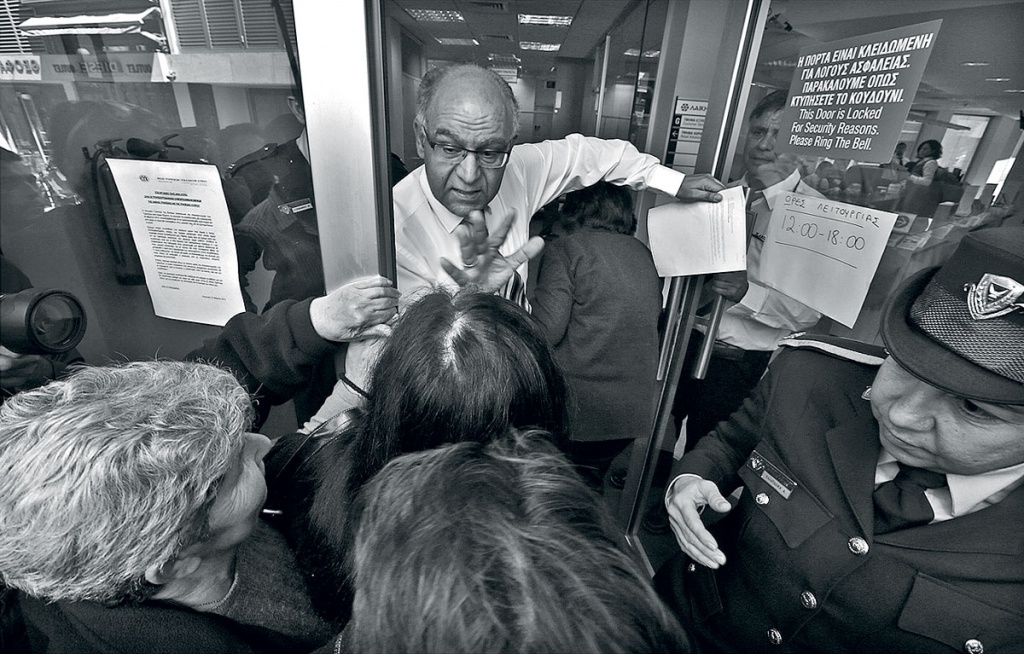
Laiki employee is trying to reassure excited customers on the opening day of banks on March 28
| *A significant reduction in government departments and restructuring Bank of Cyprus (BOC) and Cyprus Popular Bank (Laiki) became a condition for obtaining a loan € 10 billion for 22 years, provided by the European Troika (European Commission, the European Central Bank and the International Monetary Fund). At the same time, Laiki will be completely eliminated, deposits protected by the European insurance system up to € 100 thousand will be transferred to BOC, the remaining depositors will receive their funds as part of the bankruptcy procedure. In general, Laiki clients can lose up to 80 % of their savings. As for BOC, 37.5 % of deposits over € 100 thousand will be appealed to the bank’s shares, 22.5 % will remain frozen as a reserve so that if necessary they can also be converted into shares. The remaining 40 % still remain in the accounts of depositors, but only 10 % of this money can be transferred to the current account. ** Check, along with a credit card, is a nominal means of payment. Almost every Cypriot and every company have a checkbook. |
"Unrest? No, everything is still calm, except for the fact that BOC and Laiki customers begin every day with a trip to an ATM. And sometimes they finish, ”says in an interview with Aida magazine, a Russian language teacher from Nicosia. - People begin to work early. The police, for example, at 6.30 in the morning, cafes, restaurants, many offices with eight. It happens that in the morning there is no money at the ATM yet, but in the evening no longer. So you have to think all the time, how to break out early. ” Aida itself has an account with a stable Jelenic bank, but it can also withdraw only € 300 per day - all Cyprus banks without exception received this order without exception after the end of the forced “holidays”. True, Aida does not go to the ATM every day: “I don’t need cash yet,” she says. But the point is not only this. Unlike BOC and Laiki clients, fearing for their contributions and therefore seeking to quickly withdraw all the money, the clientele of the rest of the banks still feels calmer.
How to spend a salary
Banks in Cyprus opened on March 28 under the supervision of the police, although its intervention was not required. The departments lined up the lines of customers who came to resolve financial issues that have accumulated “holidays” for two weeks: pay bills, deal with debts. The lifting limit of € 300 could only be exceeded in case of traveling abroad: in this case, the operator at the checkout immediately issued € 1000. More, according to new prescriptions, can not be taken out in cash. In Cyprus airports and ports, customs officers were strictly monitored by passengers: on April 1, the police detained three people trying to leave € 200 thousand.
Another headache for Cypriots is the banking checks widespread here **. The beginning of the month is the time of payment of salaries. Traditionally, Cypriots, receiving hourly payment or working in the company for less than three months, receive money not transferred to a bank account, namely a check. However, after the opening, many banks refused to accept checks issued by other credit organizations.
“My girlfriend owns a company that sells office equipment, so she already has these checks for € 20 thousand,” says Aida, “she needs cash before the head cut, but she cannot do anything.”
But even if you work with the same bank as your employer, the amount of the check can only be credited to the account, but the cashing is again according to the general rules-no more than € 300 per day. At the same time, many outlets refuse to accept the cards of two problematic banks, so thousands of Cypriots have been trapped: even it is difficult to spend a salary, not to mention savings.
However, one of the Russian bankers working on the island told The New Times that in early April he calmly paid a Laiki card - a hotel, restaurants, etc. - During the vacation in the Maldives, and the total amount of the account was in the region of € 20 thousand.
Relations for a million
On March 27, on the eve of the opening of banks, the Cyprus Central Bank issued an order to restrict the movement of capital: legal entities can now be freely transferred abroad up to € 25 thousand, for all transfers in excess of this amount it is necessary to submit confirming documents, for example, an agreement with the supplier. But for all transactions exceeding € 200 thousand, now a special permit of the Central Bank is required.
The sources of The New Times in one of the major banks in Nicosia shared the observations of the last days: "€ 300– € 400 thousand. It is not so difficult to translate, but by greater amounts of the Central Bank, it almost always refuses." The same source noted that almost all small and medium -sized customers (up to a million euros) are trying to withdraw money from the country, the larger ones are still waiting, and they do not have so many spaces for maneuver.
The investment banker named Stepan (did not want to name the name) explained The New Times that the main path that investors use to withdraw money is the division of large sums into several small transfers, explanatory documentation is provided for each of them. However, this works when it comes to operating funds of companies, the deposits in this way cannot be crushed.
Maxim Osadchiy, the head of the BKF Bank, told The New Times that you can buy as an alternative, and then sell some real or invented goods: “The restrictions were introduced only to the capital movement, and not on the goods. So no one stops from acquiring, say, an oil tanker, and then sell it abroad, ”the economist explained. In this case, however, again, a special permit for transactions over € 200 thousand will need.
In addition to these methods, the sources of the magazine spoke about offers to redeem the deposits dependent in Cyprus banks at a price of 80 euro centers for € 1 or to transfer deposits from Laiki to any other Cyprus bank for 20 % of the deposit amount. True, which structures made such proposals, sources did not explain.
“Of course, it is necessary to withdraw money in all possible ways not only from Cyprus, but also from Europe,” Stepan is sure. - From the very beginning of the crisis, we were shown that if desired, the authorities could not act according to the law, but by “concepts”. On what basis does the Cyprus Central Bank allow one to transfer large amounts to one, refuses the other? Yes, the prosecutor’s office is crying for these “central banks”! A dangerous precedent of clientelism is created, some kind of bonds of friendship, kinship, and private backstage agreements work. In general, consider that the reputation of Cyprus has already been buried. ”
Victims of propaganda
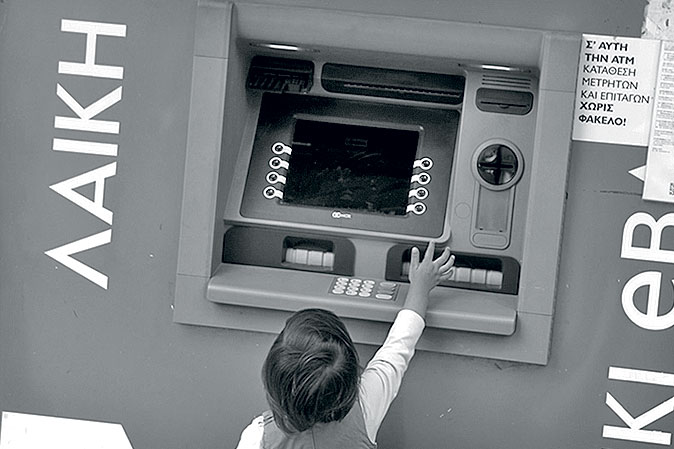 |
| Cyprus ATMs do not give out more than € 300 per day |
Cyprus authorities and journalists accuse suspicious selectivity. So, in the Cyprus press there was a list of 132 owners of accounts who managed to withdraw funds a few days before the meeting of Cyprus President Nicos Anastasiadis with the European Troika on March 15–16, which was the first time to introduce deposits in Cyprus banks (see The New Times No. 10 of March 25, 2013). Among them, the head of Gazprombank Andrei Akimov, who closed the two -million -billion account in Laiki, Donetsk businessman Rinat Akhmetov, who sent € 30 million abroad, as well as companies belonging to relatives of Anastasiadis - they withdrew € 21 million.
However, the Greek television channel MEGA with reference to Reuters assures that during the banking “vacation”, money calmly flowed from Cyprus through the British “daughters” of Greek banks - Bank of Cyprus UK and Popular Bank UK, as well as through the Russian uniastrum bank. However, the interlocutors of the magazine from the financial world unanimously announced the technical impossibility of such operations: the mentioned banks could only dispose of their own liquidity, but not withdraw money from closed Cypriot institutions.
Whether during banking “holidays” there were cases of using insider information and illegal capital movement - a specially appointed commission should figure out this. However, Cyprus seems to have already decided on the main sacrificial ram of the March crisis: the Minister of Finance Mikhalis Sarris became resigned. He, they say, was the first to sign an agreement with the Eurotroshka, which implies the “haircut” of all deposits without exception, he also did not manage to agree with Moscow either on the sale of Laiki, nor on the provision of a new loan, or even about the restructuring of the old. At the same time, few people remember that the disgraced minister asked for a business trip to Moscow: they did not let go.
“Cyprus had to take care of the state of its banks for a long time and a year ago to start the bankruptcy procedure of Laiki,” the Cyprus economist, managing director of the Ledra Capital investment company Antonis Polemithis, explained. But then at the head of the country was the communist Dimitris Christophys, who, according to the economist, wanted to calmly sit until the end of the mandate.
“However, the most important culprit of this mess is certainly the European Union,” said Mr. Polemitis. - First, they offer the “haircut” of capital standing outside of any financial and legal practice. Moreover, due to the problems of two banks, for some reason, depositors of absolutely healthy institutions should have suffered. Then, when this option did not pass, they decide to restructure Laiki and give its bad debts to BOC, which did not go so bad at all. Again, the problems of one bank solve at the expense of another! "
"
It happens that in the morning there is no money at the ATM yet, but in the evening no longer. So you have to think all the time, how to break out early
"
But the most important mistake, according to the economist, is to think that € 10 billion provided by Europe will go exclusively to save Cyprus: “No and no! A huge part of them will go to the salvation of Greece, which means eurozone. ” After all, the difficulties of both problematic Cypriot banks began in Greece: BOC and Laiki. At first they bought up Greek bonds, according to which the EU provided guarantees that not a single EU country could declare a default on these bonds. And then the restructuring of Greek debts was announced, which meant that Cyprus banks would not receive their money back. In addition, both banks had a wide network of branches in Greece, injured due to the general problems of the Greek economy. But for some reason, neither lenders nor investors in Greece were injured, so it turns out that Greek problems are solved at the expense of Cyprus, that is, the problems of the entire eurozone, ”Mr. Polemitis explained not without indignation.
However, according to the interlocutor of The New Times, clouds over Cyprus began to thicken for a long time: “Since the fall of last year, European newspapers and television from the filing of politicians joined the propaganda campaign, the main thesis of which: Russians are only engaged in money laundering, and Cyprus helps them in this. Any Russian is a criminal, every Russian euro in Cyprus has been obtained illegally. For me, a mystery, why neither the Russian nor the Cyprus government, nor the business communities of these countries reacted in time? Russia has passed this crisis. ”
The irritation of the Cyprus economist is understandable and is separated by many of his colleagues and compatriots. But on the other hand, Cyprus, which joined the European Union back in 2004, but not too scrupulously applied European standards for control over capital, should have long been noticed for the irritation of his neighbors on the eurozone of a too swollen offshore bubble.
When the Cypriot authorities can withdraw crisis prohibitions and restrictions in the field of finance, none of the interlocutors of the magazine undertook to name even approximate deadlines. And one local banker completely redirected another address: “Ask this in Brussels.”
Photos: Reuters