
Translated material
Munich, Mezeberg, Merkel
Around Russia
 Munich, Mezeberg, Merkel
April 8, 2013 Arkady Moshes
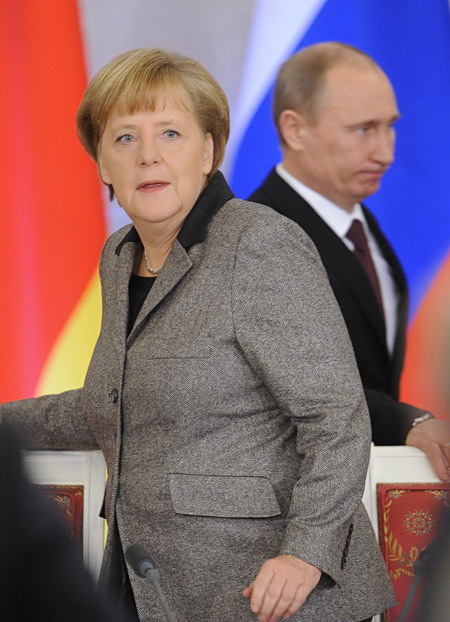
I will not say that in Russian-German relations there was a turning point. So far, this, fortunately, is not so. But the time to explain himself unequivocally - after all that was expressed in Russia addressed to Berlin and personally, Madame Chancellor in the context of the recent Cyprus crisis and after “checking” the Russian departments of two leading German political parties. Therefore, in Hanover Vladimir Putin and Angel Merkel, even if they really wanted to, it would hardly have been able to limit the meeting with the discussion of the tempting prospects of the “special partnership”.
However, there would be no Cyprus and funds, something else would come out. Because the tension hung in the air for a long time. And in this sense, the latest actions of the Russian side are not surprising. Here they simply suddenly realized: “And you, Brut!” But the reasons for the changes in the German position deserve a more detailed consideration. Much was supposed to happen before the attitude to Russia as priority, and not only in the eastern policy of Germany, but also globally, was replaced by its perception as a problem: a source of corruption, which generates a request for various kinds of offshore “laundries”, and even forces working to undermine the business foundations of today's Europe as a whole.
Traditionally, German approaches to modern Russia defined business. In the past ten years, he was actively opposed to the human rights community, which was quite critical of the internal processes that took place in Russia, and warned that the normative gap between Russia and Europe, which became wider, would sooner or later affect bilateral relations. But the real discussion did not work, and the business dominated anyway. In the end, politicians in today's West are inclined to be extremely attentive to people who create jobs and pay taxes. Plus, the business had allies among a bureaucracy related to foreign policy. Someone in this environment considered it right to achieve partnership with Moscow at any cost due to belief or inertia. Someone was moving often among the Western diplomats of the current generation, the desire for a compromise in the name of a compromise, which obscures the interests itself and forces to blame exclusively when the points of contact are not in any way. But one way or another, under one or another ideological or rhetorical cover, the business was above all. And for the sake of business, why not call Russia a “democracy of pure water,” as the then Chancellor Gerhardt Schroeder once did.
It should be noted that public opinion was configured to today's Russia skeptical for quite some time and the former chancellor has not shared assessments. So, for example, according to the annual surveys of the BBC World Service, the Germans consistently perceive the international role of Russia is much worse than on average in the world, and, by the way, along with the French, the most radically among the studied EU members. In a 2012 survey, the ratio of negative and positive assessments was 54 to 18 percent. And immediately after the conflict of Russia with Georgia, the proportion of negative assessments generally grew up to 70, and positive ones fell up to 12 percent. But it is clear that in the domestic political context all this did not play any role, and therefore for the time being and on the foreign policy of Germany was not reflected.
Gradually, however, the skepticism nevertheless seized both the expert community and a significant part of the political class. As the Hannes Adomite, an authoritative German analyst of the older generation, noted in his recent work, worked for many years in the Berlin Foundation of Science and Politics, “the vast majority of German academic specialists in Russia, Moscow correspondents of leading German newspapers and television channels, heads of German political funds working in Russia, the Russian department of foreign policy and those (a little) Members of parliament who have knowledge about Russia and Eastern Europe adhere to a negative view of the direction chosen by the country under Putin. ” If this assessment is correct, then the political effect was inevitable. And the situation with democracy in Russia is not the main thing here. The main thing is that those pragmatic exchanges, “transactions” did not take place, as it is now customary to say, which they hoped for themselves and set up the leadership of the German conductors of the so -called RealPolitik.
It is worth calling only the main milestones on the paths of liberation from illusions passed by Berlin. The first was Putin’s Munich’s speech in February 2007, which was sounded for the Germans as a thunder among a clear sky and showed that for Moscow the question of the construction of a European security system was far from closed, that no advancement to a single space of external security, which the EU and Russia seemed to be agreed in 2003, and in this sense the legacy of the Cold War is far from obsolete. But the Munich shock was overcome quickly enough. Berlin, with a double energy, began to establish a new mutual understanding.
In 2008, Germany played a significant role in the refusal of NATO to provide membership plans in the Alliance of Ukraine and Georgia. In 2009-convinced the Allies of the need to actively participate in the discussion of Russia's proposal regarding the new agreement on European security. A number of high -ranking German military and retired politicians in early 2010 in all seriousness, without realizing the inadequacy of this step, suggested inviting Russia to join NATO.
When it did not work out with NATO, in June 2010, Berlin made a new attempt on the European field itself, having signed the so-called Mezeberg Memorandum with Moscow, in which the creation of a joint committee of Russia-ES on foreign policy and security policy was exchanged for the assistance of Russia in resolving the conflict in Transnistria. Moreover, it is believed that Ms. Merkel did not have a mandate on the issuance of such an advance on behalf of the entire EU, and thus she went to certain political costs in the face of other European capitals. And again it did not work out, because Moscow was also not ready to concessions on Transnistria.
True, it remained, the now notorious “partnership for the sake of modernization of Russia”, the implementation of which was announced to the presidency of Dmitry Medvedev with pomp. On this occasion, we can only say that the pseudo-liberal rhetoric of Medvedev many in Germany for some reason for a long time took for a pure coin. At the end of his presidential term, Berlin even went, as it turned out, to absolutely unjustified and, given all the realities, an inexplicable step, publicly trying to push Medvedev to participate in the presidential election. All the more painful for German diplomacy, reality after September 24, 2011 should have turned out to be curtailed even talking about the restoration of normal personal relations between Vladimir Putin and Angel Merkel who returned to power.
Naturally, business interests have not gone anywhere. But their ideological cover was subjected to significant erosion. The Germans are ready to repeat the classic slogan of the Eastern policy “Changes through Trade” personally uninterested in a particular transaction. It became obvious that commerce and even an increase in contacts between people (not from here, including the cool attitude of Germany to the perspective of a visa-free regime with Russia?) Do not lead to reforms within Russia and do not make it more inclined to cooperation on European and global issues, but can, on the contrary, lead to imports and other “business practitioners” in Russia itself in Russia itself And the whole EU.
It is necessary to take into account the fact that the role of Germany in Europe is changing rapidly today. The economic crisis gave rise to a request for German leadership, both economic and political, that before the crisis, many members of the European Union would consider absolutely unacceptable for themselves, and Germany itself - rather undesirable. The ability of Germany to satisfy this request is completely open, but with regard to policy on the eastern borders of the EU, its role, and previously key, can only intensify. The novelty of the situation is that if earlier Berlin could afford to draw a line that was not necessarily agreed with Brussels and other member countries, then his current mission will most likely require a more complete account of the mood of partners. Not all of which, as you know, have a trouble -free relationship with Russia.
Does all this mean that it is worth preparing for further cooling in Russian-German relations? I still would like to hope not. The Kremlin is probably aware that Germany is still the main lawyer of the Moscow in the EU and in the West as a whole and that without its efforts to “build bridges”, the gap will increase very quickly. However, all this matters only if the corresponding Moscow offices have not yet decided to beat the pots seriously and for a long time and fence away from Europe in everything that does not concern the primitive exchange of Russian raw materials for European industry products. If such a decision has already been made, then spoiling relations with Berlin is of course the fastest and most effective way to the goal.
Photo by ITAR-TASS/ Alexey Druzhinin and Valery Sharifulin
Arkady MoshesAll rights to materials located on the EJ.ru website are protected in accordance with the legislation of the Russian Federation, including copyright and related rights. With any use of the site and satellite projects, hyperlink (Hyperlink) on EJ.ru is required.