
Translated material
Test profession - suffer and endure
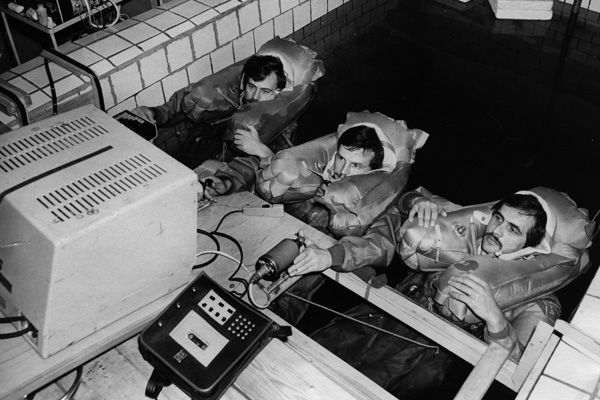 Photo: from the archive of Haidar Hobyeen
The tester is an imperceptible and ungrateful profession, which is not officially considered a profession. However, it is these people who are the first to face many difficulties and dangers of space flights, without even being in space. They are rotated for days on a centrifuge and immersed in water for weeks, imitating weightlessness. They force them to live in the same room for months, follow every step, every sigh and a heart blow - and then forget.
Publicpost spoke with one of these, undoubtedly heroic people, a well-deserved tester of the Institute of Medical and Biological Problems (IMBP) RAS Haider Khobzhino.
- Do the testers are watching the health of the tests constantly? Are you "under the cap" by doctors or only during periods of experiments?
I became a professional tester back in 1978 and I can say that there is no continuous observation. I don’t know what this is connected with, it seems to me that it would be interesting and useful. After all, the testers every now and then work in extreme conditions, the consequences of which, their influence could be monitored. Perhaps the material is too fragmented and it is difficult to collect and interpret it.
Twice a year we went through the commission, trained three times a week, followed health, but rehabilitation was not paid any attention. I don’t know one hundred percent, but I'm afraid that the astronauts have the same problem: I flew away - and that’s all.
- What is the work of a professional tester?
In patience and endurance. But I must say that so far the profession of the tester is not formally considered as a special specialty. We had a group of full -time testers at the institute - I was just working in it, officially listed as a laboratory assistant of the medical control group.
In the best years, there were 15 people in the institute. But then 2-3 experiments per day were often carried out-we were not enough for everything, so some experiments were involved in freelance volunteers-"loners".
Do not believe that we are working here with simple experimental rabbits. The rabbit is a limp creature, it is mechanically put in one or another situation and watch reactions. We must deliberately go to tests, realizing the possible consequences and risks, understanding what they want from us and what is required of us, controlling ourselves and what is happening.
The tester - a person who understands the goals and objectives of the work, has a complete confidence in the researcher who can closely come to the limits of his capabilities, but to evaluate this and stop in time. And to maintain clarity of the mind in order to describe in detail everything that was happening in detail.
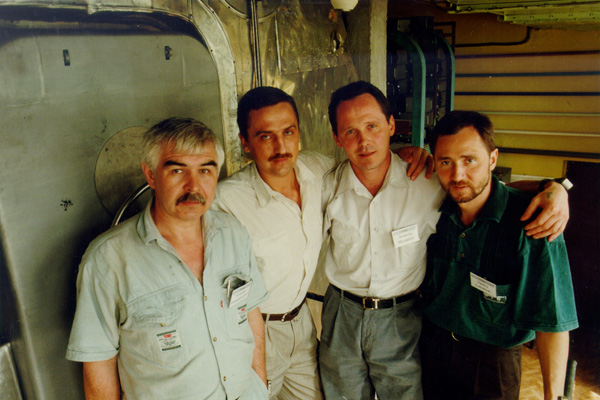
Photo: from the archive of Haidar Hobyeen
- What tests in your practice were the most difficult from a physical or mental point of view?
Complex can be called high -altitude tests in the baroacer with a lack of oxygen. This is a development of an emergency, as in depressurization at high altitude, as when climbing Everest. Only on Everest they rise with a margin of oxygen, but we did not have it.
Hypokinesic trials (mobility restrictions - publicpost) are also complex, modeling being in zero gravity. You just lie, practically without moving, at a negative angle - I spent this way from two weeks to 120 days - although I can’t name these tests exclusively painful. During one of them, by the way, one of my three children was born.
Much more unpleasant for me personally were immersion tests with immersion in the aquatic environment, also imitating life in zero gravity. Such experiments model, including the unusual state of the vestibular apparatus and low motor activity. Only, unlike hypokinesic experiments, you are constantly in the water, from which you are separated by a thin plastic film, and you swim like this - a week, two, and up to 49 days.
In ordinary life, nothing like these experiences happens: orientation is completely lost, you stop feeling support ... It is especially difficult when falling asleep, when it seems that you are falling endlessly or flying in the air. Only the film that you feel on your skin remains. This is a very unpleasant, exhausting test.
The skin cannot breathe through the film, evaporating moisture is immediately condensed - we compared this with a constant stay in the swamp. The sensations arose rather painful: the "frame" of the body relaxes, the rubber begins. People endure these tests especially poorly, although I did not have such unbearable sensations.
All this ends with rotation on the centrifuge - also a tough test. Personally, vestibular experiments are especially difficult for me, I have a poor stability to them, I can’t stand the state of nausea, I just die. But others worked with them: we had a special orbit camera, where they rotated and lived for several days. Of course, at low speeds and without overloads, quite slowly, but the testers constantly vomited, this is very difficult to transfer.
-In comparison with such difficulties, “Mars-500”-an experiment on the 520-baking insulation of the “crew”-looks like a slight walk ...
This is not entirely true ... except from the point of view of physical activity. Do not forget that “Mars-500” for six participants is a year and a half of life, moreover, ascetic life, in very constrained conditions, with constant restriction and self-control. The mental stress is extremely strong.
In ordinary life, we can afford to show emotions, respond to what is happening positively or negatively, in general, to be normal people. In conditions of isolation, it is impossible to act like this, it is necessary to constantly monitor yourself, to be in a more or less neutral state of mind. At the same time, life always brings its irritations, they come from the outside. Someone can get sick, someone broke-everything must be perceived calmly.
For example, I participated in the SFINCSS-99 experiment (imitation of the flight of an international crew at the space station). The insulation lasted nine months, and just at that time in Moscow, those terrible explosions of houses took place (in 1999). And outside our entire “crew” had relatives, everyone was constantly on the platoon, worried about them, for everything that was happening there.
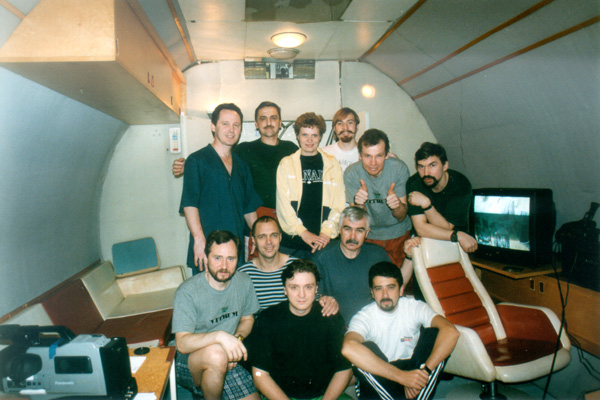
Photo: from the archive of Haidar Hobyeen
- Have real conflicts have happened between the testers, long locked together in a limited space?
It also happened. In our SFINCSS-99 there was a fairly serious conflict with the tester from Canada-the crew was international-which, because of this perch, took the New Year's kiss as sexual harassment. The problem came out quite serious, subsequently she sued a European space agency for a long time, demanding to punish this person and compensate for moral damage ... From some point I ceased to be interested in how this story ended.
In fact, in the usual normal life of conflicts there may be more. But we, if we talk about experiments on prolonged isolation, cannot afford normal emotions. We all keep under tight control, we always try to find compromise decisions.
But it is impossible to damage the psychological danger of life in isolation. It is quite difficult to explain this, you just need to survive, being in such conditions for a long time. You feel like a spring that is constantly twisting, increasing the stress. And you must constantly restrain it, do not let the spring work. This is a condition that is quite unusual for ordinary life, which, of course, can end with breakdowns. Therefore, we learn to sacrifice our interests in some ways for the sake of strangers, for the sake of the common good.
- Probably the same can be said about the work of the tester in general: sacrifice your interests, your health for the sake of the common good?
Of course, although to a certain limit. Often we are treated so that, they say, they paid you money - you must do anything. We had a piecework payment, but they were paid well. After a 120-day experiment, I was restored for a year and did not work, I lived on what they paid. In fact, the tester needs his own personal space, especially in the conditions of that total, comprehensive control, which often has to work in.
Just because of this total, personal space is of particular value. During the isolation, everyone seeks to somehow fragrance, designate their place, their bed, which will be your own, and many are very actively protecting it. This is an ordinary psychological output, and the testers to each other's personal space are very sensitive.
-Now you continue to participate in some tests?
Now I am finishing illustrated instructions for the operation of the medical and technical complex, which conducted the Mars-500 experiments and others. This will be a rather voluminous description, but the work, of course, is quite modest.
As for the IMBP, then, as far as I know, in the past and this year, experiments related to fires in the suburbs that were in 2010 are conducted. They want to find out the influence of dangerous factors - smoke, heat, soot - on different age groups, clarify the maximum permissible concentrations of various substances and so on. Unfortunately, I do not know the details of these experiments.