
Translated material
How are the horrors of the Soviet past become part of the positive image of the USSR?
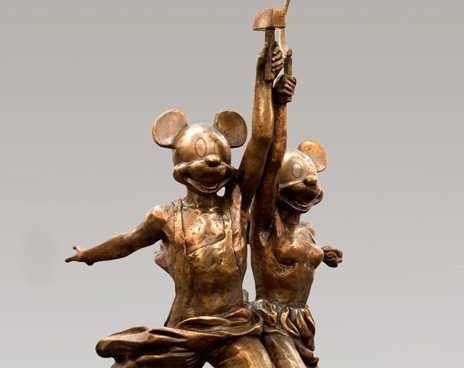
At the international conference of the magazine “New Literary Review” “ XXI Bath Readings ”, dedicated to the unofficial memorization of traumatic experience in Russia, the report “The image of the USSR in a modern popular consciousness” was made by Professor of Columbia University in New York, Doctor of Philology, Linguist Boris Gasparov. Slon publishes a reduced version of this report.
We all well know the official memorialization of traumatic experience, which, undoubtedly, was the collapse of the Soviet Union, and the ideological experiences of people associated with this. Looking at the Internet responses at the imposed ideological articles about Stalinism, you understand that they are even worse than the articles themselves. The essence of the image of the USSR in the mass consciousness is now in its inconsistency.
She, this picture, boils down to the fact that the negative features of the Soviet past are not denied, but reinterpreted and become part of a common positive image. On the one hand, Russia appears a backward, poorly suffering from the arbitrariness of officials, dramatic stories are told about soldiers left by the government and mediocre generals. On the other hand, all this seems to pay off the heroism of these soldiers and military leaders, periodically encountered among mediocre generals. Still, of course, the role of the suffering intelligentsia is great, the image of which, however, is also contradictory. The memory of Sovetsky, by the way, becomes part of the memory of Russia before the revolution.
They tell us about "Russia that we have lost"
They tell us that then people lived better, in general, without explaining the better. There is an image of "Russia that we have lost." I love to listen to the conversations of the elderly about the USSR: about wonderful bread, still about something wonderful. Many publicists use different such images - from heroic to household - to manipulate the consciousness of modern people. The brightest example is Prokhanov, who speaks of the feat of the people as a "Christ victim." Notice, he does not deny repression, but tries to reduce the numbers. “Only 800 thousand executed,” he says. Only 800 thousand, understand? A modest sacrifice for the sake of a great idea.
Now about the issue of religion. It would seem that there is the exact opposite between the Russian state and the atheistic Soviet. The facts of repression cannot be denied. They are not denied, they are admitted, but they say about them with a very interesting turn. I quote Prokhanov (by the way, Zyuganov speaks out in the same spirit): “They say that the Bolsheviks destroyed the church, smashed the church. Yes. But Stalin saved a huge number of churches, forced the workshops to make them. And when the workshops left, the temples remained. ” This means that the closing of the churches and the discovery of workshops in them became such a form of salvation of the Christian tradition, says Prokhanov. “The Russian church on the eve of the revolution was demoralized. Stalin with his policy caused the Orthodox clergy to feat and thereby spiritually revived Orthodoxy, ” - this is what we are told.
The revolution is mentioned less and less, the role of Lenin is marginalized
The legitimation of the Soviet Union as Russia leads to a decrease in the role of the October Revolution. It is less likely to be mentioned, the role of Lenin is marginalized. What are they saying about Gorbachev? They say about Gorbachev that he could not cope with the forces that he called to life, and ruined everything. And having ruined, he was in the role of an exile, who continues to tell his no one who was already needed, which clearly suffered a disaster. It is easy to see a transparent analogy with the image of Kerensky. Gorbachev - Kerensky. The emphasis on his weakness, helplessness, combined with talkativeness and narcissism, is made in order to emphasize: that’s why it was not possible to maintain that moment of aspiration for democracy, which was even after the February revolution, under Kerensky.
Kurginyan, another very skilled manipulator, accuses Gorbachev and the policy of the last years of Soviet power of that they did not give real freedom and democracy. Again we see the image of a mediocre government. The authors that I quote use a different method, but, having analyzed their remarks, it is easy to fold the overall picture. An interesting image is introduced by Dugin: he talks about the anxious mood of Russian society, always waiting for the war.
It’s no longer at Dugin himself, but in the responses to his performance, I read an interesting judgment: “If we count from 1991 today, we find ourselves, as it were, in 1938 in relation to the October Revolution.” What does 1938 mean for this person? Not repression, but this is a psychological feeling of approaching the war to be prepared.
The built system of mythology is very strong
It is by no means should you think that such moves are characteristic only of skilled manipulators such as Kurginyan and Prokhanov. Our modern intelligentsia willingly use them - I see this discourse in the topic that everything has died: education, culture. This can be heard from the lips of people who do not experience positive feelings for the Soviet Union. It turns out that they admit that education and culture were, since there was something to die.
The whole process of building mythological consciousness in Russia illustrates the Eurasian discourse. Its essence is that Russian history consists of consistent segments, between which there are necessarily periods of troubled time and interruption. This idea, developed by Trubetskoy, is alive now. The mythological consciousness that I speak about today poses a problem a little differently: here we see not consistent segments, but, on the contrary, their unification into a certain common background. The vaccinated image of the USSR is perceived through the prism of the background that is created around the February Revolution. You need to understand that this built system of mythology is very strong; She clearly has creative potential.
When a simple-minded reader reads some kind of, for example, a novel about collectivization, he cannot but notice many inconsistencies and facts, let's say, territy. But he cannot but notice a hero who certainly understands all this, but in the end he certainly suffers defeat. And he suffers him precisely because, paying attention to the details, he does not see the overall picture of what is happening. It is also embedded in the current mythology.
If you say about the balance of such rhetoric rhetoric conditionally a liberal sense, then I will answer that this is a special article that also deserves a special study.