
Translated material
"Swamp business": they will be silent
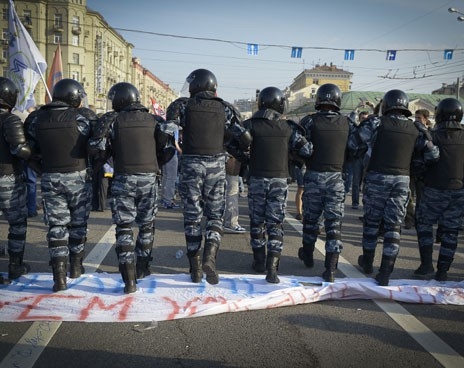

Photo by ITAR-TASS / Anatoly Strunin
- 1 -
On May 6, a rally agreed with the authorities in Moscow against the “third term of Putin” took place in Moscow. Recall that in the presidential election, Vladimir Putin received much less support in Moscow than in other regions. In Moscow, he received 47%. On the eve of the inauguration with the authorities, two mass shares were agreed - on Bolotnaya Square (opponents of Putin) and on Poklonnaya Gora (supporters). The authorities were well prepared for the mass action on Bolotnaya. More than 12 thousand police and military personnel were pulled together, a direct public broadcast and video recording of events on approaches to a large stone bridge were organized. On both sides there was already extensive experience in coordinating such shares. The route of movement from Kaluga Square to Bolotnaya was worked out, there was an agreed plan for the location of police units designed to ensure the safety of participants in the procession. However, the organizing committee did not check the compliance with the plan on the morning of May 6. The location of the cordons was changed. There was difficulty in moving the large masses of people from the Obvodny Canal bridge to the embankment and in the square of Bolotnaya Square. An official investigation on the reasons for such a decision was not carried out. On the line of exit from the Obvodny Canal bridge, riots arose. They did not take the nature of the mass, as evidenced by the report of the deputy chief of the UOOP of the Main Directorate of the Ministry of Internal Affairs of Russia in Moscow Dmitry Deinichenko.
It was not possible to achieve any investigation of the police; Thus, many circumstances of the incident remain unclear. In general, the picture is as follows: having reached the Stone Bridge and seeing a large number of troops and equipment, many participants in the procession began to leave the Obvodny Canal bridge and move to the adjacent embankments. A group of leaders with the participation of Alexei Navalny, Sergei Udaltsov and others made an attempt to sit on asphalt at the exit from the bridge. Some of the participants began to accumulate in the second framework. There was a section of dense contact between participants and the police. An attempt was made to break through the first line of cordon. If it ended successfully, the participants in the procession would expand the corridor of the entrance to the square of Bolotnaya Square. Another result, taking into account the number of military and technology, cannot be imagined. There were two foci of active actions: an attempt to break through the cordon in the area of the second framework and the power actions against the attempt to expand the “sedentary action” on the bridge. As a result, more than 650 people were detained.
- 2 -
Neither a sedentary action on the bridge, nor an attempt to break through the framework in the direction of the square carried any threat of mass riots. The Moscow police were well prepared to prevent a possible change in the route of the columns on the Bolshaya Stone Bridge and in the direction of the Alexander Garden.
On the eve of the action, the possibility of "Maidan" was publicly discussed, i.e. Organizations of the "unlimited protest." The prospects of such a "Maidan" in Bolotnaya Square not only ordinary participants, but also most opposition leaders evaluated extremely low. It is possible to deploy an opposition camp in the city center only with a conflict of federal and city authorities (as it was in Kyiv or Cairo). With the support of the city authorities, the tent camp is impossible. The decision to sit on the bridge was spontaneous. This is a traditional form of temporary protest action, widely used by civil activists around the world. The purpose of such a campaign is a winning photo and video material on the power actions of the police against protesters.
According to Deanichenko’s report, three tents were delivered to the bridge. No other organizational and technical actions indicating the preparation of riots were found during the action. There were no signs of preparation of any assault groups, attempts to be praised into the area of clashes of fire, bottles, reinforcement, stones, incendiary mixtures. In a spontaneously arising collision, the participants used pieces of asphalt, the battles and helmets lost by police, and the gearboxes.
The reason for the strict preventive actions of the police was an erroneous assessment of the situation based on the expectation of the Maidan. Apparently, the leadership of the Moscow police feared that if it misses the columns to the embankment and to the square of the Swamp Square, it could not quickly eliminate attempts to deploy a tent camp (“Maidan”) in this space. Thus, both sides were disoriented: the police held the line of fences, creating a panic, and the leaders of the columns, seeing this, decided not to go to the Kapkan of Bolotnaya Square and sat on the bridge.
- 3 -
Now we are waiting for a frankly staged and monstrous court in violation of the rule of law in the “case of May 6”. Although the mass riots did not take place on May 6, the task of the investigation is to incriminate a large -scale conspiracy on the preparation of riots. Thus, the investigation is not interested in what exactly and how it happened in Bolotnaya Square. The process will be built as the “On Preparation” case.
The testimony of Luzyanin, Lebedev, who went to the agreement with the investigation, as well as the first testimony of Razvozhaev, will be used to show large -scale preparation for riots. 3 thousand dollars of Razvozhaev will turn into 3 million dollars from Lebedev. Three tents at Mityushkina will turn into tens or hundreds of prepared tents. On those seized from Volgograd and Nizhny Novgorod left -wing computers, recommendations will be found for the preparation of Molotov cocktails. Although the summer camps of Ponomarev’s activists were later on May 6, they will be sewn to the case of “preparing mass riots”.
As Alexander Podrabinek and Oleg Kashin correctly write, it is impossible to establish where there are real technical measures of the left in preparation for the “Great October Socialist Revolution”, and where the actions of FSB officers implemented in this environment. The process focuses around the “left front” and other left -wing informal organizations close to it. Initially detained in the “May 6 case”, who spent almost a year in jail, although they have nothing to do with the “preparation of mass riots”, nevertheless will be convicted. On April 22, a group of human rights activists will publish their report-investigation. But its materials will be ignored by the authorities.
Police on the Obvodny Canal, of course, could indicate that there were neither riots nor preparation for them. The clashes were spontaneous. And the sanctions on the participants should have been imposed immediately and administratively.
- 4 -
But they will be silent. Perhaps the worst thing in this story. Yes, one of them was given apartments in exchange for eternal silence. Others will be silent because they sincerely believe: “enemies of the state” should be punished without fair investigation and court. Still others will be silent simply because “such a system” and “a whip of butt will not beg”. The horror is that, unlike the 18-year-old anarchists who threw pieces of asphalt into the police, these people are mature men with a legal education. They are designed to maintain the basis of law in Russia - the independence of the investigation, the proportionality of the crime and punishment. Perhaps most of them just reconciled with the atmosphere: “You die today, and I am tomorrow” (Shalamov)? We are waiting for the most shameful political process for the entire post-Soviet 20th anniversary.
In its constructiveness, it really clearly resembles the processes of the 30s. Their main idea is to turn a personal position into a collective conspiracy. And thereby destroy any possibility of a personal position.
Not only those police officers who stood in the first lines of cordon, but also judges of the highest courts, senior employees of the presidential administration, the leaders of parliamentary factions, our influential representatives of the business community, are silently at this. All these people silently agree with the degeneration of law and state. This silence is very ringing. Hugging silence. But he bursts around the whole world. And it buzzes throughout our long -suffering Russian history - both in the past and in the future.