
Translated material
Canteen wines, table books
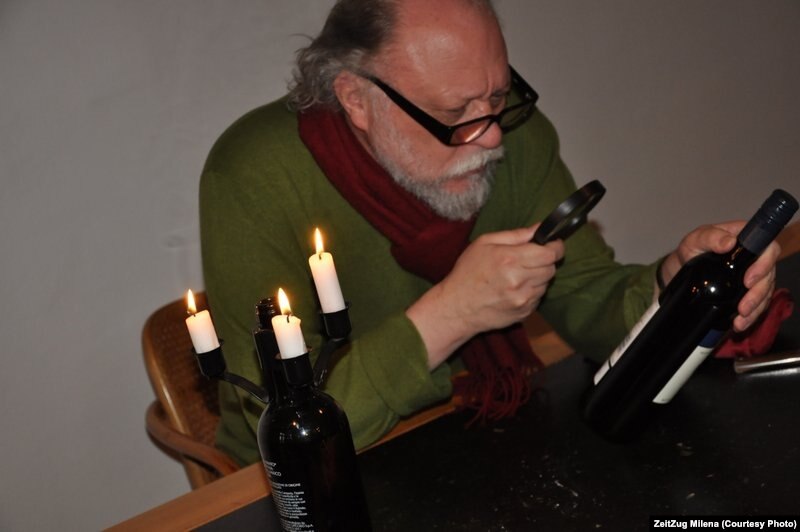
Feel free to take out a flask when sitting on the sidelines
On my desktop they are nearby: a bottle of wine, a glass and several books. Among the books are two especially beloved ones, both in English: the “philosophy of wine” by the Hungarian philosopher Bela Hamvash and “I drink, therefore, I exist” the English philosopher Roger Skruton.
I’ll start with the book “Crazy”, written in the Hungarian village on the shore of Lake Balaton in the summer of 1945 during a short respite between the war and the communist dictatorship. Its author is a philosopher and essayist Bela Hamvash. Before the war and during the war, he wrote and published several essays and books in which he mourned the loss of humanity by humanity of the Golden Age. He himself was indeed a "unhealthy" man. Born in a German family, grew up by the Hungarian patriot, and at the same time was a cosmopolitan, albeit unusual, so to speak, cosmopolitan in historical time and space: he felt his own in ancient civilizations. He was also a polyglot with roll to dead languages. In 1948, from the ranks of the Hungarian philosophers, he was excluded by the chief ideologist of the party Dry Lukak, who publicly condemned Hamvash for surreal sympathies in painting. Since then - before the death in 1968 - Khamvash worked as a gardener, after the storekeeper and wrote to the table. His "philosophy of wine" saw the light in his homeland in 1989, and translated into English in 2003. Now, excerpts from this book can be read in Russian, but I love my old English edition. On it I will quote Hamvash.
"The drinking of wine has its own rules: it should drink at any time, anywhere, and under any circumstances. This is a serious pastime for serious people and serious peoples." True, the author is immediately stipulated: the "circumstances" should also be taken seriously, especially to the time and time of the day. He classifies wine as follows: "idle", "flirty", "talkative", "tragic". According to the philosopher, you need to be a soulless person to drink "dramatic" wine on family holidays. Drinking "sensual" wine at a banquet. Still, as the philosopher teaches, only ignorants and rabbits set the table with a non -stable tablecloth. ("Maybe they have a tablecloth, but there is definitely no heart"). But what about the "tablecloth", except for the bottle? At least nuts, almonds, because the oily flavor "reveals" the soul of wine. Well, in late autumn - baked chestnuts, and to them will certainly young wine and bouquet of chrysanthemums. Let me remind the reader: the first post -war summer is in the yard, so goodies are in time and affected.

Drinking Bela Hamvash also classifies. He believes that those who know the price of poetry, music and painting get along better with wine. It is such people who perfectly understand that love and wine are appropriate at any time, anywhere and under any circumstances. By details scattered in the book, one can judge how the philosopher once lived or would like to live. (In the last military winter, his house with all the utensils, a library and manuscripts destroyed a bomb.) Firstly, a person who respects wine should have at least twenty glasses and glasses: for talking with friends , one, for a home music concert , others, for playing cards - third, and for different card games - different. The winning strategy for Hamvash is simple: never hide what you are doing. In the summer, drink in the garden, in the shade of trees or on the porch. In the heat, find a cool place or cellar. Be careless. Do not get into a corner. Feel free to take out a flask when sitting on the sidelines of the road. In winter, drink by the stove, in the kitchen, in the snow, in the beer or at the desktop. Yes, at least in the bedroom, when you are alone, or in bed, or in the bathroom ...
In the "Philosophy of the Wine" Bela Hamvash calls a good dozen of his favorite Hungarian wines: dining rooms and loafers. Honestly, for a long time with distrust - a reasonable distrust - I treated Hungarian wines. But in recent years, Hungarian winemakers have made a breakthrough. Now I can even say that I have a favorite wine that is made from the Caburne of Caburne in the southern region of Villan, so revered by Hamvash. The farm that produces it is called Jackfall - named after the village. At least the bottle indicates this, German, name. Winemakers can be understood: in Venger, the name of the village is not easy to master - Kisjakabfalva.
I already wrote about my other desktop wine book in my blog on the Radio Liberty website. This is an exciting philosophical treatise of the Englishman Roger Skruton "I drink, therefore, exist." The main idea of the philosopher: wine is civilization, and therefore it should not be considered that winemaking goes into the depths of history in the same way as civilization. Moreover, civilized countries differ from non -cylidized in that in the first, unlike the latter, they value and drink wine. The wine reminds the soul of her carnal origin, and the flesh is about its spiritual sense. In the book of Skruton, in addition to two sections, there is an application: "What to drink with." This is a joke of the English philosopher: such recommendations are usually given in traditional books about wine and gastronomy. For example, reading the German Martin Heidegger, a tireless researcher of the “Nothing” category, the author recommends that an empty glass to the lips. Bele Hamvash in the Appendix, Scruton devotes a whole chapter. Skruton recalls how he drank a barrel of cartoon in Budapest with the courtyards there, for whom Khamvash was a hero. But most of all, Skruton liked the fatal Cabernet Fran from the Sexard area. Writing a bottle of Sexard, he sadly thought that, as it turned out, he was not the first philosopher to write a book about the philosophy of wine.