
Translated material
And now about Russian "strategists"
Around Russia
 And now about Russian "strategists"
April 15, 2013 Lilia Shevtsova
Once such a thing went and the “hedgehog” began a discussion about the foreign politician E, I cannot overcome the temptation to participate again ...
If we are talking about American "strategists" who want to conduct their affairs with the Kremlin without annoying the Kremlin, then everything is clear with them. Georgy Satarov and Dmitry Weisburd closed the topic. I have nothing to add. In addition to one: attempts by American "strategists" to convince Russia to "act in such a way as to promote the interests of America", they will not cause support from either the Kremlin or the Russian opposition. They will only add persuasiveness to the Kremlin’s attempts to search for “foreign agents”. So we have an obvious example of a policy that is doomed to failure in advance (not the first!). I join in the laudatory Blacks of Georgy Alexandrovich addressed to Thomas Graham . I believe that Tom really deserves gratitude for formulating the concept of American “strategists” against Russia, thereby explained to us the reasons for its inevitable failure. That's how the law of "unintentional consequences" works!
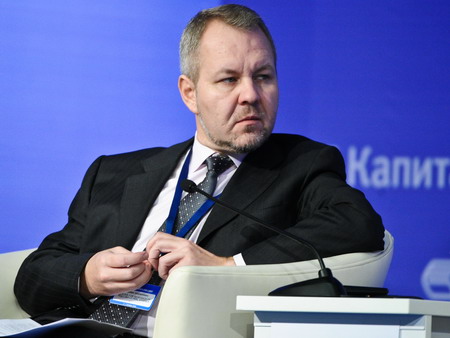
And now let's move on to a more interesting topic - to the problem of Russian "strategists". I mean those who analyze foreign policy and conceptualize it, but from the point of view of the interests of the authorities, not society. I just got an article by Vladislav Inozemtsev (in the photo below) in The Moscow Times (Vladislav Inozemtsev. More Respect for Russia Would Go a Long Way, The Moscow Times, March 29, 2013). I will say right away: I think Vladislav Leonidovich is one of the brightest analysts who works in the genre inaccessible to many is trying to design and create concepts. Therefore, everything that he writes is interesting. This time, Vladislav Leonidovich decided to advise Obama what to do in relation to Russia.
In 2009, we - Lev Gudkov, Igor Klyamkin, Georgy Satarov and Lilia Shevtsova - turned to Obama through the Washington Post newspaper. We tried to convince the American administration (here are naive!) Do not forget about values in its relations with the Putin Kremlin and not to legitim the Russian authorities. Inozemtsev today turns to Washington with the opposite call - to abandon the value approach and not annoy the Kremlin. I don’t know what prompted him to take this role, but he reflected what the Russian expert community, which is engaged in foreign policy (with rare exceptions), expects from America and the West. In short, the Inozemtsev acted as a horn of Russian "strategists." That is why his thoughts deserve attention.
Here, according to the analyst, the United States must do in order to resume the dialogue with Moscow: to offer Russia economic dividends “in exchange for political concessions”; do not “emphasize civil rights and other painful issues” in relations with Moscow; Instead of talking about values to involve Russia in the construction of a “new world order” and “global management”; Search for "new areas of cooperation" with Moscow, in particular in the Pacific Ocean region. Finally, the United States and Russia can create its own alliance-"Organization of the North Pacific Treaty."
It seems that Vladislav Leonidovich composed his theses, sitting next to Graham. Despite the difference in privileges, they both look for the same thing: how to ensure a deal between Washington and Moscow and avoid hints of irritating factors such as civil rights.
It is not clear how foreigners believe that America will suddenly begin with Putin Russia to create a new “world order”. After all, we are talking about two states that build themselves on various principles. Moreover, the power of one state looks at another as its global enemy! And how to force them to coordinate the principles if they are on different principles?
Well, let's say that Washington has time for the Potemkin villages. Why not? After all, Obama found time to “reboot” in the style of “let's pretend”. In this case, let's ask the question: what influence the mentioned proposals will have on the development of Russia - will they facilitate our transformation or strengthen autocracy? Whose interests will the new “world order” work and the alleged concessions of Washington to Moscow - the corruption elite or society?
It is not clear how the expansion of cooperation between Russia and America in the Far East will help Russia get out of stagnation. American investments? But in order for them to come, new rules of the game are needed, and not the expansion of the territorial application of the same game. And how the Russian alliance with America will act - I leave to discuss those who have developed imagination.
If domestic “strategists” believe that the proposed dialogue between Russia with America (and the West as a whole), cleared of annoying values, will facilitate the prosperity of Russia, then why did this not happen? After all, so far both America and the rest of the West pursued this particular policy!
Do our "strategists" do not understand that they offer foreign policy supports for decaying Russian authorities. In a situation where its internal supports begin to stagger, foreign policy turns into an important means of reproduction of the regime. The Kremlin’s cooperation with America and the West and in the creation of the new system of “world management”, and in games in the Pacific region, and in other exercises - a good reason to divert attention from internal problems and the factor of international legitimation of the authorities.
However, our “strategists understand everything perfectly. Inozemtsev himself scattered doubts regarding the goal of his recommendations. The main problem for the West is not the power of Russia, but “its instability,” he says. Russia, in his opinion, is like the USSR in 1988. Therefore, the West should help ensure stability in Russia. But since we are talking about the West dialogue with the authorities, then this refers to stability in a cream, i.e. Self -preservation of the Russian autocracy. In a word, our "strategists" do not hide that they are guardians.
Although for the purity of discussion, we must offer Vladislav Leonidovich and other “strategists” to dispel our suspicions. Suddenly they know how to use the usual dialogue between Russia with the West to release society and for all good for society! In this case, I will immediately remove all my criticisms.
In order to dispel doubts, I propose a “hedgehog” to turn to our foreign policy experts with a request to speak out on one issue: to what extent the foreign policy recipes that they offer the West (expanding trade with Russia, increasing investment, negotiations on nuclear security, energy cooperation, expanding cultural and other exchanges), and those proposals that they make the Kremlin (turning towards Asia, cooperation in the Arctic And the Pacific region, etc.), can facilitate the transformation of Russia? And how exactly can they facilitate her?
If experts answer us, we will discuss their answers. If they refuse to answer, this will also be an answer. So?