
Translated material
On political prisoners and "solidarity"
In the opposition
 On political prisoners and "solidarity"
April 15, 2013 Elena Sannikova
Searches, interrogations, arrests, absurd political processes ... All this has already become the usual background of our everyday life.
Another person in the “swamp business” was arrested. In one city, politically motivated searches from civilian activists were held - four at once in one eagle. The weeks have not passed - and now searches in Volgograd, in Astrakhan ... The extension of the arrests under investigation is undergoing a continuous series.
Where in these conditions to find the forces to our not yet strong civil society to somehow resist this avalanche of political repression? How to gain a will to solid in the defending of human rights and freedoms, without which it is simply not to overcome this impudent capture of the country with tentacles of repressive mechanisms worked out during the time of Soviet totalitarianism?
On April 6, a wave of shares in defense of political prisoners passed through the country. People went to the squares of cities with portraits of prisoners on May 6. Skeptical voices also sounded relatively smallness of protesters: no more than two or three dozen people in cities, no more than two thousand-in the Novopushkinsky square in Moscow.
But in the times of public apathy, when a sense of hopelessness, meaninglessness of any action, at such times and one person with a poster in defense of political prisoners, are already mastering - already joy - already joy.
According to the Central Internal Affairs Directorate, in the rally in defense of political prisoners on April 6, 600 people participated in Moscow. Perhaps so much remained at the end of the action, which lasted three hours, and on a rather cold day. Photos indicate that people were a total of 3-4 times more. This, of course, is not dozens and not hundreds of thousands, but the fact that there is an initiative to protect political prisoners, that people understand the acuteness and bitterness of problems and go to the square, in itself is valuable. It is worth recalling that before the start of the public rise in last winter, rallies in defense of political prisoners gathered no more than 300 people. Awakening, despite the strengthening of repressions, goes, and you can not let this light be faded away. A large number of flags that reminded the gamut of the colors last year’s crowded rallies on Sakharov Bolotnaya and Avenue, enthusiastically. When people of different, sometimes even hostile political beliefs are united, when something supporting, simple and deeply human is higher than party narrowness and isolation, helps people see each other-it still helps to warm the climate in society. When relatives of prisoners approach the microphone and read their very good, thoughtful letters from prison, demonstrating not despair and hopelessness at all - it pleases. At the rally they sang bard songs, recited poems, the performance of theater.doc was shown with a bright satire on political trials. It was time even for the lines from Hamlet, read by actor Alexander Filippenko. Probably, this is how it is necessary to support people who are where the overwhelming atmosphere of fear, longing and hopelessness reigns. We are not able to free them today, but we are able to create the tone of support that will help them maintain health and vigor in captivity. And therefore, targeted assistance is so important, it is important to write letters to them, to support their relatives. At the rally on April 6, people inscribed postcards to prisoners with good wishes, collected money to help political prisoners (only the Union of Solidarity with the political prisoner raised about 65 thousand rubles at the rally). There would be more such shares!
However, in order to really stop the roll of political repressions in the country in order to achieve the liberation of prisoners, and the country to turn to healing, a much more effective and active solidarity of people is necessary.
We, in fact, have a movement with such a name - "solidarity." For this, it was created to unite everyone, to rally. But I would very much like to understand why it does not come out of this and a small part of the desired, expected.
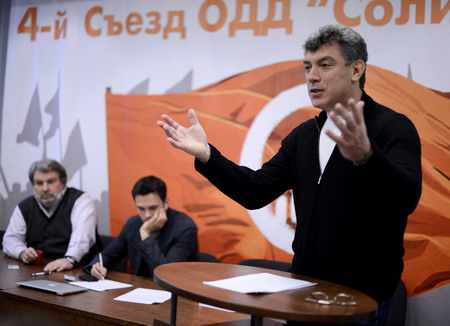
The day after the rally in the Novopushkinsky square in Moscow, the 4th Congress of Solidarity was held. The media did not really tell anything about him, except for some far-fetched sensation about the exit from the movement of Harry Kasparov, coupled with his decision about the new emigration (in reality, Kasparov simply did not re-elect into the new political resolution). About more serious events at this congress - the adoption of software documents on the tasks of "solidarity", the protection of political prisoners and educational activities - the press was silent.
A week earlier, a collection of Moscow “Solidarity” was held, where delegates were elected for this congress. I attended it and heard the remarks of those who were attracted to me that were very understandable to me, which were not acquired in motion, which were not justified hopes for an analogy with the Polish “solidarity”.
However, I came to this meeting literally from the train, having returned from the city, where there are many educational institutions, many scientists, artists and poets - but where there is no civic activity of the intelligentsia, and therefore corruption and the arbitrariness of security forces flourish impudently and impunity. When you fully realize the degree of public apathy in the Russian province, not for long and faith in the possibility of good changes to lose. And therefore, it was simply gratifying for me that a large number of people, including young people who believe in their strength and ready to work a lot and disinterestedly for the healing of the country and society, were simply gratifying.
At the meeting, Tom did not do without friction - but will it do without it where more than three seekers of Pravda gather? Not without demonstrative statements about the exit from the movement - with reproaches, as if fair. But reports on real affairs were also sounded.
Konstanty Yanskauskas, who conducted the meeting, was elected a deputy of the municipal assembly and has been doing real work in his district for a year. Alexei Gusev, also a municipal deputy, collects signatures for direct elections of district leaders. The work is painstaking, everyday.
Many shares of the White Ribbon and the events in defense of the political prisoners were initiated by activists of "solidarity". The movement is alive, despite the difference in opinions, to the split, to what it weakened and lost in something after the formation of the Parnas RPR.
But as in Poland, in any case, it does not work.
Why? Maybe people are not the same? No, people are very good. Selfless, thoughtful, ready to sacrifice themselves for the sake of others, in my opinion, a lot. Maybe the fact is that we do not, relatively speaking, Lech Valens - a qualified worker, familiar to physical work, harmoniously developed both physically, intellectually, and morally, who would be able to unite and inspire people of different layers of society for the sake of the general thing that is understandable to everyone?
Those events at the dawn of the Polish "solidarity", which inspires the impulse of which is so memorable to my generation, grew out of the trade union movement, from workers of strikes. And where are the free trade unions we have? And how many "solidarity" pays attention to the support of working movements, the problems of ordinary workers?
The Polish "solidarity" was supported by the church. The priests, who sided with the protesters, knew how to inspire people with the spirit of genuine Christian love. Open -air worships in shipyards with the participation of hundreds of thousands of strikers inspired protest, united people with a sense of understanding and fraternity, tempered the forces of the soul in the confrontation of evil.
In our country, the church is sick, split by a rotten episcopate, planted at the time of state atheism, is eaten by the charm of civil and public inaction in the name of falsely understood spirituality. The intelligentsia in relation to the church is also split: some see in it hostile power, placing an equal sign between the unworthy representatives of the Moscow Patriarchate and the Church as such, while others who came to churchly through moral search, do not advertise it, not believing in the success of the direct gospel sermon in our society. This site is filled as a result of the atrocities of ignorant, aggressive false church activists, which generates another misunderstanding, another split in our already broken society.
The meeting of the Moscow “solidarity” has a lot about the reluctance of ordinary members of the movement to have leaders over themselves, about the desirability of the horizontal construction of the movement. One girl even announced her withdrawal from “solidarity” due to the rejection of the VIP zone at rallies and the inaccessibility of leaders for communication and joint solving certain problems.
Is a social movement without leaders possible? I would like to recall historical examples. There were leaders in the Polish “solidarity”, but there was no impassable barrier between them and the protesting masses, they did not look at people over their heads. I don’t know if the founders of our “solidarity” will be able to ever become truly recognized leaders, but it is obvious that they are not such now.
The informal leader of the human rights movement during the years of Soviet stagnation was Academician Sakharov. He did not feel like a leader and never thought of being, he was not called a leader and was not elected to this role, but he was a leader, and not because of the title of academician. But his exceptional personal qualities are high intelligence, education, the ability to fully realize their talents, firmness and courage in combination with softness and kindness, sensitivity to people, a sense of deep responsibility, both for their actions and for what is happening in the country, openness, attentiveness, thoughtfulness, sincerity, will to active and thoughtful action - all this was done by Andrei Dmitrievich The focus of attraction, some source of light and warmth, which seemed to warm others, inspired people to develop vital principles and methods of movement. In the conditions of Soviet ideological totalitarianism, it was impossible to win the movement of human rights, but the moral victory unconditionally prevailed over the inexorably inert, anti -human system.
We were encouraged by events in Poland in the early 1980s. But later I had to hear from the leaders of the Polish “solidarity” that they were inspired by an example of Moscow human rights activists and academician Sakharov.
Maybe you still need to start with yourself? From issues of moral self -improvement?
However, where to start and what to do is questions for an inexhaustible discussion.
And there are things obvious and indisputable.
The first thing Andrei Dmitrievich Sakharov began to talk about when he was called the head of the superpower in the Gorky link is about the problem of political prisoners, about the need for their immediate liberation.
Even if we have the idea of political prisoners, helping them and the struggle for their liberation will be in the first place.