
Translated material
Venezuela: six -year -old riot
Throughout the post -General Venezuela, Cacerola (Poster) is heard. More than 10 million people go to the balconies of their houses and knock on empty pots, pans and hasterings, protesting against the fact that their voices were stolen. The decision of the National Electoral Council (NIS) on the recount of the election of "rebels" did not reassure
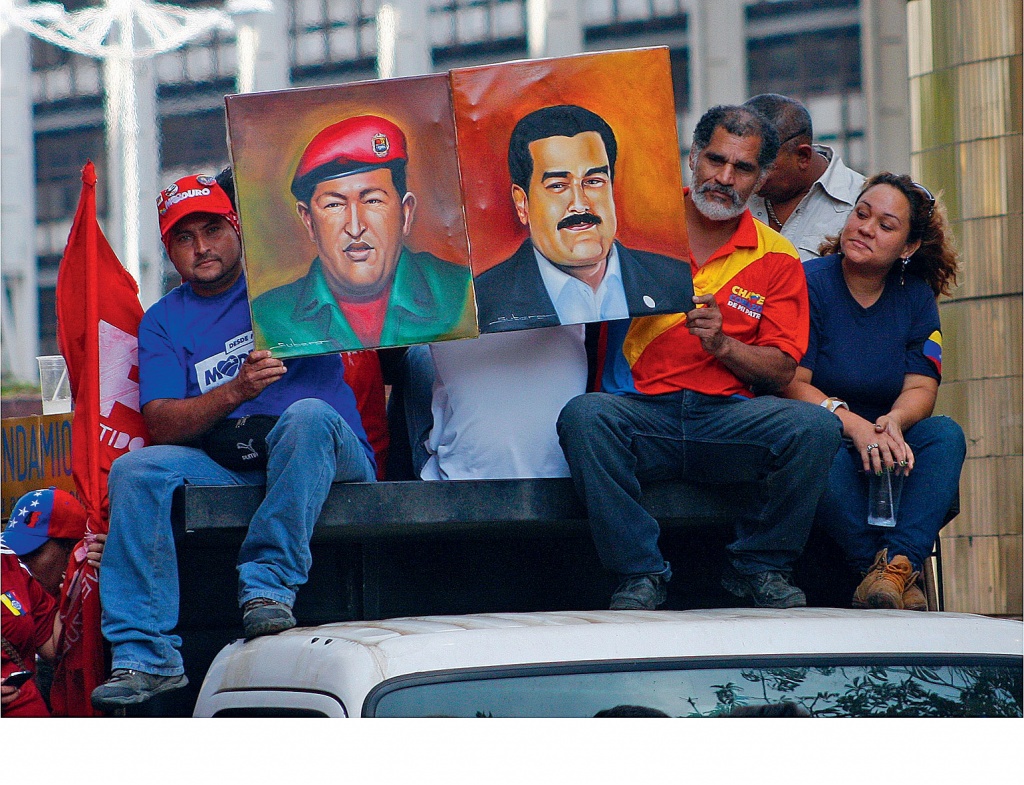
Karakas after the election. Supporters of Nicholas Maduro today put him on a par with Chavez
| *50.7 % versus 49.1 % of Enrique Capriles. |
Supporters of the successor of Chavez - Nicholas Maduro, who won the elections on April 14 with an advantage of less than 2% of the vote* in response launches rockets painted in the colors of the national flag, but their fireworks are not so audible. The leader of the opposition Enrique Kapriles called his supporters not to go out into the streets in order to avoid new victims in clashes with government forces - in the first days after the elections, seven people died and 61 were injured. But Cacerola ("Poster Riot") will last an arbitrarily long time.
The untimely departure of the leader, who alone made all decisions, leads to the rapid degradation of the political machine he created and the sliding of the oil country to the fact that the Spanish newspaper El Pais called "economic and political insanity." That is why the Venezuelan experience is not interesting to anyone as for Russia.
"In fact, he lost"
Nicholas Maduro is a swearing with a monstrously weak mandate. The gap between him and his opponent Caprilem amounted to only 235 thousand votes, and this is in 29 million Venezuela. Immediately after the plots closed, the opposition accused the authorities of sub -selection of elections. Capriles counted about 300 thousand various violations on them.
Maduro first agreed to count the voices, but then he abandoned his word and was hastily brought to power. And thereby confirmed the opinion of his people about him: Chavez’s protege is a useless leader who does not hold a word and is not able to lead the country. “Maduro, in fact, lost the elections,” Time magazine writes in this regard.
You will not envy its position. Throughout the election campaign, a party colleague criticized him for inept style, for ineffective propaganda, for the mistakes that he made daily. What is worth only the story that during the church mass a bird flew around, in which he recognized the spirit of the deceased Chavez - he thus blessed the successor to win. The whole country laughed at this “recognition” for several days in a row.
According to the very informed Spanish-language newspaper, the US El Nuevo Held, at the election stage, every four of the five chavists, as the supporters of the former leader are called here, opposed Maduro, but it was too late to change him to someone else.
And after he defeated such a dubious result, another prominent politician of Venezuela and his direct competitor, the chairman of the National Assembly Diosdado Cable expressed extreme irritation of how the victory was achieved. In the first tweet on personal Twitter after the announcement of the results, he wrote that the Chavists "should be deeply self -critical discussing everything that happened."
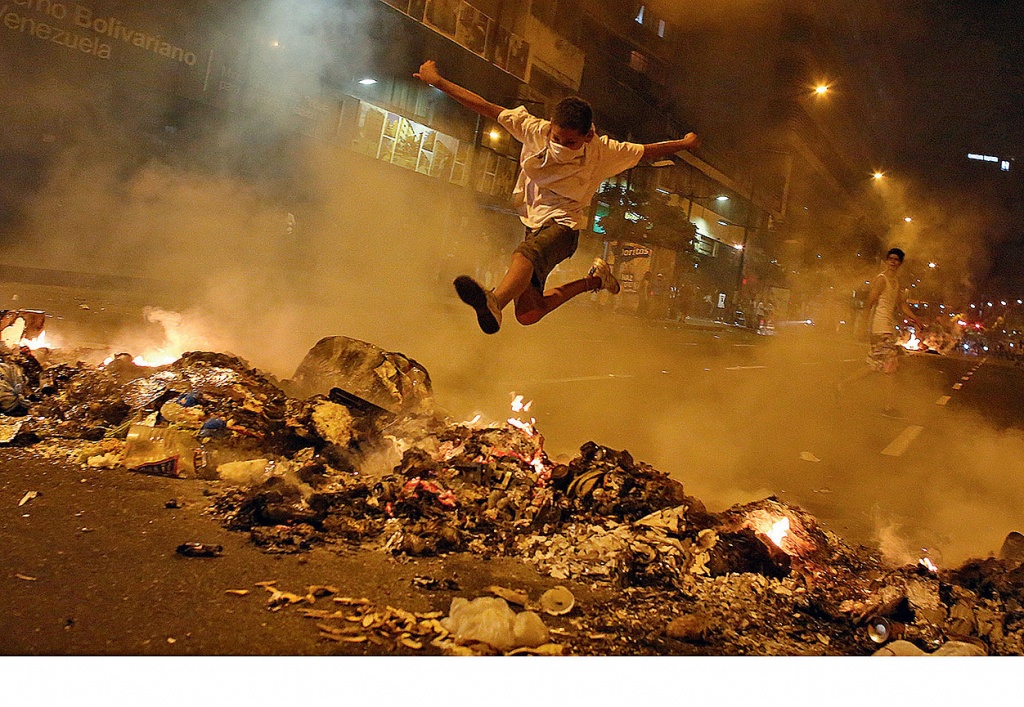
“The political positions of Maduro are extremely weak,” says The New Times Diego Moya-Okampos, an analyst with the consulting company HIS Global Insight. - His leadership is questioned within the ruling party and the armed forces. The most important thing is that in Venezuela after the death of Chavez there is a change in the dynamics of the political game and the reorganization of power occurs. If earlier all decisions were made exclusively by Hugo Chalsh, now the responsibility applies to many members of the office, but they either do not want or are not able to accept it because of the lack of the habit of leading. ”
Venezuelan political strategist Orlando Vierce Blanco agrees with this conclusion. “We are present with a very interesting phenomenon,” he told The New Times. - For the first time in the last 15 years, the “internal migration” of votes has been taking place. Elections show that the personality of Maduro does not fit into the structures of the Chavists and does not enjoy authority even among the ardent adherents of Chavez. Moreover, one of the supporters of the current government clearly preferred to vote for Capriles. ”
One way or another, Nicholas Maduro announced the upcoming reorganization of his office. At the same time, he hastened to notify the supporters in the party that the vice president would remain Jorge Arreas, the son-in-law of Chavez. But Arreas himself, also on Twitter, who, even under Chavez, became a very popular method of communications in Venezuela, complained that "the results of the elections could be the best."
The unstable position of Maduro after the elections, meanwhile, is connected not only with its low IQ, the lack of charisma and elementary oratory skills. The Unified Socialist Party ruling in Venezuela is a symbiosis of various political forces - from the leftists who are holy believing in the ideas of the “socialism of the Bolivarian sense”, to the pragmatists of the military - they always laughed at the fables that were fed by the late leader. They were all connected only by the approximation to power and the arising possibility of open enrichment.
Oil no longer helps
The institutional crisis, which is experiencing after the death of Chavez Venezuela, is growing in parallel with the deterioration of the country's economic situation. Bolivar’s devaluation, twice in recent years, was unable to stabilize the local cash unit. The parallel dollar exchange rate not only did not disappear - it has grown dramatically: officially $ 1 costs 6 bolivars, but on the street any shopkeeper, having cash, will give 20 bolivars for it. Capital runs from Venezuela, the country's foreign exchange reserves are melting before our eyes. In mid -April, they amounted to $ 25.995 billion, and this is only half of the foreign exchange reserves, which, for example, have by no means rich in oil.
After the election, it was reported that the state oil company Petroleos de Venezuela (PDVSA) will continue large -scale financing of social programs. In the past, it was the basis on which the socio-economic program of Chavez held. Last year alone, PDVSA spent $ 44 billion on housing construction programs, road laying and medical care of the population. However, her income falls from year to year, despite the preserved high oil prices: only in 2012 the fall amounted to 6.1 %, or $ 4.2 billion.
There are several reasons for this. Chavez with the hand of a generous sower, as if leaving the picture of Van Gogh, distributed oil to everyone who could. Only Cuba was supplied daily up to 100 thousand barrels of oil, the cost of which was paid by Cuban doctors working in Venezuela. Oil was received by the friendly left regimes of Nicaragua, Bolivia, Ecuador, half a hundred small Caribbean islands, as well as ... the poor in the United States, which Chavez annually gave fuel oil for heating dwellings as part of a program operating since 2006.
Venezuelan oil workers also fall due to the lack of investments in the industry, as a result of which oil production since 1999, when Chavez has come to power, has fallen from 3 million barrels per day to 2.4 million. Finally, the drop in oil industry revenues has been associated with the practice of generous subsidizing gas prices in the country. In Venezuela, the price of one gallon of gasoline (3.7 liters) is $ 0.06, and, for example, to fill the SUV tank requires only $ 2 - less than the Bigmak costs. (See also “On the other side of Chavez” - The New Times No. 9 dated 03/18/2013)
The neglecting policy of Chavez led to a shortage of essential items on store shelves - and this is in a country that greatly depends on food imports - to a fan shutdown of electricity in various areas. It was felt even during the election campaign. Maduro, of course, accused Venezuela’s enemies of this - American imperialists and an internal opposition, whose leaders he did not stop calling the “fascists” throughout the elections.
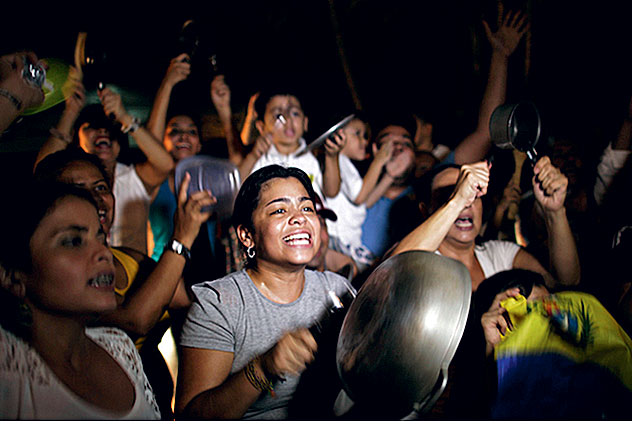
"Kastryudny riot" near the Venezuela embassy in Panama
Castro brothers are still happy
"Poster Riot" is a phenomenon not rare for Latin America. The most impressive "marches of empty pots" took place in Chile during Salvador Allende. Soviet propaganda assured that the “desperate” Chilean housewives were bribed by the CIA to dump the power of the working people.
A military coup in Chile was branded all progressive humanity. However, few knew that in Chile in the early 70s of the last century there were about 30 thousand Cuban militants, military and special services agents. They were the main support of Allende, whose government consisted of various leftist and centrist groups, which could hardly have a common language.
In Venezuela, from 30 to 40 thousand Cuban doctors are now working, most of whom are informants of special services, as well as, according to El Nuevo Held, 60–70 thousand civilian and military advisers. They keep Venezuela, party and state apparatus, armed forces under the control of the special services. They are in charge of the central electoral council. Cubans would never have allowed the loss of Nicholas Maduro - the former bus driver would be swore in any situation of votes. Cuba could not allow the loss of free oil from Venezuela, which Enrique Capriles would blocked her in case of her victory. And it is no accident that the first to congratulate Nicholas Maduro on the “historical victory” was the Cuban leader Raul Castro.
Incredibly, but the fact: a small poor country with a paralyzed economy turns the fate of millions of citizens of a much richer state. For Fidel Castro itself, this, by the way, is not only a vital necessity, but also a kind of historical revenge. In the early 60s, he personally went to the then President of Venezuela Romulus Betankur to ask him for oil. Betankur did not even accept him and ordered him to be sent to hell. Fidel did not forgive insults and a few years later he ordered the landing in Venezuela of the Cuban landing, which was instructed to overthrow the country's government and capture its oil crafts. But that expedition broke - just at that time, the failure of the Che Guevara in Bolivia, and the expeditionary corps, which was about to swim to the Venezuelan coast, was released.
How long is the Cubans to use Venezuelan gifts now? The “indestructible friendship” of the two countries, between which two years ago, negotiations were underway on the creation of a single state, relied exclusively on the personal relations of Chavez and Fidel. Will the successor of the deceased Venezuelan leader want to feed the Cubans if his own people are not norment? Will the opposition of this large -scale embezzlement of resources by pragmatists in the Venezuelan army begin? And finally, will the power of the Chavistov be held in the country divided evenly in half? It is possible that the “socialism of the 21st century” in Venezuela and in Cuba will degrade at the same time, and his life life is measured by selective cycles - 5 years in Cuba and 6 years in Venezuela.
Photos: Reuters