
Translated material
How to equip a prison
Members of the Council for Human Rights under the President are preparing for the head of state new proposals for the reform of the modern Gulag. How they want to change the life of the prisoners - the New Times found out
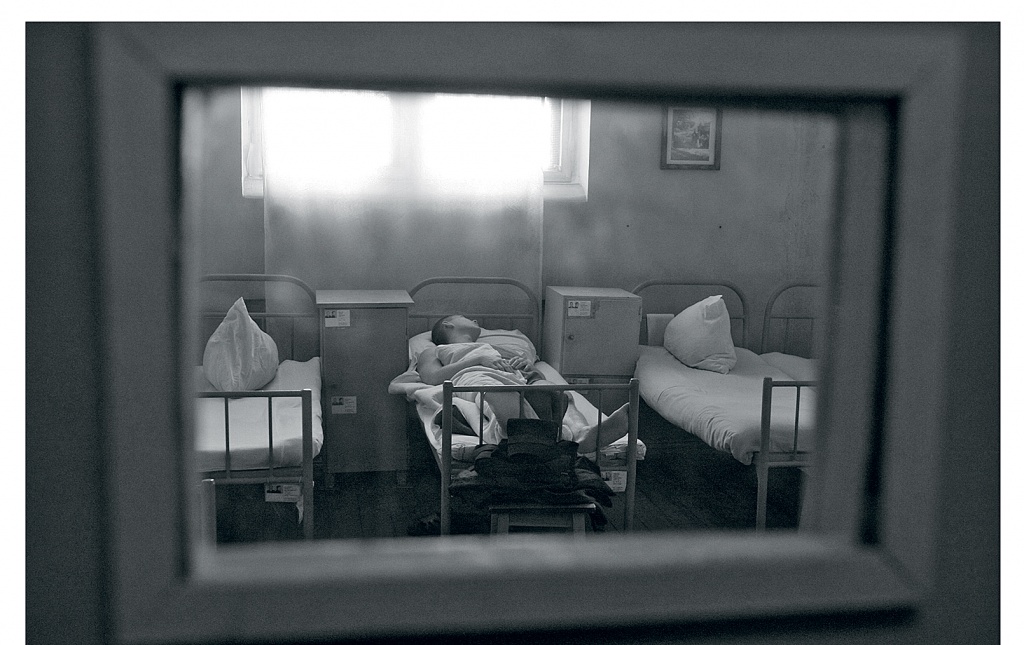
Investigative insulator (pre -trial detention center) No. 4 of the Federal Penitentiary Service in Moscow
| *See The NEW Times “Correction of Colonies” No. 46-47 dated December 21, 2009 |
The widely advertised reform of the Federal Penitentiary Service (FSIN), which began in 2009*, failed - this is the opinion of experts. You need to start all over again. All mistakes and financial abuses will probably be written off to the former head of the Federal Penitentiary Service Alexander Reimer, sent by President Putin to resign in June last year. The new leadership of the prison department requests another fabulous amounts for the construction of new prisons from the state, and human rights activists offer the President assistance in adjusting the failed reform.
"
*And then suddenly I read that our bracelets cost 120 thousand rubles. And when there was an experiment, the bracelets cost a thousand dollars, that is 30 thousand. Why are our bracelets four times more expensive than imported?*
"
Embezzlement or violations?
Seven months were required for the new head of the FSIN - the native of the special services Gennady Kornienko to identify large -scale financial violations in the activities of his predecessor. At the February College of the FSIN, he said that the prison budget over the past year did not read more than 10.1 billion rubles. For comparison: damage from thefts in the Ministry of Defense, about which all the media thundered for several months, was evaluated by the military prosecutor’s office and the Ministry of Internal Affairs only at 5 billion.
In response to The New Times, to confirm the multibillion-dollar amount of the stolen funds, the FSIN press service said that, they say, the overwhelming part of these 10 billion is not at all “theft”, but financial violations. For example, “discrepancy between reporting data from analytical and synthetic accounting; discrepancy between accounting registers and primary documents; application of incorrect accounting records; Reflection of various types of property and obligations to accounts not provided for these purposes, etc. ”
The New Times from the Accounts Chamber was more specific: it turned out that only when concluding contracts for the supply of electronic bracelets and the provision of construction services were 3 billion 691.7 million rubles were stolen - the amount quite comparable in scope with the detected theft in the Ministry of Defense. However, no indicative arrests have been noticed in the FSIN.
According to reports in the press, the ex-head of the Reimer department and his ex-deputy Nikolai Krivolapov may become the defendants in criminal cases. In any case, one of the most important cases investigated by the Investigative Committee concerns just the purchase of electronic bracelets for prisoners - it was the Reimer and Krivolapov that affirmed their prices. True, according to some reports, both have already left the limits of the country and are unlikely to appear before the court.
The head of the public observation commission for the places of compulsory maintenance (PMC) of Moscow Valery Borschev told The New Times that he had known about overstated prices for bracelets for a long time, because he himself was one of the main initiators of their implementation: “In 2002, we were in England along with the head of the legal department of the Federal Penitentiary Service Oleg Filimonov, they saw these bracelets and thought: as they thought: as it was: as it was: as they thought: how It's great if it would be so in Russia. We began to break through the adoption of bracelets - Filimonov in the FSIN on two lines, and I knocked out a grant in the European Commission to an experiment that was successful. And then suddenly I read that our bracelets cost 120 thousand rubles. And when there was an experiment, bracelets cost a thousand dollars, that is 30 thousand. Why are our bracelets four times more expensive than imported? "
Appetites above the budget
Despite the disappeared billions, the new leadership of the prison department is still eager to continue the reform. One bad thing: no money.
In the Ministry of Finance, to the question of The New Times on the problems of financing the FSIN, they preferred to answer the official dialect: they say that the allocation of funds is carried out "in full accordance with the laws on the federal budget for the corresponding year and other regulatory legal acts of the Russian Federation, as well as in accordance with the decisions adopted by the President and the Government." Judging by the figures, the amounts that the government allocates in the budget for the prison department are growing from year to year: in 2011-150 billion rubles, in 2012-already 177 billion, and in the next three years the amount of expenses will vary around the figure of 180 billion. Another thing is that the requests of the Federal Penitentiary Service are also growing.
In the media in the media, a memo prepared for Gennady Kornienko in the media by his deputies Anatoly Rudim, Vladislav Tsaturov and Alexander Sapozhnikov, it is said that 1.8 trillion rubles are needed to continue the reform. The answer from the press service of the Federal Penitentiary Service to the question of The New Times, what these gigantic amounts will go to, it looks like this: “Within the framework of the reform, 754 correctional institutions of a new type will be created” (see certificate No. 1).
Wooden prisons
| | | --- | | What prisons does the FSIN build? In total, it is planned to build 754 institutions of the following types indicating the cost of one new institution: * a general regime prison for 1000 seats - 3.0 billion rubles; A prison of a special regime for 400 seats - 1.8 billion rubles; A prison of a reinforced regime for 500 seats - 2.2 billion rubles; colony-settlement with conventional observation of 700 seats-2.0 billion rubles; a colony-settlement with increased observation of 500 seats-1.9 billion rubles; * Educational center for 200 seats - 0.96 billion rubles.
|
The FSIN response explains in detail why the construction of prisons costs such money: “Most correctional institutions are buildings built before the revolution or in the 30-50s of the last century. Their designs are mainly wooden and have significant wear (over 61%), therefore, reconstruction are subject to reconstruction, or they must be built again. At the same time, many buildings were adapted and built in an economic way (it is not clear what the press service means here-The NEW Times) using the existing building materials that do not meet modern requirements. These buildings in their architectural and technical characteristics do not comply with design standards. ”
Nevertheless, the prices that bring to the FSIN are surprising. For example, the cost of a colony-settlement for 700 people is estimated at 2 billion rubles. It turns out almost 3 million rubles per person-for that kind of money, each convict can buy a good one-room apartment in the suburbs, and if somewhere in Chelyabinsk, then a three-room room. Is the same story not repeated in construction as with “precious” bracelets?
Similar fears are shared in the Presidential Council for Human Rights. “We hope that the FSIN will abandon his project to build prisons, they are now half empty,” explains the member of the council, human rights activist Andrei Babushkin. And he adds: “When they (in the Federal Penitentiary Service) are talking about“ wooden buildings ”-this is clearly not about Russia, there are no wooden prisons in our country. And in general, there are a hundred ways to much more effectively use the FSIN tools, from the creation of a powerful psychological service and ending with the creation of jobs. The most insane thing that can be done is to spend money on strengthening isolation. ”
To cancel the program for the construction of new prisons is not the only proposal of human rights activists to correct reform. No less important they consider the rejection of the "sink content" of prisoners. “Initially, it was implied that prisoners from camp huts must be transferred into separate cameras to increase the level of comfort and reduce the level of violence,” says Valery Borschev, The New Times. “The concept suggested that the cameras would be a place to sleep, and in the afternoon prisoners would be able to communicate freely and move around the territory, but in reality they began to simply be planted around the cameras, in fact worsening, and not improving the conditions of their detention.”
The third proposal of human rights activists - the reform should lead to the creation of the so -called promotion service: this was also stated in 2009, when the reform was just beginning. But the probation service was never created. Meanwhile, we are talking about a structure that helps socialize to people who have recently left prison. In many countries, this service has been working for a long time and efficiently, its employees also observe former prisoners, those who are conventionally or left for free to leave the departure. “We proposed to create this service on the basis of the penitentiary inspection, but the Federal Penitentiary Service wants to preserve the inspection and create a probation service from scratch,” says Andrey Babushkin. “This is an expensive undertaking - the amount of 50 billion rubles was called - but due to it, relapse will be reduced so much that it will more than pay for costs.”
"
*The cost of a colony-settlement for 700 people is estimated at 2 billion rubles. It turns out almost 3 million rubles per person-for that kind of money, each convict can buy a good one-room apartment in the suburbs, and if somewhere in Chelyabinsk, then a three-room*
Cosmetic repair
While smart heads in Moscow decide how to properly carry out reform, neither human rights activists nor the FSIN employees themselves see special changes. The Deputy Chairman of the PMC for Tatarstan, Vladimir Rubashny, who himself worked in the FSIN for many years, told The New Times: “Somewhere, maybe cosmetic repairs were carried out, but for all the stated goals-changing the prison regime and medicine, improving the quality of personnel-nothing changes at the level of territorial bodies. Continuous good intentions. " And here, according to Rubshny, it is not only a matter of money - a matter of people who work in the system: “How do we get into the FSIN? In childhood, someone else dreamed of becoming Uncle Stepa, but certainly no one wanted to become a warden. So people come random. ” But the selection in the FSIN, the interlocutor of The NEW Times is sure, should be tougher than in the Ministry of Internal Affairs: "The system is closed, the powers are almost not limited." FSIN employees do not want to talk openly, but on the terms of anonymity they admit - with the beginning of the reform, the amounts of requisitions that colony employees demand from the convicts increased. They explain this “cuisine” in the same way as their high -ranking bosses explain the stopping of the reform - insufficient financing.
“The reform was said, but additional money was not allocated for it. We, on Earth, change nothing. The territorial Federal Penitentiary Service is lowered by the order - let's reformat the detachments into indoor premises, ”says one of the jailers working in the regional Federal Penitentiary Service. - This is a complete absurdity. Well, in the end, what they do: take one zone, make a demonstration with rooms there. And they show everyone. It is clear to professionals what kind of money is made by such a “European -European Republic”.
| ** SM The NEW Times " Dust Reason " No. 40 dated 03.12.2012 |
The fact that the employees force prisoners, sometimes under torture, to ask relatives for building materials and money is now not only for their personal needs, but also for repairs, referring to the requirements of a higher authorities - human rights activists have been talking for a long time. And the general public learned about this after a rebellion in a Kopeysk colony in November 2012 **. And on December 4, in Chelyabinsk, at a meeting of the Working Group of the Council for Human Rights under the President, where events in Kopeisk were discussed, the first deputy chief of the FSIN Eduard Petrukhin first announced the failure of prison reform. For which, however, he almost paid his position - his statement of the higher authorities considered his overly emotional.
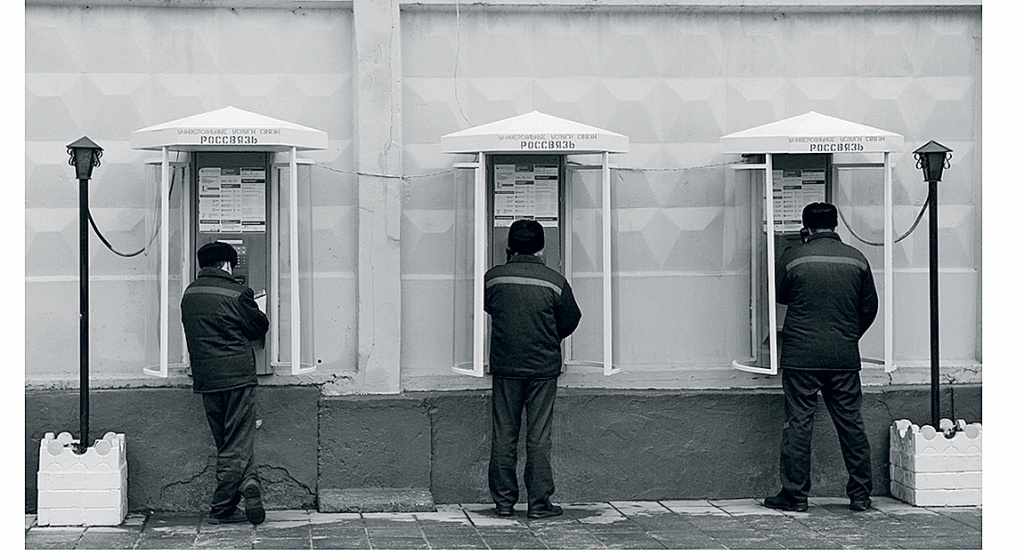
Prisoners are talking on the phone on the territory of a correctional colony of maximum security No. 7, "Yablonevka"
Free reform
The former convicted person has the physicist Valentin Danilov, who had served 11 years in the “spy case” and went out of parole, his idea of how to “equip the prison”: “I believe that the FSIN reform should mainly be aimed at maintaining the health of prisoners. And such a reform will not cost anything for the budget. If there are no money to provide prisoners with clothes and shoes for the season, then you need to allow them to wear their own warm clothes. It is necessary to improve food, and again, if there is no funds in the budget, to allow the convicts to pay an additional fee for food, for an expanded menu with vitamins. It is necessary to ensure the conditions for the employment of the prisoners - hundreds of thousands of healthy men are unisigned, they would love to work for a moderate salary. ”
The main thing, Danilov believes, to observe the legislation and send prisoners from the convoy colony in the colony in time: “Let them work there and feed at the expense of their work, as provided for by law. After all, now we have a standard in the colonies - two square meters per person in a sleeping room stuffed with a bit, can you imagine what air is there in the morning? ”
The jailers and prisoners have different ideas about how to reform a modern gulag. The guards are unlikely to listen to the convicts. Another question: will human rights activists will hear the Kornienko in the department, or after a couple of years they will again tell us about the failure of the reform and about the billions of rubles that have lost somewhere?
Photo: Yuri Martyanov/Kommersant