
Translated material
Russian paths and freedom of choice
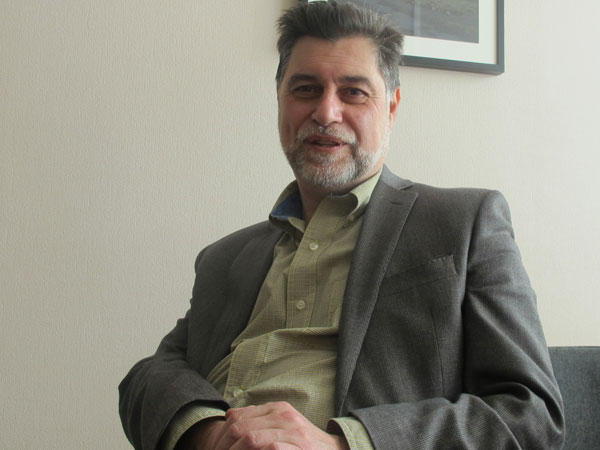
What rector of the Moscow Higher School of Social and Economic Sciences (Shaninki) and the dean of the faculty of public administration of the RANEPA sees the future of the symposium of the “Way of Russia”, which recently celebrated its 20th anniversary, and the future of Shanka itself? About this in an interview with Natalia Demina with Sergey Zuev .
What in your opinion, as a rector, is the importance of the “Routo of Russia”?
Any event that has a 20-year history in the post-Soviet period has, apparently, internal and often not even understandable meaning. If this tradition has developed, it means that someone needs it. It is clear that the question of the "paths of Russia" has some kind of internal energy that makes people gather. Everyone in different ways. Actually, the variety of sections that take place for two days, just shows that everyone is different.
Another thing is that I, as a rector, are interested, first of all, from the point of view of the content of education. The relationship of education and culture as some established tradition, system of norms, images, values is always floating. In traditional and stable situations, in traditional contexts, culture is the subject of broadcast. Education is an institution that broadcasts some basic, cultural values, knowledge, skills, etc..
But in a situation of uncertainty and some transformational shakes, this ratio changes and the formation is no longer inside the culture as a mechanism of reproduction. Education begins to exist quite autonomously, trying to become a bridgehead for generating a new content, interpretation of history, prevailing traditions, and so on.
Therefore, the conference “Where is Russia going?”, Which was called “Where Russia has come?” A few years ago, and now passes under the name “Rossi of Russia”, there is the idea of the direction of some movement. For me, this topic is important in terms of the basic question, what is the content of education? And how can it be conveyed? Is there a ready-made content or does it require any completion and interpretation?
In addition, it is clear that in an administrative way, such a forum in an administrative way, when up to 300-500 people gather on one site, this event is important for the school. This means that the school has a certain question that is not purely internal, but represents significance for a large number of people.
You would not want to change this question now, call the conference not the “path of Russia”, but somehow differently? Do you think that, maybe, to radically change the concept?
We say so, as if the university should have only one conference. Yes, from my point of view, there are a number of other issues that have at least proportionate potential and energy. Yes, of course, the fate of humanitarian knowledge in the modern world and in particular in certain political national cultures, political systems, economic ways, etc., in particular, actually excite me. What is humanitarian knowledge? Why is it? Why does it exist for several millennia, despite the seeming impracticality? If there were no some inner meaning of existence and movement, then, probably, it would have long disappeared. But this I would say an academic question. It is also appropriate for a university with a humanitarian orientation.
There are questions and more relevant from a political or economic point of view. For example, what is a modern crisis, why is it needed. And this is not in the sense of a natural disaster, which falls on everyone, but as on the exchange ... How can the fall of securities be used to build business processes? How can crises in the political and economic system be used as such a driver for structural restructuring? This is a very important question now for Russia.
There are a number of other questions, of course. But this does not mean that this question needs to be removed, but to put something else in its place.
That is, it seems to you that this issue is not outdated, and that it is worth holding the 21st, 22nd conferences of the “Way of Russia”?
I would say the following. If there is a certain tradition, then it should be treated very carefully. For me there is some inhibition or slowdown in terms of discussing this issue in all options for two decades. Obviously, there will be some variations, even if interesting, but in general, any conference, any scientific reflection is some reflection of what really occurs outside the window. But since tradition should be treated carefully, let it be.
How do you yourself see the paths of Russia? Judging by the plenary meeting, experts see the country's future in a negative manner, and how do you evaluate this future as an expert, as a scientist, as a rector?
No, I do not think that they evaluate negatively. How can Zorin's report can be considered as a negative assessment? He tries to understand on the basis of historical reflection how they thought about the path throughout a sufficiently long historical period.
In this sense, the question is why history is needed ... or some other components of such a general collective statement ... You understand what kind of thing ... I think that a lot depends on the integrity of the world system in the next 30-40 years. What is the global world order now? Not only Russia, but also all national and not only national entities, are now looking for their new identity in this spontaneously or artificially emerging world order. Everyone answers this question: China, India, Russia, Bangladesh, Switzerland and other countries.
Another thing is that, regardless of the basic process of searching for this identity, there are some political ambitions, realities, contentment or dissatisfaction with the current government. These are two different layers.
And what is Russia on the map of the world in 2040 - this is actually the answer to the question, but what is the place of China or the USA ... These are interconnected questions. Therefore, the matter is not only in the paths of Russia. At the same time, I am not a supporter of the concept of a special path, whether it be American Exceptionalism or a Russian special way, I do not consider these value concepts to be productive. Each country subject, the collective subject, the people, the ethnic group, etc., has the right to choose and open opportunities in the previous story. Actually, a story is needed in order to understand the inconsistency or the possibility of this zone of the scenario of the previous course of events in the previous course. A person remains a man when he has the freedom of choice, and not when he has everything painted up to the cemetery.
That is, it seems to you that now there is freedom of choice in Russia?
Freedom of choice always remains. Actually, this is the foundation of human intelligence. Or such things as cognition and so on, if we speak academically. If this freedom of choice was not, then what distinguishes us from wildlife?
You have recently become a rector, as you see Shaninka’s paths in the next five years? What is Shaninka in 5 years? Do you have such a view of the future?
I spent a year and a half in this chair, this is a relatively short time, I believe that the most important thing in all discussions of education, programs, etc. is the concentration of new persons, new and old ones at the school. This is some place through which interesting or close in spirit flow, undisputed people. This is probably the most important thing.
What can this be provided? Is it in the form of new research projects, some clubs that are attached to the frame of Shanka, right? This is another question, this is the choice of specific ways. But in general, modern educational university, modern educational sites, their rating in the broad sense, and not in a narrow, formal, is determined by the presence, on the one hand, people gathering at one point, and on the other, the possibility of the evolution of these human groups. Their gradual change, rotation, the appearance of new ones. I would say so.
Of course, with all the uncertainty of the answer to the question of what modern or future higher education is, in any way, it is a club of people with its special atmosphere, it is a club of people who answer strange, sometimes excessive questions, in relation to the pragmatics of sociality. This is a club of people with whom it is interesting, whom I want to talk with, who I want to learn from. The creation of this club is a strategy of such a small educational institution that is Shaninka.
Do you think about creating your own PhD program?
Certainly. We had such an experience in creating PhD. For various reasons, including financial, it has stopped at one time, but yes, of course, one of the conditions for creating a club that I spoke about is the internationalization of education, free access to various human, information educational resources. And PhD is one of the important channels of reproduction of both its own professorship, on the one hand, and the establishment of constantly changing and current contacts. This must be done, this is one of our strategic priorities.
Speaking about the club, do you mean a formal organization, association, society?
Clubs are very different. I used this word as a metaphor. This is a meeting place of interesting people, in the interests of which there is something in common and whose something unites. But the club, unlike production social machines, is not an obligation, not selling your time for a certain amount of banknotes, but a place where you want to come, although there may be certain obligations, but this is a different layer.
Club space is on the one hand, it seems to be excessive. What are they doing there? They sit, read, talk and drink coffee among themselves, but, in fact, this is such an important thing in history, at least European culture.
Good luck to you!