
Translated material
Alexey Kiselev received a political fiction in Spain
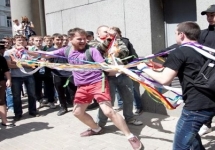
Activist of the Russian LGBT movement Alexei Kiselev received political asylum in Spain, according to the Gayrussia website. In July last year, he left for Barcelona, fearing the arrest in the "swamp business".
The Spanish authorities gave Kiselev a five -year residence permit in the country, as well as a document confirming his status of a political refugee. The case was considered by the Spanish authorities unprecedentedly quickly. The decision, which became known only now, was made in early January. Kiselev passed only one interview in Barcelona, although usually applicants for refugee status are called for a second interview in Madrid. The appeal to the judicial authorities was not needed.
"The European community in the person of Spain has proved that it considers last year's events in Bolotnaya Square as a purely political business aimed at suppressing protest sentiments in Russia," Kiselev said. "The Spanish authorities came to the conclusion that clashes on Bolotnaya Square were provoked by the police and were an attempt to put pressure on civilian activists."
“None of the detainees and detained in the“ swamp business ”will not be justified,” Kiselev is sure. In his opinion, the defendants will become more. Kiselev said that he would return to his homeland "only after the change of power in Russia, recognition of the regime of President Putin to dictatorial and the liberation of all political prisoners."
The departure of Kiselev became known on July 31. In an interview with the “Independent Newspaper”, Kiselev then said that he managed to leave Russia at the last moment before arrest. “I literally escaped from the paws of these investigators or eshnikov (EC employees“ E ”to combat extremism. - Ed.)“ I don’t know who they were there. They were on duty at my house for a week, ”he said.“ Would they be on duty near my entrance if I only interested them as a witness? ” Kiselev emphasized that he was only convinced of the correctness of his actions after the arrest of the lawyer of the Committee for Civil Rights of Nikolai Caucasian.
“I think they are now gaining at random, just to gain the required number of victims to the altar of Putin's stability. They need to intimidate activists of all political and civilian strata. Therefore, they needed some LGBT activist. The first, apparently, I stood on the list because it would be easiest to sew the case on me. But they could now attack other activists, and even even Those who were not detained at all on May 6, ”Kiselev sums up.
In March, Ukraine officially refused Russian political emigrants Alexei Devyatkin and Jenny Kurpen in refugee status. They waited for the response of the Ukrainian authorities for nine months. Emigrants themselves called the refusal unreasonable and politically motivated. Domososs Devyatkin and civil activist Kurpen, his wife, emigrated to Ukraine in the summer of 2012, hiding from persecution in the "swamp business".
In connection with the "swamp business" Russia was left by the activists of the "solidarity" Anastasia Rybachenko and Mikhail Maglov, the left activist Philip Galtsov (Dolbunov) and others. Alexander Dolmatov, who left for the Netherlands, committed suicide in a deportation prison. Estonia granted a refuge for Karelian human rights activist Maxim Efimov, against whom a criminal case was opened for an anti -lrical article. In the case of an attack on the Khimki administration, the anti -fascists Denis Solopov and Pyotr Silaev received refuge in Europe.