Translated material
"Island of Mercy" - help homeless animals
In an interview with the greenhouse of social technologies, the president of the Island of Mercy charity fund Tatyana Nikitina talked about why public organizations are interested in the Online environment, and which barriers have to be overcome in daily work.
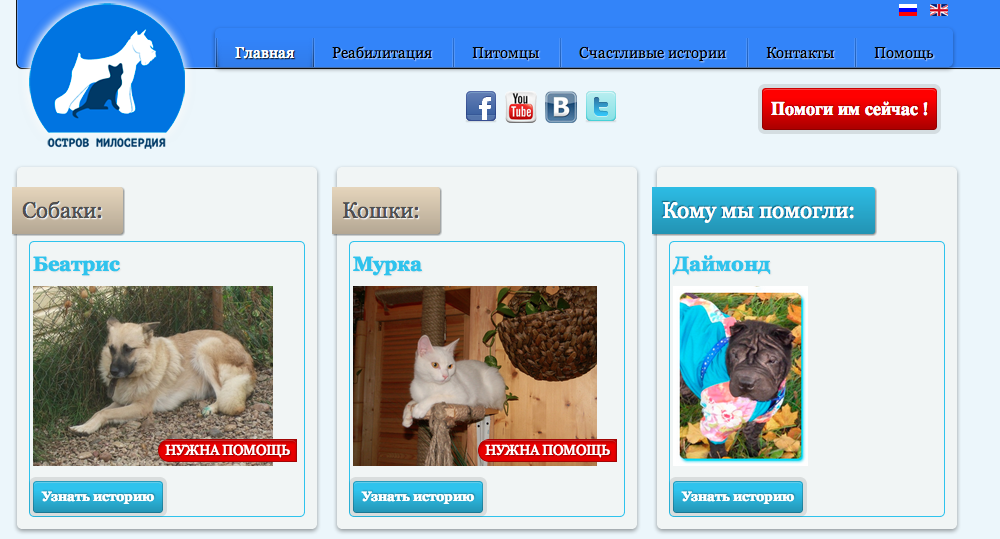
As of August 2013, the project website does not work.
Interviewed by Evgeny Voropay. April 2013.
E.V.: “Island of Mercy” is a charity fund, which is engaged in the help of homeless animals. How many similar organizations are registered in Russia?
T.N.: It's hard to say. I think there are a lot. The fact is that organizations engaged in the help of homeless animals are diverse. Any shelter or fund fall under this classification.
Before taking shape in the charity fund, we in private tried to solve the problem. And there are a lot of people who help homeless animals. Therefore, calculating the exact number of organizations will be very difficult.
E.V.: For charitable organizations, the theme of Internet canvas is sick. Everyone knows the schemes when, under the guise of helping sick children, money is made. Is this situation relevant in the animal assistance segment?
T.N.: This, of course, is relevant, although it must be admitted that there are not very many such cases. In the situation with animals, not only material assistance is needed. Here people help who, what can. There are much more ways to transfer the money-someone makes bank transfers, someone buys food, someone pays for the zoo-resistant. Fraudsters have little space for maneuvers. And the segment for them is less attractive. People help animals on the network less than, for example, to children. No one will just give money when you see a photo of a dog on social networks. It's hard to make money on this.
If the animal asks for money for an animal, you always need to pay attention to the authorized documents, registration certificates, and, of course, you can always require checks in return. “Island of Mercy”, starting to work with new partners, always provides a full package of documents confirming the status of the fund. This is a necessary measure, because There are organizations that abuse the help of donors or sponsors and spend funds for other purposes.
We try to report to our donors in order to exclude the slightest misunderstanding.
E.V.: Many charitable organizations work online to draw attention to the problem, increase the audience, raise more funds, etc. What has changed for the fund with the advent of the “Island of Mercy” website?
T.N.: There were no special changes. We just got a GOOGLE grant to promote the site. Therefore, the first task that has to be solved is how to do it competently and with the greatest efficiency.
The site gives users a more complete picture of what we do and how we work. Single posts on social networks or somewhere else on the Internet do not have such an effect. We connected electronic payment systems to our own site. By the way, another fact that is worth paying attention to when you start working with NPOs: if the organization works with electronic money and well -known payment systems is the self -erection that these are scammers to minimize. For example, the “island of mercy” was checked for a long time before connected to electronic payments of RBC.
E.V.: Returning to the issue of money, for charity organizations "electronic" money is a real alternative to virtual? How are the receipts through these channels are distributed in percentage ratio?
T.N.: Users have long understood the advantages of electronic money, so the percentage of funds entering these channels is constantly growing.
E.V.: Often charitable foundations and organizations place requests for help on their pages and accompany them with some terrible photographs of sick children or animals. From my experience of perceiving such ads, I’ll say that usually these pictures scare me, and I don’t even reach the text, I just close the link. On your pages on social networks, I found a couple of such pictures. What kind of trend is this, where did it come from, and why do people think that it can be effective?
T.N.: This is not a trend, rather a real work. Constant movement. I am also not a supporter of such photographs. But, as a rule, the animal that needs help enters the veterinary clinic, and the volunteers or doctors themselves take such pictures in real conditions. This is a kind of report on how and what happens to a dog or cat.
The problem is that after the animal is assisted, no one exhibits pictures of the saved pet. The “Island of Mercy” is aging to do this, we publish stories about our animals and their fates even after they find the owners.
Often people react to the appearance of the dog, to the nickname. You know, there are times when a person wants to help not the whole organization, not all animals at once, but to some one. We are also happy about this. Among our donors there is one singer, she is a native of St. Petersburg, but lives in Turkey, so she monthly pays for the content of the dog named Batti.
E.V.: Cats are a trend not only in Russia, but on the entire Internet. How do you feel about the emergence of social networks for animals? Maybe you thought about the possibilities of cooperation with such projects?
T.N.: This is very interesting. I would really like to participate in something similar. But we again rest against the financing problem. Joint projects need funds, and they are not always enough even for the maintenance of animals. In principle, I would like to develop a virtual story - I believe in its effectiveness.
Although something is very difficult to do here alone. When I conquer a conversation with specialists and offer some of my ideas, I have to explain that these are all non-profit projects and money will not work on it. Unfortunately, this is a barrier that not everyone can overcome. It is good that there are volunteers, caring people who are ready to devote their time to this. I am close to the idea of crowdfunding. I would love to work in this direction to help animals.
E.V.: There are funds, there are good owners, there are bad ones, but there are those who are ready to take a homeless animal to themselves. All. The division ended on this. Minimum communication exists only between the first and the last. Suppose I am the owner of a dog that I do not need, but I don’t really want to get into the category of “bad owners”, and I will not leave the animal somewhere in the landing. What options can I have, where to call, to contact?
T.N.: This is a very common story. People often turn to us and say that they can no longer contain an animal. The “Island of Mercy” in such cases takes pets. Sometimes the owners consider it necessary to support us and help with money to maintain their former “favorites”, sometimes not. After the animal enters the veterinary clinic, undergoes an examination, it is taken tests and sent to the zoo -resistant for adaptation. If during the examination some health problems were identified, doctors provide all possible assistance.
In fact, there are ways to solve the problem of both homeless animals and owners who no longer want to have a dog or cat. Patronage is one of them. For example, if a pensioner who wants to get a pet, but does not have the opportunity for this, give a cat and help in its maintenance, many elderly people would gladly meet such an initiative.
E.V.: In Russia there is a problem of shooting homeless animals. They say about her, but in fact, the public has neither numbers, nor any other data. If you create a “federal shooting card of animals” using crowdsourcing, would this help attract attention to the problem, activate users and animal rights wrestlers?
T.N.: The shooting of animals is a consequence of a larger phenomenon. I do not understand when the problem of homeless animals is artificially pumped and presented as a social threat. We often hear about how flocks of stray dogs attack people, and almost never, about why this is happening. You understand that from any aggressive, sick, three -legged dog you can make a good animal.
Crowdourcing or any other social projects dedicated to animals could help to solve the problem. Indeed, information, verified data and people who are ready to do this are needed. A tool is needed that will show that animals are hostages of the situation. Maybe then, people will begin to empathize with them.