
Translated material
"I do not go to rallies with empty hands"
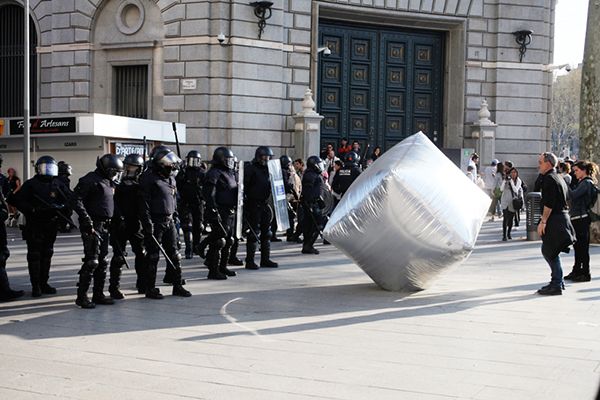 Photo: Oriane Elicao
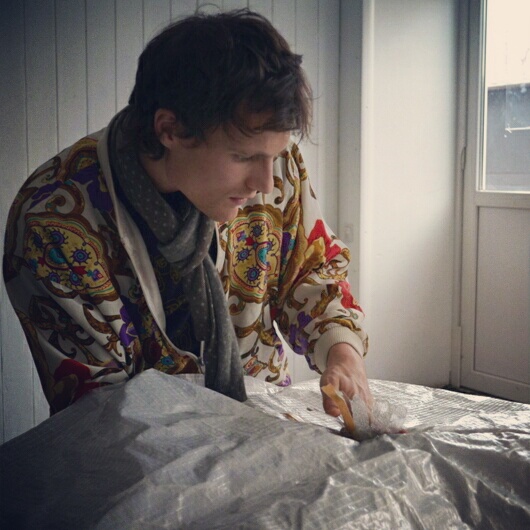
German artist Arthur Van Balen came to Russia to speak at the Delaisamit conference and, together with Russian activists, make a giant inflatable sculpture for the upcoming rally of the opposition on May 6. He uses inflatable objects as a new method of struggle for justice - they not only attract the attention of the press, and also protect the police protesters from the batons. The traditional forms of protest - mass demonstrations, rallies with monotonous slogans and extreme hunger strikes - Van Balen considers obsolete and boring.
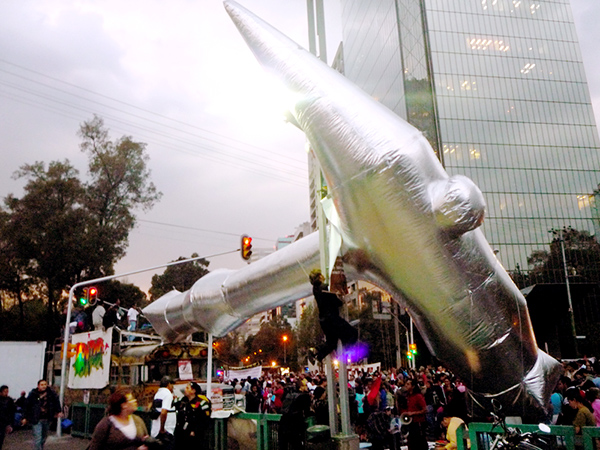
El Martillo (Hammer) in Mexico, at a climate conference in Cancun, December 2010. Photo: Author is unknown
His inflatable sculptures appeared at rallies not only in Germany, but also in Mexico, and even India, the activist tamps his gigantic crafts in the suitcase and sends foreign like -minded people on an airplane to take them to their shares.
- Arthur, how to call you correctly - an artist or activist?
I prefer to be called an artist. I started with art - I studied sculpture at an art school. There we had a class in self -organization, where classes were held without a professor. We had to engage in self-education, self-organize, invent some of our projects. It inspired me very much. And then I went to Scotland for a year and there I met a group of environmental defenders ... I began to engage in activism five years ago with one guy who was also an artist. He talked about our projects to friends, they told their friends, people began to come to us. And so our ECLECTIC Electric Collective group appeared. I have been engaged in directly inflatable sculptures since 2010.
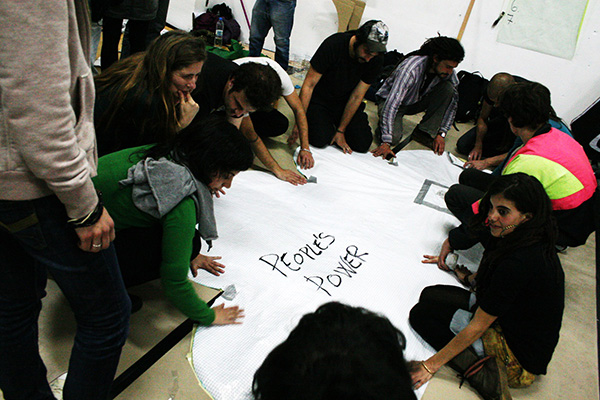
Seminar at the Como Acabar Con Mal art festival in Berselon 03/30/2012 . Photo: Kim Smith / ECLECTIC Electric Collective
- Your first projects were devoted to environmental protection.
Yes, in 2010, we sent our El Hammer to the climatic conference of Cancun -a 12-meter silver hammer, symbolizing the protest against the deterioration of climatic conditions (the phrase of Mayakovsky inspired the creation of artists: “Art is not a reflection of reality, but the hammer that you create”-approx. Ed.). Then we did not have money to fly to Mexico ourselves, so we just stuffed the hammer into the suitcase and sent it on an airplane.
Now we are no longer limited to environmental topics, we cooperate with initiative groups from different countries in different directions - we are supported by both the cultural and activist community.
- Giant inflatable sculptures attract attention, but you did not think that they could discredit protest? They look ironic, and the protest is a serious thing.
Why can't the protest be exciting? Maybe thanks to our inflatable sculptures, new people will come in motion, become interested, begin to study these problems. It is necessary to attract people by any means, to act from different angles. People do not want to participate in ordinary protests, but when you begin to do something unconventional and creative, it clings to their attention, they begin to want to listen.
Activists are usually not very inventive. For example, in India, young farmers arrange a hunger strike - this is their way to draw attention to themselves, they choose the most extreme form of protest. Instead of such traditional forms, I prefer to go beyond the usual frames and look for new, more creative methods of agitation.

Inflatable female slippers on a demonstration for women's rights in India (a stab with a tapochka in India means an insult). Photo: Still Janica Television
I do not think that “tactical frivolity” (in the original-Tactical Frivolity, as the art group calls the genre in which it works-approx. Ed.)-this is bad. These are all prejudices. Good everything that attracts attention. The inflatable sculpture is just the tip of the iceberg. With our objects, we attract people's attention to the demonstration, and then they will learn about the problem itself, begin to dig deeper, think.
After all, there should be something positive in protest. Rallies are mainly under the sign "Minus". Most of the requirements are based on denial-"there is no one", etc. And our sculptures carry "yes". If you always say only "no" - it becomes boring.
- How do you carry these gigantic objects on demonstrations?
We find different ways-we hide in advance on the site of the upcoming action or try to somehow imperceptibly drag them. Now I have stopped going to rallies empty -handed. I feel more confident when I have such things with me.
- And how does the police react?
At last year's Pervomaisky demonstration in Berlin, it was ridiculous - the police tried to control the crowd, built people in the line, and commanded everyone. And suddenly our huge inflatable stones attack them (activists created inflatable sculptures in the form of brick - improvised weapons, which was often used by protesters during the May Day demonstrations in Berlin Croutsberg - approx. Ed.). Of course, they did not expect this. They began to try to get rid of them - beat with batons and trampled their feet. It looked very comical. They put themselves in full jester. We managed to undermine their authority with the help of such "frivolity".
And sometimes our sculptures are used as a means of self -defense - activists hide behind them from the batons of police officers.
“Have you ever been caught for it?”
As a rule, the police cannot track down who launched these figures is too unpredictable for them. But when they get used to it, we will have to look for some other forms of protest. So far, it works well enough. Often we use art as an excuse (in Germany there is a law that protects the freedom of art - approx. Ed.) - they say, this is the way of artistic expression, so there are usually no problems.
- Your sculptures are so mercilessly destroyed. Do not sorry for them?
I like it when objects are destroyed - so they become not only a work of art, sculpture, but also give birth to a performance. And this performance creates a whole story of the life of this object, a certain drama. People will discuss why he was at a rally, how he was destroyed.
For last year’s demonstration in honor of the anniversary of the 1956 events in Budapest (when the inhabitants of Hungary protested against the communist government - approx. Ed.) We made an inflatable sculpture of the Hungarian Orange (in one satirical film, agricultural cooperatives are trying to grow its orange, but as a result, a small sour fruit receives. A quote from this picture: “Small, sour, but its own!” Was a slogan of the national-conservative forces of Hungary-approx.) And they launched it into a column Supporters of the authorities (for the most part pensioners) who went in this column began to beat him and quickly destroyed him.

Photo: "Hungarian orange" at a demonstration with Budapest 10/23/2012 . Photo: The author is unknown
- Many artists do not like to talk about politics and prefer to remain apolitical in their work.
And I love political things. But for me, political art is the one that is as integrated as possible into reality. I like to travel, go to different countries, learn new stories, delve into their study. When we created the Hungarian Orange, I learned a lot about this story, we had violent discussions about this with my uncle.
-Do you believe that mass promotions can change something?
Certainly! Protest can achieve a lot, people simply should not give up. Sometimes 100,000 people collect protests, but state television does not illuminate them. And our inflatable sculptures are another way to attract attention, including some alternative media and social media.
- In Russia, people do not really believe due to protest.
The authorities are simply trying to inspire it to you, to create the impression that everything is pointless and that nothing can be changed. And so they win. This is such a strategy. But if you achieve support for the press and betray all shares of maximum publicity, this will put pressure on the state, and it will no longer be able to ignore your requirements.
- Where are you going to protest in the near future?
Now we are making a sculpture for the Moscow rally on May 6. We are still thinking of arranging something at a climate conference in Istanbul. Let's go to Bosnia. There we will make a giant inflatable spoon - some politicians in the former Yugoslavia promised that in a few years the country's inhabitants would eat golden spoons. So we want to beat this story.
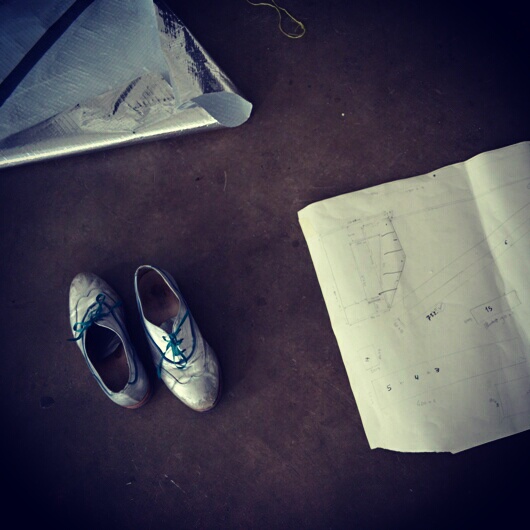
Inflatable sculptures are my artistic practice. I am fascinated by activism, and I also want my art to benefit. This should work in two directions - in an artistic sense to be more interactive and be more creative in terms of activist agitation. I would like to find a middle ground between art and activism.
- And to make inflatable sculptures for commercial purposes?
No. This is shit. Isn't it?