
Translated material
Unauthorized drawings
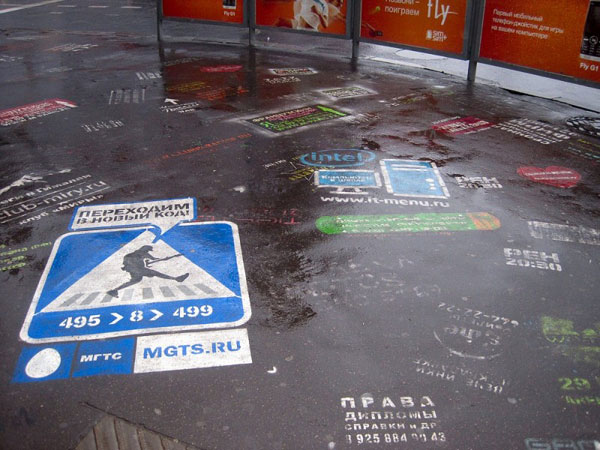
The Moscow City Duma adopted amendments to the City Code of Administrative Offenses, establishing fines for "advertising on the asphalt". After the mayor of the city approves the bill, for “unauthorized inscriptions and drawings” on the coatings of “roads, sidewalks, pedestrian and bicycle paths” a fine of 500 rubles to 2.5 thousand rubles will be set.
This sanction, of course, does not apply to the drawings with chalk: they will only be fine for images and inscriptions made by “persistent materials”. Moreover, the legal entities who committed this offense face a fine of 7.5 to 15 thousand rubles. Obviously, in this case, they mean, first of all, not customers, whose guilt will be quite difficult to prove, but performing firms: their number has grown quickly in the past few years.
The law previously provided for responsibility for “placing ads and other information materials outside the places specially designated for this”, as well as for “unauthorized inscriptions, images”. But the corresponding article of the Code of Administrative Offenses of Moscow under number 8.13 is about “buildings, structures and utilities”. Therefore, the “legal status” of the asphalt still remained unresolved.
Legislators tried to prohibit advertising on sidewalks at the federal level back in 2011. The bill was introduced by the deputy of the Just Russia Oleg Mikheev. The document was under consideration by the State Duma for more than two years and was rejected in March 2013.
The official review of the government says that the adoption of the bill is inappropriate, since the “road surface” always has an owner, and the current norms of the civil and administrative codes and so allow him to demand compensation in case of property damage. Moreover, according to the government experts, such a ban could violate the rights of the owner who is free to dispose of property at his discretion, including allowing inscriptions.
“The ban on the distribution of advertising in this way will limit the owner in the implementation of the authority to dispose of property ... If the owner of the property with the placement of advertising on the surface of the bicycle or pedestrian or sidewalk disagrees, he has the right to prohibit the use of property or eliminate advertising from the corresponding surface due to the person who placed it or independently with the subsequent recovery of costs,” the government said.
This objection, of course, is not meaningless, especially against the background of numerous calls of the federal antimonopoly service, which has been insisting on the introduction of official regulation of advertising on the sidewalks for several years. However, in Moscow, this problem clearly acquired a different character and other scale. The city authorities regularly hear Muscovites complaints about how advertising changes the face of the city. And the success of resolving the issue can, to a certain extent, influence the opinion of voters about the current government.
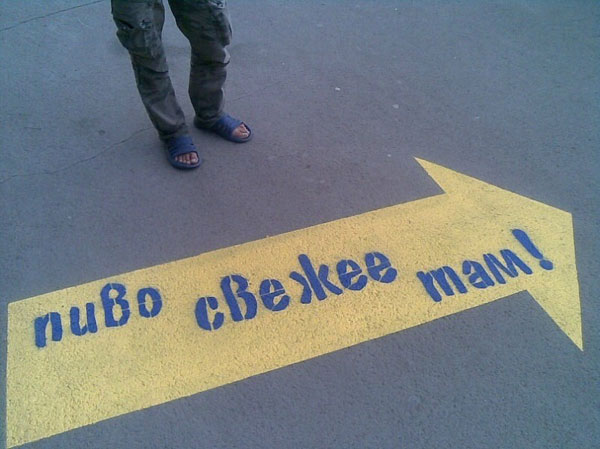 Photo: Asfalt.ws
Judging by the number of colorful ads on the sidewalks, now in Moscow the inscriptions on the asphalt are a whole submarine of the advertising market. According to the first request, hundreds of firms appear in the search engine, offering such services to everyone for a moderate fee.
For example, the manufacture of a plastic stencil 60 cm wide and 90 long will cost 700 - 900 rubles. And the average “application price” is even lower: “solid” companies offer to make a drawing with particularly stable paint and cover it with varnish for 500 rubles. But numerous competitors “engage in dumping”, and ask for only about 180 rubles for a monochrome announcement. The minimum order volume is usually limited and starts from several thousand rubles.
Probably, it will be even cheaper to hire a couple of students, armed them with spray cans, but in any case, the prices depend on the number of colors and the size of the image. Of course, there are firms offering drawings by a real artist without a stencil or even creating skillful images on the asphalt that create the impression of a three -dimensional picture. Here, prices are regulated individually.
 Photo: Effect-3D.ru
The issue of the legality of these services has so far been decided by customers and executors quite clearly: everything that is not prohibited is allowed. On many sites advertising the placement of ads on the sidewalks, there are entire sections dedicated to the legal side of the issue. Basically, advertisers convince customers that due to the existing gap in the legislation, sanctions from the authorities cannot follow.
However, some companies warn that they will not be announced to any illegal goods or services. And the largest moral achievement of individual performers was the refusal to "carry out work near the historical and cultural monuments."
If, under the created conditions, Moscow lawmakers decided to regulate the placement of advertising on the asphalt, instead of prohibiting it, then it is likely that the sidewalks would soon be covered with a continuous carpet of multi -colored ads. Official regulation of this type of advertising would be perceived as permission, and after that “legal” and “illegal” inscriptions would be traced after that.
After the amendments made by the Moscow City Duma in the city Administrative Code, the situation may begin to change. In the end, the campaign to combat the dominance of advertising in the capital, which began the field of coming to power by Sergei Sobyanin, has already brought some fruits. The city authorities cleared the streets of annoying stretch marks, removed many neon signs and huge advertising banners from roofs and facades of houses.
On the other hand, inscriptions on the sidewalks are just the type of outer advertising that is most difficult to control. It is impossible to determine the company-performer by the drawing; no one will become students painting asphalt at night. And the introduction of fines is unlikely to instantly solve this problem.
A similar example is paper advertisements that are full of public transport stops: trying to overcome this phenomenon, the city authorities in March this year introduced responsibility even for “officials” responsible for “work to remove unauthorized ads”. But while the “Paper Spam” has not disappeared anywhere either.