
Translated material
Internet censorship for growth
In society
 Internet censorship for growth
April 30, 2013 Irina Borogan
Six months have passed since the moment the Internet filtration system, technically designed in the form of a single register of prohibited sites, began to operate in Runet. Today it can already be said that during this time the state managed to convince most international services, such as Twitter, Facebook and Google, to make concessions and block information at the request of the authorities. Only Wikipedia is released from the general list, which edited only one article - about the smoking of Cannabis, ignoring the rest of Roskomnadzor's requests.
Today in Russia there are two parallel sites blocking systems. The old system is represented by the federal list of extremist materials, which has been formed on the basis of court decisions and has been operating since the end of 2006. At first, books and newspaper articles were included in this list, but soon it began to replenish the Internet resources. Now on this list is 1802 points, and the last record applies to the page on the VKontakte social network dedicated to the ideas of National Socialism. For this list, there was no debugged filtration mechanism, and as a result, sites prohibited in one region often remain available in neighboring areas.
The new Internet filtration system, which has been held on a unified register of prohibited sites, began to operate since November last year. Under this system of pre-trial blocking, the Ministry of Communications immediately developed a mechanism that allows you to quickly block access to prohibited sites and Internet pages throughout the country. According to the data provided to us by the press secretary of Roskomnadzor Vladimir Pikov, now the register consists of 6595 records. For six months, 3789 records from it were deleted "Due to the fulfillment of the requirements of Roskomnadzor."
Last fall, when the register was launched, many experts and human rights activists were most afraid of DPI (Deep Packet Inspection)-technologies for deep analysis of packages, which allows you to monitor and filter Internet traffic, blocking the necessary content or service. Representatives of the industry and the Ministry of Communications in August last year have been talking about the widespread introduction, reasoning that this is the only technology that allows you to block a separate page or video instead of the entire site or service. However, it also makes it possible to look into the packages of the transmitted information: as one engineer put it, using DPI you can not only see the address on the envelope, but also read the letter itself. DPI is new opportunities for surveillance, with its help it is possible to identify all users who have visited the prohibited resource or those who mentioned in letters or chats, for example, protests.
In addition, we were afraid that it was this technology that would be used to block individual pages in international services - such as Facebook, Google and Twitter. This would allow the Russian authorities unnoticed by these services to remove any content that they did not union for them. With this method of filtering, the resource remains affordable, most users do not notice anything and the state avoids hype, which is inevitable when blocking the entire site or service.
Meanwhile, six months later it became clear that the Russian authorities did not need such complex technologies at all.
It turned out experimentally that the possibility of a scandal is the last thing that the Russian authorities could stop: YouTube, Google+’s Cross, the Lurcomorye Counteratic Encyclopedia, Internet Biblio, Librusek, has already got into the black list of sites.
In paradoxically, this frontal approach, in which the authorities do not stop before blocking the entire service, turned out to be extremely effective in building relations with international Internet corporations.
Already in winter, global services began to meet the requirements of the Russian authorities, and in the spring Roskomnadzor admitted that with large world Internet companies it was possible to establish a dialogue, and in most cases illegal information is removed at the first request.
For example, at the end of March, Facebook, at the request of Roskomnadzor, blocked the Suicide School page with appropriate pictures and black humor on this topic. The blocking of information posted on the social network by users, in principle, does not contradict Twitter policy. In January 2012, the company announced that now it has a technology that allows you to block certain content in certain countries, and will use this to comply with legislation in each particular country of the world. According to representatives of Roskomnadzor, this became possible after long negotiations with the leadership of the social network on correspondence, since the company has no representatives in Russia. And in March they managed to agree. The result of these agreements was, apparently, on March 14, the tweet of the journalist “Lenta.ru” Sultan Suleimanov: “Friends, make suicide, this is fun.” Twitter sent a notification to the owner of the account, and then, without waiting for anything, blocked the record.
Google also has to compromise, although, judging by the company's report for the second half of 2012, not without a serious struggle. In 2012, Google received 107 requests for removing information about drugs and suicides from Roskomnadzor, but blocked the content only in response to a third of the requests. True, another half of the content was removed due to its inconsistency with Google's rules. (It is significant that during this time only six requirements for the removal of information on court decisions were received.)
As for YouTube, out of the 55 videos that the authorities demanded to block, the video hosting began to delete 19. In addition, now the Russian office of the company is disputing in courts a decision on blocking on YouTube an entertainment video, where a girl shows how to apply a special makeup on Halloween. Rospotrebnadzor considered this video by propaganda of suicide.
Over the six months of the existence of the Russian Internet filtration system, another forecast has not been justified. As you know, the register is formed from the sites and pages of three categories: FSKN makes sites containing drugs about drugs, Rospotrebnadzor is responsible for suicide, and Roskomnadzor - for materials with child pornography. Many assumed that blocking the content allegedly dangerous for children will become only a reason for the introduction of Internet filtration, and the register would be replenished mainly by sites prohibited for extremism. In addition, it was believed that the filtration system would begin to be used to block protest groups on social networks. Such a strategy fled into the logic of point persecution of only politically active and opposition network users. However, it is now clear that the authorities have gone to a different scenario.
It turned out that for extremism, sites continue to be blocked according to the old minister system, and as far as it is known, not a single site blocked in court for extremism has entered. In addition, mass blocking of protest groups in social networks is not yet noticeable. It is possible that protest groups are not closed simply to monitor the activities of activists: since 2010, Russian special services have been actively purchasing software for monitoring social networks.
Instead, the authorities are constantly expanding the list of grounds on which sites can be blocked. At the end of March, the State Duma approved a bill that allows the register to introduce sites with information about children who have become victims of crimes. On May 25, a project is assigned, which will bring in the register sites that promote homosexuality. And finally, a week ago it became known about the project of the Ministry of Culture, which provides for the expansion of the register at the expense of sites with pirate content.
Obviously, the Kremlin changed the strategy, and relied on a general Internet censorship, which will affect not only activists, but almost all Runet users.
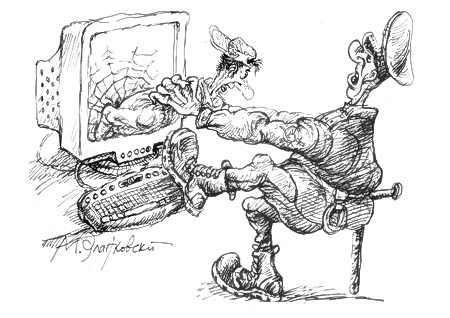
Graphics of Mikhail Zlatkovsky / Zlatkovsky.ru