
Translated material
Details about Bolotnaya. "Where are we sitting?"
In the last material , we figured out who and why blocked Bolotnaya Square. The next episode of events is although not the most dramatic, but one of the key: "Sitting strike." On the one hand, it causes a lot of controversy even among the participants in the demonstration. This is also shown by the results of a public investigation: descriptions and assessment of this situation among 600 participants in events are very different. On the other hand - apparently, the investigation considers it precisely its beginning to the notorious "riots." One way or another, from that moment the situation became more and more uncontrollable and was less and less like a calm organized rally.
The police leadership and many, after him, claim that the unexpected change in the route and the boundaries of the site for the rally did not prevent people from going to the stage and start a rally.
Was it possible to go through?
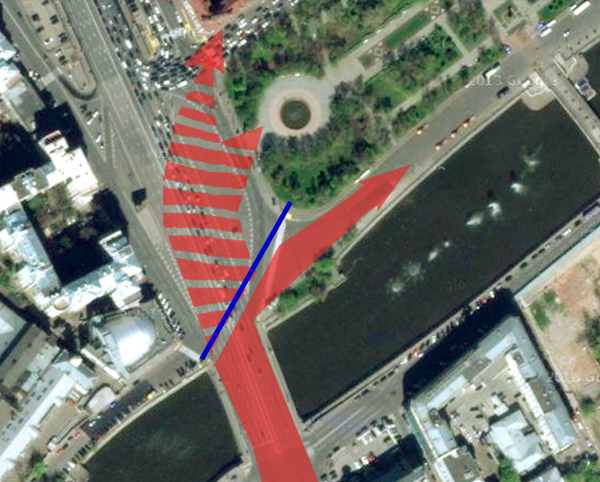
In its schedule, the police allocated for the rally classified only the Channel embankment for the rally. The blue line is a police chain that cut the area. The red column and the turn that she had to commit to go to the embankment are indicated in red. The width of the meadow in the last section is 8 lanes, or 40 meters.
And the dotted line shows how people could move if the initial plan (published on the sites of the Central Internal Affairs Directorate and Rihan and a replicated mass media and blogs) was respected. In this case, the column would not have to, "cringing" on the go, lay a steep turn. The crowd would smoothly divide into two sleeves - going to the right would turn immediately on the embankment, and the left - continued to move forward, smoothly wrapping it on the square from the center and the far corner. But the police chain did not let this do.
The curtain in this place was inevitable outside the dependent on the will of the so -called "leaders". The scientific director of the Research Institute of Transport Mikhail Blininkin: "There was no provocateurs, the police themselves provoked the riots when she decided to deploy a dense pedestrian stream 90 degrees to the right. This is simply impossible to do: of course, the tank began."
“And still they could see and turn,” the authorities insist, and some include her to believe her here. But could they see?
It must be taken into account that by the time of the approach of the main column (at about 17:00), the embankment was already filled with several thousand demonstrators who approached "uncontrollably." This is not to say that it was "like herring in a barrel", but from the side it seemed that there was practically no place left there.
Here's how they saw the embankment suitable from a small stone bridge :.
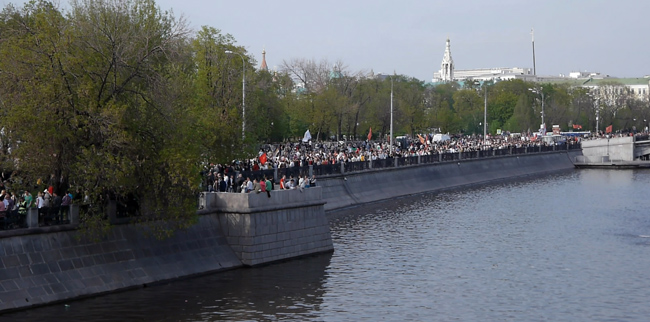
At the same time, the turn from behind the trees was not visible at all:
Therefore, many witnesses say that it was impossible to go there.
Those who were on the left flank of the column, near the “drummer” (even in the forefront), saw the following picture in the direction of the embankment (leaving deeper): 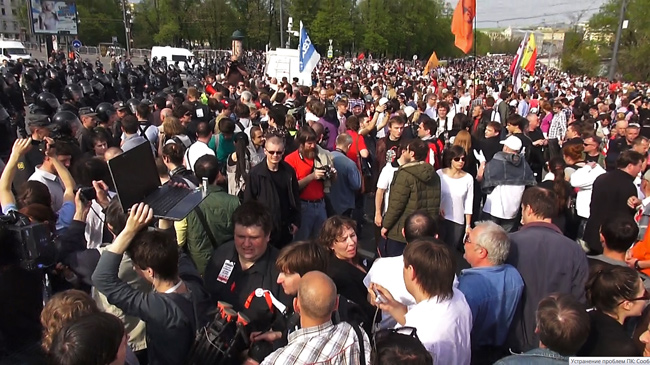
From here also the impression is that the embankment is filled and it is pointless to go there.
There was also no way back (to the clearing) - from there all new demonstrators approached, supporting the first rows stuck at the cordon:
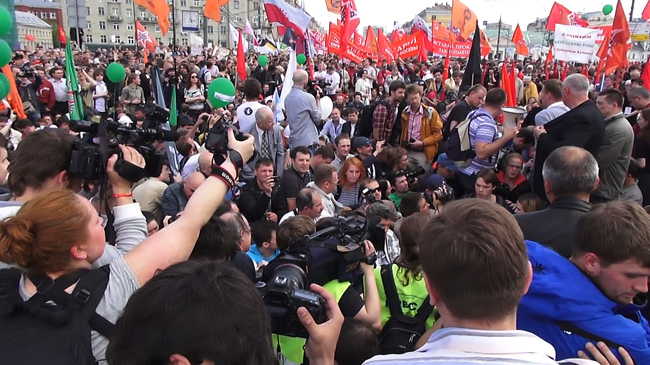
And only those who went through the small stone bridge in the forefront of the right side of the column (or squeezed there through the crowd), they could find that the passage to the embankment was possible. It is these witnesses that claim that they were quite calm to the stage (see video above). But this situation was different at different times from 17 to 18 hours.
Conclusion. At different points and at different times, people observed and evaluated the situation differently, hence the disagreement regarding the possibility of passage somewhere. This situation was primarily because an artificial obstacle in the form of a police chain from the “drummer” to the corner of the embankment stopped the movement. If the column could continue to move, people would watch different angles in the movement and found the possibility of passage.
Also, the possibility of placing all those who came on the embankment remains. The police claim that in this case the square would be open. But it is impossible to check this, since the situation of congestion and confusion was already created and demanded an immediate resolution that did not happen.
"Sitting strike"
The opinions of witnesses surveyed during a public investigation about the goal and the result of a "sitting strike" are also different. Some believe that, having called the demonstrators to sit on the ground, the "leaders" finally blocked the movement to the place of the rally. However, three times a larger number of witnesses are sure that, on the contrary, they stopped the movement of the columns to the police ranks and prevented the crush and pressure to the police, pulling the clashes for a while. But the most interesting thing is that many participants in the events were not aware of what was happening near the “drummer” and about the “seat” much later.
People were in different places and everyone saw only their own site.
The place where the largest number of people sat (there were several more small groups):
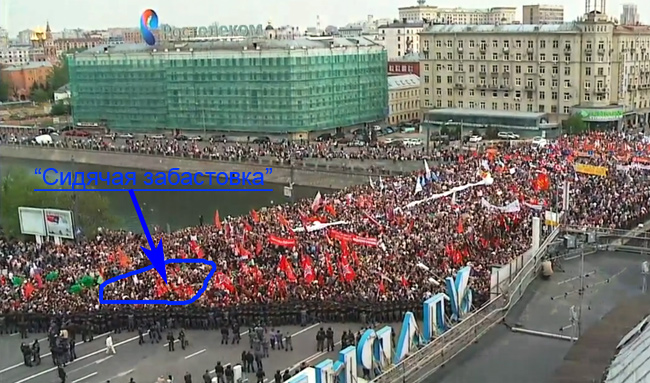
On this frame of broadcasting the minevlive passage to the right, to the embankment, is already tightly clogged by people. At first, when the column only approached, it was much freer. But it is also evident what a steep turn was supposed to make a column in order to get to the embankment. Arguing about the notorious "bottleneck", people, apparently, also mean different circumstances. Someone is a simple narrowing of the passage at a bend, which turned out to be not so critical for those who approached the first. Others (who saw him later) is a tightly filled passage that could be overcome only by working with elbows. After some time, when the police chain moved forward, the passage between the bridge and the embankment narrowed to the width of several human figures. But more on that later.
What did the "leaders" call for?
It is no secret to anyone that on the eve of some participants in the rally discussed plans to go beyond the agreed action. The topic of tents arose not from scratch. But if some of the demonstrators had intention to stay in the square and arrange the Maidan, then the square was a more suitable place for this. Colonel Zdorenko speaks of these "secret" opposition plans. And it was precisely the actions of the police, the frightened "Maidan in the Skorik", that forced them to change the place of protest from the square to the roadway - which noticeably exacerbated the situation. This, in particular, says Ilya Ponomarev ("The plan to sit in front of the chain arose already during the demonstration, when it became known about the overlap of most of the area and changing the route").
What would happen if some of the demonstrators still remained in the square after the end of the rally? These actions would not carry any danger to Muscovites, the movement would not be blocked, no one would go to the Kremlin. Whether to disperse those who want to express their position in a secluded square - this would be a matter of the conscience of the authorities. But it turned out that the demonstrators provoked to stop at the roadway. And then they were accused of this.
What the initiators of the seats called on is called throughout the world "peaceful non -violent civil protest." They suggested sitting, and not to attack the police. And did the demonstration respond to their call? Of the thousands of demonstrators, "hanging" in the small stone and a clearing, several dozen sat. So why was the procession stuck: because of the desire of the "leaders" to sit or because people were sure that there was simply nowhere to go? There is another explanation: people in the mass themselves did not want to obey unexpected "orders" of the authorities. They simply found all these hordes and fences with another insult and violation of their rights. This is evidenced by the numerous conversations of the demonstrators with each other and with police officers, we found in the video.
What did the police expect?
If the security forces who were responsible for order and safety in the Bolotnaya really wanted to discharge the voltage as much as possible, they would be worth it to convey people to Bolotnaya Square by any means. The trouble is that the police considers the only “affordable tool” to be a return of categorical and meaningless orders to MegaFon. They, apparently, perceive a huge mass of people as a subordinate division. But for some reason, this causes people not enthusiasm, but the desire not to obey and protest. But that would be half -worn.
The main mass of the demonstrators came to the Bolotnaya Bolotnaya by 17:00. At 16:00 they still stood in the middle of Yakimanka. A breakthrough near the "drummer" took place at 18:00. But the testimony of the police contained in the criminal case states that they received an order to eliminate the riots from 17:00 and even from 16:00.
"At about 16.30 hours, by order of the command, the Drummer of Moscow arrived at the cinema" Drummer "to detain persons who violate public order and participate in the riots" (D. Budantsev Budantsev)
"About 16 hours 30 minutes from his command he received an oral instruction to nominate riot police to the descent from the large stone bridge leading to the marsh of Moscow, since the danger of a breakthrough appeared in the vicinity of Bolotnaya Square" (A.M. Drummers)
"In the period, from about 16 hours, mass riots began" (A. Algunov))
"At about 16 o’clock, the peaceful rally began to go into riots" (Skalozub D.E., doctor riot police)
"About 17 hours, the demonstration in the indicated place began to grow into riots" (A. Tyugashev)
"At about 16 hours 30 minutes, the protesters began attempts to break through the cordon, while behaving aggressively, expressed with obscene abuse, used violence, threw stones, bottles" (Shevchenko D.V.)
"About 16 hours in Bolotnaya Square a large number of people with posters and banners have accumulated." (Shamukaev I.I.)
"From the very beginning, people gathered at the exit from the Small Stone Bridge, and chanted various slogans. At the direction of the commander, his group began the detentions of aggressive citizens who violate public order." (Arkhipov A.L.)
"At about 17 hours 40 minutes, a group of protesters approached a small stone bridge, most people were wearing black masks ." (Belovodsky IB, battalion commander)
"By order of the command, in the event of mass riots, they had to identify the most active citizens, detain and deliver to special vehicles" (D.A. Kuvatov)
"He was given the task of not missing the protesters, in the event of riots from Bolotnaya Square to Borovitskaya and further" (Semenov M.V.)
"The task was set to protect public order and security, to identify and detain persons provoking mass riots" (O. Badmaev)
And so on. Either the police lie, or for some reason they rearranged the time on their hours a couple of hours ago (and most of them Muscovites). In any case, it is obvious: they constantly heard the phrase "mass riots" from their commanders on the eve of May 6. They were pumped with fear. Is it amazing that "at the same time he heard shouts from the crowd:" Kill! Kill him! ". He perceived these cries seriously, fearing for life and health" (Gorbachev S.A.)?
The fighters even heard the screams "Give a putsch!" (Oznobkin A.S.)
Only panic fear can be explained by the fighters who were flying in them "rods from the gratings, pieces of steel reinforcement." (Ovechkin M.A., Department commander)
Fear or obvious lie. One way or another, from these testimony it simply blows the initial readiness of the police for decisive fights. Tens of thousands of Muscovites merge in their eyes in an aggressive, dressed in masks, armed with a reinforcement crowd.