
Translated material
Political strategist of all Rus'
Who is mr.surkov?
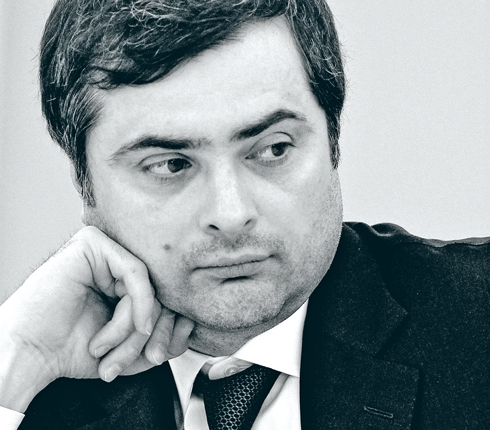
It is generally accepted that Russian policy is created by gray cardinals. Richelieu at one time was called both Boris Berezovsky and Alexander Voloshin. But the true master of his craft, a great and terrible courtier, about the power of which was composed of legends and whose name other actors of the Kremlin political scene were afraid to pronounce aloud, in recent years, Vladislav Yuryevich Surkov became. Some called it a cynical intriguer, a manipulator capable of the dirtiest provocations. Others considered a talented creative who could not only generate brilliant ideas, but also successfully organize the process of their implementation. Who is mr. Surkov? - asked The New Times
Surkov is a closed person, with a bunch of demons. He is very difficult to build relationships with people, always tried to be either “over”, or in the worst case “under”. Or the owner, or slave ”(Leonid Nevzlin, ex-head of the Yukos oil company).
“Glory was one of the best. The strongest student. He behaved modestly, did not pay attention to himself ”(Lidia Znamenskaya, a teacher of mathematics at school No. 62 of the city of Skopin).
“This is a person who has a political concept and philosophy, he is a real performer, whoever is his boss” (Gleb Pavlovsky, political scientist).
“I was surprised when he said about the decision to enter the Moscow Institute of Steel and Always. He has a creative soul - what alloys are there! But Glory said that a specific specialty was needed to help mom and family ”(Vera Rozhko, a literature teacher at school No. 1 of Skopina).
“Surkov is a born manipulator. He does about the same thing that the Chekists did in the 20-30s. Everyone has a weak place for which you can hook. Fear, greed, personal vices. This approach destroys not only the recruitment object, but also the recruiting person ”(Dmitry Oreshkin, political scientist).
“His tentacles, a web, to which he has braided the today's cultural and political world of Russia, concerns everyone in one way or another. Few people are so active, powerful and strange in today's context ”(Alexander Prokhanov, writer).
“Surkov has many masks” (Vladimir Lukin, the Commissioner for Human Rights under the President of Russia).
The New Times was looking for these masks: in the city of Skopin, where Surkov grew up, among the owners of the companies where he worked, for his friends and enemies.
Capital achievements
The track record of Vladislav Surkov looks simple: Bank Menatep-Alfa-Bank-Kremlin. The last decade is the top of the Surkov career. In the 2000s, it was he, the permanent deputy head of the presidential administration (both under Putin and Medvedev), who formed and controls the country's domestic policy. He was a guide for the most important initiatives of Vladimir Putin aimed at building a vertical of power, such as the elimination of real multi -party systems, the abolition of elections of the heads of regions, total control over the press and television. He turned the Unity of Berezovsky Boris Berezovsky into the main party of United Russia, which enjoys the support of 45% of Russians * * Data of the January survey of Levada Center. . He invented “sovereign democracy”, he is the main customer and censor of the main information and analytical programs on the country's main television channels. Until recently, the leaders and chief editors of the leading media every Thursday gathered at the Surkov at the instructions in the Kremlin. And now they no longer need “introductory”: they themselves already know what can be written, whom to show on the air and how many seconds, and whom - never. And it is this person in the coming year that will make a new (old?) President.
What drives Surkov? The idea, but whose, if everyone who worked for, they say about him as an absolutely loyal performer (“a dictator in relation to subordinates, the loyalist to the bosses,” said one of those who paid him a salary), and what kind of idea is this? The thirst for the power of the boy, from God and the people of the forgotten town, from the incomplete family and even with the dad - the “face of the Caucasian nationality” of the people repressed by the Soviet power, who made his way through life, climbed as he knew how? Passion for money, like the memory of a young man who was stubborn by the generals who earned everywhere and how does it have to be expelled from two institutions? “Glory respects himself: he can’t take and bring a million to him,” one of the New Times, which Surkov worked in the 90s, is sure. “Surkov is a very rich man: he earned even at Khodorkovsky and Friedman, and he controls the“ black box office ”of the Kremlin,” says politician Boris Nemtsov. “But for him the power is in the first place.”
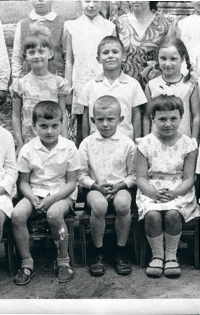 |
| In childhood, Glory was the same as everyone |
Childhood
The town of Skopin in the Ryazan region, where Vladislav Surkov studied and raised, is a place of 284 km from Moscow. It is cut off from the north from the outer world with a six -meter railway embankment resembling a fortress wall. Through it a narrow tunnel is laid, which the locals are simply called - “pipe”. On the other sides, the border of the city is protected by an ancient trash strip. Inside this fortification, the city map is drawn by a standard socialist set of streets: Lenin, Karl Marx, Ordzhonikidze, Lermontov, Komsomolskaya. The historical center is entirely one- and two-story houses, frozen streets and many abandoned buildings. Sberbank, a half -abandoned cinema with a registry office on the second floor, a lot of car repair shops, a cafe and a grocery store Kolos, a jewelry Tsar Midas. Only a little more than 30 thousand people live here.
As the fellow Times of the mother of Surkov, the future theorist of sovereign democracy, was born in 1964 in the city of Chaplygin of the Lipetsk region (70 km from Skopin) told correspondents. His mother, Zoya Antonovna Surkova, graduating from the Chaplygin Pedagogical Institute, worked on the distribution in the Chechen-Ingush Autonomous Soviet Socialist Republic at the rural school of Duba-Yurt. The pregnant woman returned to her homeland, gave birth to her son and again left to teach. Glory was brought up by a grandparents, who had a pen in the village of Solntsevo, Chaplyginsky district. “I remember him well,” recalls the fellow countryman of his mother Sergei Kaverin. - He was understandable, smart. Our tractor driver, when I brought Vladislav to him, said: “What a guy! This one will be some special competent. ”
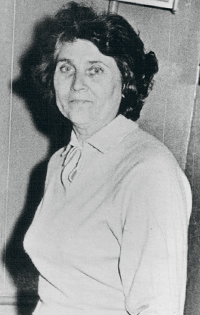 |
| Zoya Antonovna Surkova in Skopina is remembered with kind words - she was always a good colleague and teacher |
In Skopin, mother and son lived modestly, helped the brother of mother Ivan, the head of the local state farm. He arranged for his sister with his nephew a room in a hostel (teacher’s house), and later they received an apartment-in short, the usual problems of a single mother.
However, immigrants from the village of Duba-Yurt claim that Surkov was born in Chechnya, in the Shalinsky district hospital. And up to five years, he lived in Duba-Yurt with his mother and father, Andarbek Danilbekovich Dudaev, who belonged to the rare mountain Tap Zandarko. Father and mother were taught in one school. But, as the Dubayurts say, the Andarbek threw his family, went to Leningrad and did not return to Chechnya. So my mother and son had to return to the Lipetsk region. “The fact that the Chechen Surkov I learned from himself when he and I met at one of the tricks in Alfa Bank many years ago,” recalls the member of the Federation Council, former adviser to President Putin Aslambek Aslakhanov. “He introduced himself and said that his father was a Chechen, whom he practically did not remember.” They say that in the 90s, working in Alfa Bank, Surkov sometimes flaunted what was, they say, a relative of Johar Dudaev and attracted the Chechen diaspora to solve some money disputes. In short, wherever he was born, in 1971, little glory entered the first grade of a school-dwelling No. 62 in the city of Skopin, where his mother had already worked as a teacher and geography as a teacher.
School
The freshly painted green facade of school No. 5 (former 62nd) stands out sharply against the background of a dull Skopin. In an oblong one -story building, the features of the former station are guessed. Inside, well -repaired corridors, the walls are hung with children's pictures and information posters. At one of the stands - “The pride of the school” - photography and biography of the first deputy head of the presidential administration Vladislav Surkov. And no wonder: as they say here, it was thanks to him that the school received 9 million rubles for full restoration and repair. 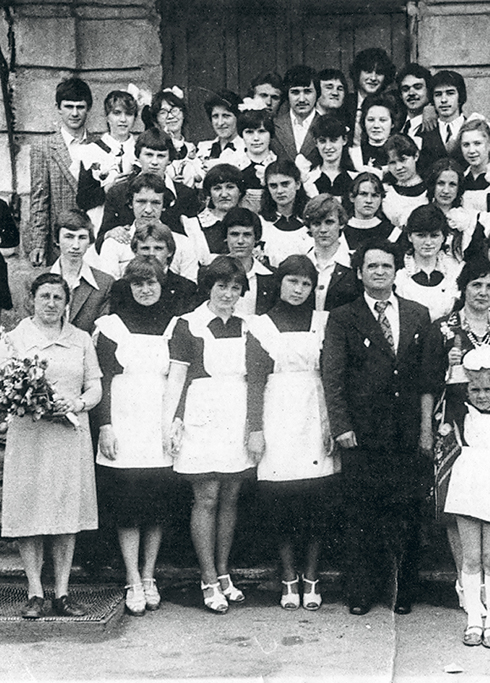
Teachers willingly recall Surkov’s mother: she wrote poetry and scripts, put dancing, replaced history teachers, knitted, awl, raised two children. “A hardworking and decent Russian woman,” emphasized chemistry teacher Valentina Androsova. “She handed it to her children.” Zoya Surkova/Vesvetova (surname of the second husband) worked here for 25 years and still regularly send letters to school, calls, sends his paintings. Now dozens of these paintings, which depict baskets with flowers and night sky, are hung in the assembly hall. The director’s office stores the 230-page collection of poems by Zoe Antonovna “Dreams and Hopes” independently published by Surkov with a gift inscription. Under the verses are the places of their spelling: Moscow, Skopin, Duba-Yurt, Uspenskoye, Voskresensk, Moscow “Airport”.
They talk about the schoolchild of Glory as the “first student”: diligent, talented, attentive, played the button accordion, built railway models, was an authority in the classroom, did not be rude, had a unique performance, the girls liked it, knew how to be friends, says Lidia Znamenskaya, who taught Surkov mathematics. The school director Mikhail Sivtsov notes that in his youth, Surkov showed signs of leadership: he gathered an amateur team in hockey and said once to his mother, "they say, the guys will go to the fire for him."
In order to talk with teachers, The New Times correspondents had to get permission in the city administration, a certain Nikolai Anashkin, who used to be managed, and now there is no name of his position: he said, he simply “resolves issues”. The official gave “good”, wished all kinds of successes and asked not to write that Surkov was a Chechen.
After the end of eight grades with honors, the future Kremlin ideologist moved to school No. 1, which is located in the very center of Skopin. The school, by the way, is now also repaired.
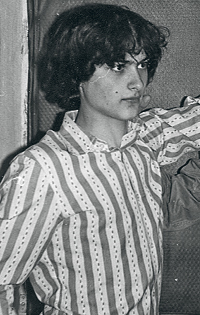 |
| The Surkov school was handsome and poet |
As Surkov’s classmates recall, “Slavka was considered a handsome man, fans were constantly chasing him.” He was fond of music, listened to Pink Floyd and Deep Purple, tried to look good and fashionable, wore velvet jeans, wrote a lot of poems and stories. According to the memoirs of the literature teacher, Vera Petrovna Rozhko, held restrained, and looked older than others. However, his company of three guys is now remembered as “funny hooligan shalopays”. He was ironic, loved to joke. The man who created the movement “ours” in his youth with humor treated the Komsomol meetings and once for this, according to the complaint of the Komsomol, was called to the director. He wrote excellent works: they were read out in the teacher's. I read almost all of Dostoevsky: “Probably, he was attracted by the fact that Dostoevsky had all the heroes with a tear, completely opposite to him,” says Vera Petrovna. She still holds at her house in a blue daddy a dilapidated branch with the works of Surkov, which she treats almost with religious trepidation, is reluctant to show, without letting go of her hands, and does not allow photography: “only with its permission”. A tall, dense handwriting, a neat letter, in some places the irony skip: “Mayakovsky wrote:“ And life is good and live well, ”though he, despite this, shot himself.” Or here in the essay about Yesenin: “Yesenin writes that he is not sorry in the past, but it is clear that something in life does not satisfy him. Maybe it was necessary to be more conceived in life, more precisely to decide? " - With youthful ease, the future author of the "perone" judges: the course and the presence of thoughts, as they say, is evident. “Quasiroman, doll, scarecrow. Fiction ” - is written in the preceding text to the second edition of the“ PDONOL ”.
 |
| Natalia Eganova - school friend Vladislav Surkova |
First love
At school No. 1, Surkov, as they said then, “walked” with the girl Natalya Eganova, who studied for a class younger than him. Skopin is a small city, everyone knew about these relations. “It was beautiful love,” recalls Ekaterina Tikhonova, who was pioneer inhibited in those years. Now Natalya is of the surname of Roman, works as an editor on local television, and her father - the mayor of the city in the second time. It is reluctant to speak about the former boyfriend, but clearly makes it clear: there is something to tell. “His life was completely difficult, I am glad that he was knocked out, although I do not really share the situation in the country.”
Music was connected by music: Natalya played on a frustrated piano and sang “There is a black pond in the count of Count Park // Lilia bloom there”, the future Kremlin ideologist sang along, wrote poetry and beautiful letters. “We went to cinemas and evenings. The whole city admired us, ”recalls Roman.
As soon as Surkov graduated from high school (on five, only three fours: for labor, physical education and drawing) - they parted. He went to conquer Moscow, to enter the Institute of Steel and Always. In Skopin, Surkov remained only the sister of her mother Nadezhda and her husband Mikhail Yashkin, a former military man. They live in a modest wooden hut and noticeably nervous, talking with correspondents. They are worried about how not to damage the career of the nephew. Relatives are proud of them: "We see him on TV - he matured very much, looks solid, he achieved everything himself." On the table of the Yashkins lies the book “Vladislav Surkov. Texts 97–07. " This book in Skopin is appreciated. The city has a political club "Landmark", a book of Surkov - and there is one of the cult objects. The club’s meeting takes place once a month, various socio-political issues are discussed at these meetings. The cherished dream of the club is to call Vladislav Surkov to one of these meetings.
Universities
In 1981, Vladislav Surkov entered MISIS at the Faculty of Black Metals and Alage. His fellow students recall that during the summer vacation he went to relatives in Chechnya. He studied the metallurgist in the metallurgist. According to one of the fellow students, Surkov flew out, because not a techie, quite often skipped classes and in general there was a hippie. On June 2, 1983, he submitted an application for expulsion of his own free will "in connection with difficult family circumstances." In the statement he indicated that mother and sister are dependent, since the father does not live with them. The order on the expulsion was signed, and Surkov went to serve in the Soviet army. After 20 years, he will write in the song for the Agatha Christie group: "I will be how you // you will be how he // We will be like everyone else." According to the official biography of the first deputy head of the presidential administration, he gave the duty to his homeland in the artillery part of the southern group of troops based in Hungary. True, in 2006, the then Minister of Defense Sergei Ivanov told the Vesti program that Surkov actually served as urgent in the GRU special forces. Vladislav Yuryevich himself did not confirm this and did not refute. Although he could: The New Times sent an official request for an interview, but still did not receive an answer.
Having demobilized, our hero in 1986 entered the Moscow Institute of Culture (“Kulek”) at the directing and acting faculty. But after the first year he was expelled. Both his fellow students and his teachers refuse to talk about this page in the life of Surkov. The official version: left the institute for "family circumstances." Unofficial - expelled for a fight in a hostel. “Glory returned from the army, and, apparently, this laid out an imprint on him,” one of the graduates of the Moscow Institute of Culture told The New Times. - The guy he beaten was an enemy of the army service, and they brutally argued. It ended in a fight, called the police. One of the teachers went to the dean’s office: such a case was extraordinary for the faculty, and they expelled fame. ”
As one of his classmates recalls, Surkov was a very contradictory person: he was fond of counter -culture, loved abstraction, Kandinsky, but claimed that everyone should have the same sausage and live with a common fate. At the same time, the acting role was more likely heroic. The desire to provide fellow citizens with the same sausage from Vladislav Surkov over the years only strengthened, however, and he occasionally induced with counterator. “Time is gloomy, the holidays, peace and peace ended. // these black horsemen are breaking through the door. This is behind me, ”the Agatha Christie sings a song on the words of the former student“ Kulka ”. Surkov did not enter the institutes anymore. And in the late 90s, unexpectedly became the owner of the diploma of the International University in Moscow: “Bought for solidity,” one of the former Yukos employees told The New Times.
Dashing 90s
It is not known how the fate of Surkov would have developed, if in the late 80s he, together with the former classmate, Alexander Kosyanenko, did not engage in hand-to-hand combat at the coach Tadeusz Kasyanov, who was also engaged in Mikhail Khodorkovsky. “Glory appeared with us in 1989. At that moment, we felt that the guards were needed, and Tadeusz recommended these two guys Khodorkovsky, ”recalls Leonid Nevzlin, in the early 90s-one of the directors of Bank Menatep. “The guys were sensible, and the guard was not so needed, and Khodorkovsky took up the cultivation of talents.”
Nevzlin recalls that at that time Surkov was "a shy intelligent guy who was embarrassed and blushed." “His abilities in the field of advertising and general creativity were quickly revealed,” Nevzlin continues. - He not only invented ideas, but also knew how to push them. He broke the advertisement of the bank logo at the Time program on Channel One. Before us there was a logo of the Italian company Olivetti. He knew how to convince of his innocence. Roads on the roads, painted trolleybuses with logo, articles in newspapers, interviews of top managers are all his activities. ”
In less than ten years, Surkov has grown to the post of vice-president, head of the Department of Relations with state organizations of Rosprom CJSC * * One of the structures of Menatep. And he became a member of the Board of Directors of Bank Menatep.
Menatepovtsy also recall Surkov’s weaknesses: he could go to the foul to loss of feelings, did not know the measure, had to pull him out of the police, from the hospital, fought with his colleagues, and was hot -tempered to cruelty.
In 1996, Surkov left Menatep: he was no longer satisfied with the position of just a hired manager, his goal was to become a partner and get a share of shares. But Menatepers did not want to accept it. “We discussed this in our narrow circle and did not want this,” Nevzlin explains. - We trusted him, he knew a lot, participated in the most sensitive projects. But partnership is the next level of trust, it is like close friendship. And he was not a friend. " However, Nevzlin is sure: Surkov is not offended. “In business, he could become the second or third partner, but what he achieved today is much higher. The political manager of all Rus' is the title. ”
On the way to the Kremlin
From one bank, Surkov moved to another-to Alfa-Bank: with its head and founder Mikhail Friedman, they studied together at the Institute of Steel and Always, although at different faculties. In the late 90s, Surkov was considered one of the most effective Russian lobbyists. This reputation ensured him not only the position of First Deputy Chairman of the Council of Alfa-Bank, but also soon-the place of the first deputy general director and director of public relations ORT (now Channel One). “There Surkov met all the important players of the political field,” recalls one of the people who have known him since 1992. “At first, Surkov in this“ troupe ”, where Berezovsky, Voloshin, Abramovich, Yumashev were nobody, but gradually his abilities began to value.” Boris Berezovsky, the owner of the largest package of ORT shares in the late 90s, told The New Times that Surkov was “a good, even excellent performer, worked for us with Badri * * Badri Patarkatsishvili, a business partner of Berezovsky. In the ORT and on me in the CIS ” * * in 1998-1999. Boris Berezovsky was the Executive Secretary of the CIS. .
And already in 1999, Vladislav Surkov was in the presidential administration. He was called to the position of his assistant by the head of the administration, Alexander Voloshin. “He then differed from everyone else with an extremely non -grinding look, was more like a designer than an official,” says political scientist Gleb Pavlovsky. - He has many bright qualities. He always determined the idea and concept of the work itself, he himself invented elegant solutions. ” One of the PR managers, who knew Surkov well in the late 90s, said that he “did not understand what it was to agree, and brought to politics the methods that he successfully used in business. There were two of these methods, both simple and effective: either a person needs to be broken or bought. Immediately money in the envelope - and that’s it. ”
Dreams come true
In August 1999, Vladislav Surkov became deputy head of the presidential administration. At the same time, Vladimir Putin also took off the political Olympus. How so, so successful for both and a little less successful for the country, coincided? Boris Berezovsky claims that “he did not play any role in the promotion of Surkov in the Kremlin: as far as I know, Alpha lobbied him. 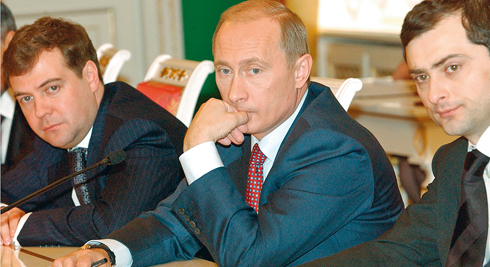
Vladislav Surkov is always loyal to his bosses, although, as they say, he considers himself smarter and better than them.
Photo of 2005
In any case, from this moment, the transformation of the Surkov began into the one who he is now - the main Kremlin ideological manipulator. “Glory, as they say, takes the shape of a vessel,” says Boris Nemtsov. - He was a democrat with Yeltsin, and with Putin he became an autocrat. He has his own system that reflects the point of view of the authorities. ”
Almost everyone who came into contact with him in business and politics and still depend on the new Surkovo and still depend on him. They don’t want to quarrel: they note that he is vindictive and hard, God forbid to become his enemy. If someone once offended him in something, he can hardly annoy a person.
He talks differently with different people. He can scream and swear at someone, changes intonation. It will speak softly with someone, envelop, calmly and with a smile, as if with a lazy one. They say that he can order an article about some oppositionist to the journalist, but if the name refuses to write too “dirty”, he will agree to a more civilian option, if only the publication appeared. Others argue that in the methods it is not shy. Boris Nemtsov, for example, is sure that his arrest for 10 days on December 31, 2010 and all subsequent provocations against him were authorized by Surkov. “Rallies of the 31st, provocations-on these issues, Moscow police generals obey Surkov. I do not think that he gave the team to plant a tuberculosis patient to me, but the fact that my cellmates were offered $ 3 thousand for telling me allegedly raped, he gave “good,” said Boris Nemtsov The New Times.
Both opponents and supporters of Surkov, who knew him in the 90s or encountered him in the 2000s, converge in one: he is very inventive in intrigues, is truly creative in this.
Wealth or power?
According to the official tax return, Vladislav Surkov earned 6 million 325 thousand 286 rubles in 2009. He does not own residential real estate. Land too. Behind it is one apartment - 59.4 square meters. m. Kremlin Feng Shui. The office of Vladislav Surkov through the eyes of political scientists and specialists in Feng Shui
People who knew Surkova well in the 90s told The New Times that he already flaunted with gold credit cards, which at that time was rare. However, there is no Surkov bank accounts in the official declaration.
But there is information about the income of his current wife Natalia Dubovitskaya. In 2010, she earned 56.4 million rubles * * * Natalya Dubovitskaya - Deputy General Director for Public Relations of OJSC “Group of Industrial Enterprises of the RCP”. The group is engaged in the starch business. . It is known that in 2006, Dubovitskaya belonged to 18.47% of Ibredredchekhmalpatok OJSC, which is engaged in the release of patho and starch, as well as 16.1% of the Garant OJSC. In her free time from business, she gave birth to Vladislav Yuryevich three children. Surkov also brings up the son of his first wife, Julia Vishnevskaya, the creator of the museum of unique dolls, who has been living in London since 2004.
“Surkov is different from corrupt officials: he does not try to fill his pockets,” says Boris Nemtsov. “Money is important for Surkov,” objects political scientist Stanislav Belkovsky, “and he is also“ brought ”. He works with those people for whom money is the main value. The rest of the people confuse him or annoy him. His main human tragedy is that by the standards of the system he is poor. Abramovich and Timchenko are much richer than him. "
Reference group
Knowing Surkov, people note that he has his own code of honor. Relatively speaking: family, children, friends who you, having risen upstairs, must help. It is said that in September 2009, the twins Mikhail Khodorkovsky Ilya and Gleb refused to accept in one of the schools of Moscow. They called Surkov and he attached boys to a good school. How does this completely understandable act combine with a letter against the Khodorkovsky members of United Russia (which is precisely Vladislav Surkov’s supervisors at seminars) or Nemtsov’s arrest for ten days on New Year's Eve?
“Surkov wants to seem to be a decent person for himself,” says one major businessman on the terms of anonymity. “He has a reference group, and he wants her not to consider him bad.” True, he added: "But with Nemtsov he crossed the line."
The head of the Euroset Evgeny Chichvarkin considers Surkov a brilliant person. In Moscow business circles, hearing stubbornly walks that it was Surkov who stopped the “hunt” at Chichvarkin. The jury acquitted Euroset employees, and the Supreme Court approved this sentence. The case against Chichvarkin was closed. “In intelligence, he surpasses everyone I have ever seen from those who consists of a civil service,” said the former owner of the Euroset The New Times. -When someone told me that one of the branches of power was unhappy with him and it may turn out that he would leave, I was upset. Surkov is a navigator, a leveling plane that flies through a thunderstorm on a mountain. He does everything so that this plane does not fall. ”
Surkov, however, does not always "align subtly and neatly." Art critic Andrei Erofeev * * was sentenced to a fine of 150 thousand rubles for organizing the exhibition "Forbidden Art" in the Sakharov Center. He said: his brother, writer Victor Erofeev and Galerist Marat Gelman with a difference of one hour, without saying a word, went to Surkov to ask for a criminal case of the exhibition, as absolutely absurd and damaging the country's image, was closed. “Surkov listened to them carefully, said that he knew nothing about this story, looked at the pictures and promised to help. The matter was not closed, and instead of one prosecutor, there were two of them at the trial. ”
Stranger
Recently, the first deputy head of the administration began to appear more in public. He goes to exhibitions at the Garage Fashion Gallery, to the Club "Color of the Night", where a fashionable and rich party gathers. He published two art history speakers in the Russian Pioneer magazine. The first is about the Spanish artist churrealist Hoana Miro, the book of which accidentally came across Surkov-School in the Skopinsky library. The second is about the fashionable Russian artist Nikolai Polis. “To be misunderstood is a tragedy for the artist,” writes the first deputy head of the presidential administration. - To be understood - simple human happiness. Being understood is incorrect - the privilege of genius. ”
The drama of Surkov, knowledgeable people believe in the fact that he is ambitious and ambitious, imagines himself smarter, better than many, including his bosses, but always on the second roles. “Putin understands that Surkov is capable of a lot, and therefore always puts a person less creative, but more loyal over him. So that there is no temptation to start an independent game. Moreover, the Surkov is "alien." Not from the Lake Cooperative, ”says political scientist Dmitry Oreshkin * * Daching Cooperative in the Priozersky district of the Leningrad region, where Putin was located in 1996 and his closest friends lived there, who made his career: Vladimir Yakunin, Yuri Kovalchuk, Andrei Fursenko and others.
“I noticed that it is very difficult for him to love those people to whom he obeys,” says Nevzlin. “But he somehow learned to cope with himself.” “Surkov is a performer,” the source of The New Times, who knew Surkov’s business, is convinced. “He will always work for the owner.” “Crucified schmuck. When he does not fulfill, but tries to steer - Berezovsky is extremely harsh and contemptuous. “Therefore, it is not interesting.”
His novel, and now the performance, which is played on the first stage of the country, Vladislav Surkov called "Plonol": how to read - "near Zero", in the sense of Nole - is this about the country? About the people who are spinning, whom he breaks and buys? About the bosses? Or about myself: “I'm not zero”?
On December 27, 2011, Vladislav Surkov was appointed deputy chairman of the government - head of the government apparatus. After a year and a half, on May 8, 2013, President Vladimir Putin signed a decree on the resignation of Surkov from the post of Deputy Prime Minister of his own free will.
Egor Mostovshchikov took part in the preparation of the material