
Translated material
We wear particles of war
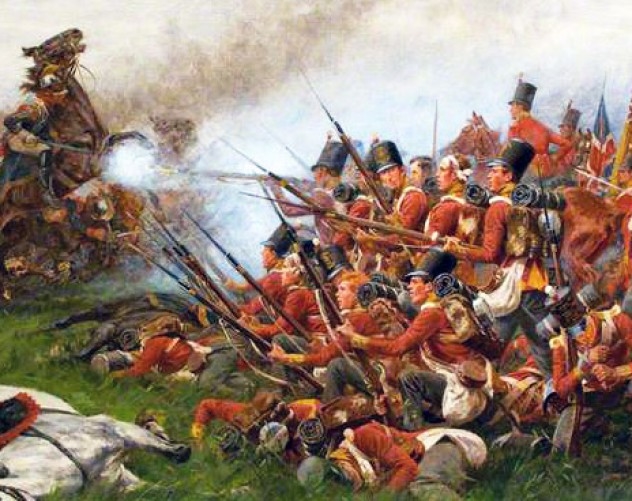
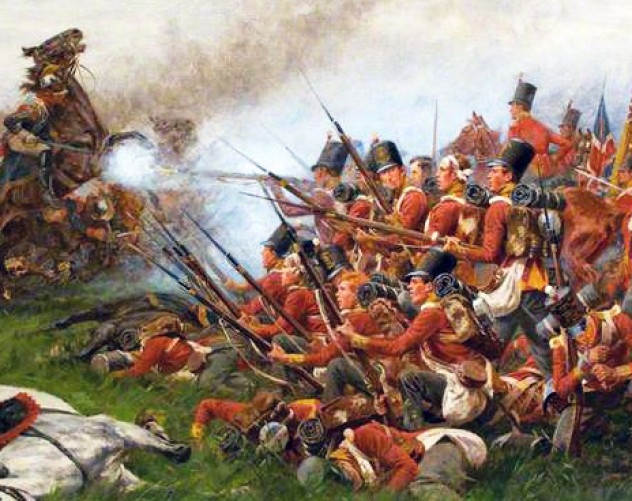
William Barnes Wallen. 28th regiment at Waterloo
All mine! - said Zlato. All mine! - said Bulat ...
I’ll buy everything - Zlato said. I'll take everything! - said Bulat.
A.S. Pushkin
Not only trenches of the past great war are already overgrown, but, to shame, and monuments in honor of those who died in this grand meat grinder. Time takes his own. And only the atoms of metals, which made up the weapons of the warring parties, continue their endless movement, again killing the great-grandchildren of those who once pressed the trigger. A person, having liberated the forces of nature, does not always understand what he did. Meeting with metal
For quite some time, our ancestors, dealing with a beast or an enemy, relied only on the strength of their fists. Then there appeared clubs, stone axes and flint tips. But this was not a fundamental change in the environment: the chemical properties of the material did not change from the fact that a small flint petal (this is silicon oxide - SIO2) . Later, in Anatolia (present -day Turkey), around the 7th century BC, people began to process nuggets of copper. Everything changed when at some point people found that the metal could become liquid in the flame, and before that it was very soft and dent. This discovery led to the emergence of the first metallurgy, the era of the copper age. Then the man received a metal from non -metall. Bronze - the alloy of copper and tin, most likely, was open by accident. She gave tools and labor and wars, was able to ensure the heyday of ancient Mediterranean cultures, such as Minoisky. Copper and tin became the first strategic metals 4000 years ago. However, tin is not so common, and after several hundred years it was in a shortage, which was only covered with the emergence of iron melting technology in Asia Minor. By this time, people knew both gold and silver and met mercury, which is easily smelted from Kinovari (HGS), which has served in red in the Middle East in red paint . The ancient metallurgists were the first to encounter the benefit that the use of mercury gives when receiving gold from the breed - the mercury dissolves gold dust in itself, then the obtained amalgam can be heated, the mercury will evaporate, and the gold will remain in the form of an ingot. But they were the first to encounter the toxicity of mercury and its compounds. Toxic, but necessary
True, for centuries there were no special environmental problems associated with metals. The weapon was iron and regularly rusted without bringing special troubles. And the method of extraction of gold and silver using mercury was reliably forgotten. But together with the advent of firearms, another heavy and poisonous metal came out to the forefront of military technology, which people literally began to throw right and left, lead .Lead is also known from antiquity, it is a fuscling, almost like a tin, water pipes, roofs and even dishes were made from it. But in the weapon affair, the main advantage of lead was its density - 1 liter of lead weighs 11 kilograms. For comparison: iron - only 7.8 kilograms. And iron melts at 1,500 degrees, and lead at 327. That is, it is the perfect material for the manufacture of bullets: they are easy to pour, and the mass provides high penetration.
Gradually, gunsmiths found that it is possible to increase the efficiency of bullets even more - it is enough to add antimony or arsenic to lead to the lead, and the bullet becomes more firm. At the same time, the renaissance for copper and tin came - the guns began to be made of bronze. In addition to bronze, brass was widely produced - an alloy of copper and zinc , which was used in the fleet. With the advent of artillery and gun shells in the 19th century, a new application was found for a brass. At the end of the 19th century, man managed to achieve a real breakthrough in metallurgy. It turned out that nickel additives increase the strength of the steel sheet. Another metal, molybdenum, also increases steel strength, making it more viscous. Molybdenum steel went to the manufacture of trunks of guns, rifles, important parts of military equipment. The company was also made up of Nickel and Molibden. The twentieth century also changed the design of the projectile. It was found that the tungsten, the most refractory of metals, is 19 kg/l as a density of 19 kg/l, is perfect for cores of armor -piercing shells.True, along the way it turned out that these beneficial metals have its negative sides: molybdenum dust acts irritating to the lungs, nickel and chromium compounds are generally poisonous. But few people thought about it - to arm their native army at all costs was much more important.
But old acquaintances made the most terrible career - mercury and lead. It was they who became the basis for the so -called initiating explosives. First, an explosive mercury appeared, which quickly registered in capsules and detonators. Then, at the end of the Second World War, the company was compiled by the Azid of lead. These small items (capsules and detonators) contain only 10 - 20 milligrams of mercury or lead compounds. But in the world, billions of ammunition are produced every year, which, when used, throw into the atmosphere one and a half to two thousand tons of this poison, which is equivalent to a hundred million toxic doses of these substances. During the Second World War, only only one cartridge plants in the USSR produced up to 7.4 billion rounds a year . The plants of Germany and its satellites, as well as the production capacities of the allies (USA, Canada, Britain), were equally active. These shot cartridges left their mark on the battlefields from the Atlantic to the Volga. Metals and politics
Even Peter I discovered that metals are of great political significance when he lost guns in an unsuccessful business near Narva. There was nowhere to take bronze, and he, as you know, began to remove church bells, which was found without joy the public.
The problem of strategic metals stood before Hitler after he, having come to power, began to revive the German armed forces and prepare for the Rarefish war. For example, he really needed Nickel. Nickel could supply Finland from her mines to Petsamo. Finland, although she did not obey the German command, was still an ally. The second source was in Northern Greece, which was simply occupied.
But the main prize was, of course, Spain. It is here that the greatest mercury deposit of Almaden, which is being developed for almost 500 years. In the 30s, Spain accounted for half of the entire world prey of mercury. In total, up to 700 thousand tons of silver metal, from this deposit, is obtained from this deposit. Before World War II, prey reached 9,500 tons of mercury per year. In addition, Spain is the world's largest supplier tin, copper, lead, tungsten - all strategic military metals.There is no doubt that Hitler supported the rebellion of General Franco not so much in ideological as for economic reasons - he received a grand treasury of metals. It can be assumed that if Hitler had not had this strategic reserve, then Germany could not withstand a couple of years of active hostilities.
This eternal mercury
Thousands of tons of mercury shot at the Second World War, of course, have not gone anywhere. They settled with precipitation and slowly migrate with water flows to the seas and lakes, simultaneously embedded in various food chains. For example, only about four thousand tons of copper, three thousand tons of lead and 33 tons of mercury , only in the Baltic, get into the Baltic. This is too much for 21 thousand cubo -kilometers of the Baltic Sea. After all, this happens every year. Here they remember the scandalous story of 1981 with eels, which were prohibited for sale in Hamburg. These acne caught in the Elba River carried mercury in an amount, 1000 times higher than the permissible norm for human nutrition . But the most dangerous story is the “Minamat disease”, by the name of the Japanese bay. In 1953, more than one hundred inhabitants of coastal villages, strange diseases began: joint pain, impaired memory, hearing and vision. Mercury was thrown into the sea at a nearby factory, it entered the food chain and turned into an even more poisonous methyl. It turned out that the chemical was most strongly acted on the children. It was after a whole series of trials associated with this Japanese bay that a careful study of poisoning by the compounds of mercury , which continues to this day, began.The danger of poisoning with mercury is also associated with the fact that at the initial stage poisoning is not manifested in any way. One of the most common symptoms is the "chronic fatigue syndrome." A person continues to live, as a vein, there are oysters, lobsters, tuna, sword-fish (this is the most greedy to mercury by sea organisms) -and poisoned, since mercury accumulates just on the top of food pyramids.
A similar situation with lead. After all, each bullet is the very notorious “nine grams” that develop in tens of thousands of tons of scattered lead per year. It is no coincidence that the military began to think about this problem, planning a transition to steel bullets . New misfortune
In the post -war years, a new candidate for the title of metal poison No. 1 appeared - impoverished uranium. This is a by -product when receiving enriched uranium, which is going on for the production of atomic bombs. The impoverished uranium is not radioactive - it is just poisonous. It has a density of 19 kg/l, differing little from the tungsten, and in addition has the property of pyrophoricity - that is, when its dust is impact, it is ignited in itself. This is a wonderful material for armor -piercing shells. In addition, it is cheap - after all, it is, in fact, waste.
Now there are fears that it was the use of shells with armor -piercing cores from the depleted uranium that caused diseases of the soldiers of NATO countries during operations in Iraq and Yugoslavia, and officials are rejected from these assumptions.So the modern war, which the nations are preparing, having been preparing all the environmental norms, begins to kill people even before their first shot , including their own, in factories and factories, in mines and laboratories, so that later, when the rumble of cannonade subsides, to sow death with their sprayed fragments.
And we have not yet talked about military toxic substances, bacteriological and nuclear weapons, and only casually affected the issue of war for the sake of raw materials for warfare. If we consider everything in the complex - humanity has become a hostage to its own weapon, on which a crazy amount of strength, lives and “gold” is spent. So, maybe it's time to stop the power of the Bulat?