
Translated material
Miracles of energy conservation: for the "Hour of the Earth-2013" Moscow saved 26 thousand rubles
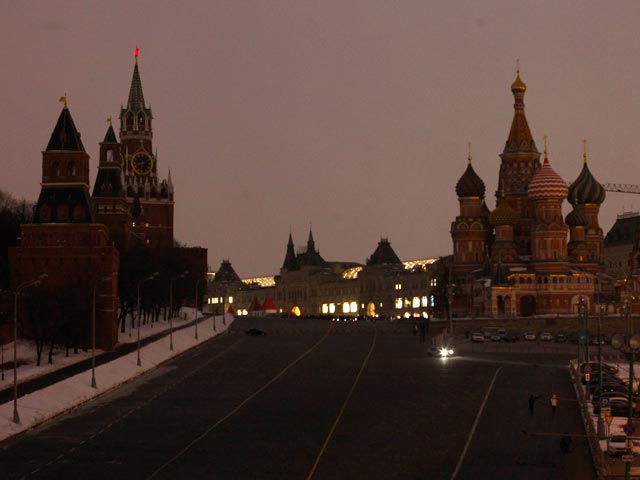
During the campaign "Earth 2013" Moscow saved 26 thousand rubles. However, as RBC Daily writes in the Department of Fuel and Energy Economy of Moscow is proud of such a modest figure. After all, if in the architectural and artistic backlight of 90 buildings, which was disconnected during the World Environmental Promotion for one hour, ordinary lamps, not LEDs were used, the savings would be ten times more.
In other words, according to the head of this department, Pavel Livinsky, today these 90 buildings in Moscow cost not 260 thousand rubles per hour, but ten times less.
Recall that the action "Hour of the Earth 2013", organized at the initiative of the wildlife Fund, took place on March 23 to 7 thousand cities of different countries, whose authorities at 20:30 local time turned off the light on buildings that are local attractions and even symbols of certain states. In Moscow, the Kremlin and the White House first took part in the promotion.
It is a pity that so far it is so good to save budget funds only pointwise, the publication complains. During the March press conference of the same Lyvinsky, dedicated to the results of 2012 and the plans for this year, it became known that up to half a million rubles were spent on the coverage of one Moscow court. Huge amounts also “eat” lanterns on the streets and along the highways.
According to the International Energy Agency (IEA), today 19% of all electricity consumed in the world is spent on lighting. Modern light (primarily LED) technologies give up to 40% savings.
According to experts of the IEA, on a global scale it is equivalent to 106 billion euros per year. The advantages of the use of LEDs are obvious from the point of view of ecology: 555 million tons are reduced annually by emissions into the atmosphere of carbon dioxide, 2 TWT electricity and 1.5 billion barrels of oil are saved.
LED lamps allow you to reduce energy consumption more than three times and have no equal in durability: with continuous use, they serve from 10 to 15 years, when working only in the dark - up to 25 years.
In Moscow, the transition to new street lighting devices begins with the replacement of ordinary lamps in street lamps with LED lamps. In addition to the already mentioned project to illuminate buildings, Moscow gradually illuminates the Moscow Ring Road. Now the LEDs are testing on the garden ring.
One large Russian company producing LEDs, on its website, paints the economy of the issue in detail. For example, 1 km of a typical class A road road was taken, on which 33 lamps with conventional lamps with LED lamps are replaced. It can be seen from the calculations that the payback of LED lamps is three years, and over five years, the return on investment reaches 15.87% per annum, which is higher than the rate of any banking deposit.
The main problem is the conservatism of economic thinking. Saving in Russian is based on the principle of "here and now", it is not customary to think about the payback of technology in the long run. However, every year both LED lamps and intellectual street lighting management systems become more and more affordable, and this inspires certain hopes.