
Translated material
Non -Orthodox fairy tale
About the last film by Alexei Balabanov
Alexey Balabanov created the myth of his last film. The director stated that the painting “I also want”, whose premiere took place at the Venice festival and which was released on December 13, 2012 - his last work. On May 18, 2013, Alexei Balabanov died in the village of Solnechnaya Leningrad Region.
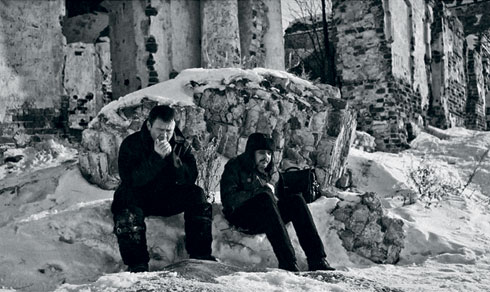
The heroes of the picture go to the bell tower of happiness through the closed zone, where after the disaster at the nuclear power station there was an eternal winter
Balabanov is a labor director. For fifteen years, having completed one film, he immediately began another. His name is perhaps the most loud in modern Russian cinema, not disputes always arise around his paintings, but fights. And suddenly such a statement. The version “He will most likely not be removed anymore” was supported by his son Peter, who played in “I also want” a small, but sign role, which the father-director not in vain entrusted to his son (to be precise, one of his two sons). Involuntarily, you think: Balabanov wanted to say that he was ready to transfer the earthly to his son and, perhaps, a creative baton.
One of the reasons is the disease. Balabanov almost does not communicate with the press, but nevertheless, the fact that the doctors had sentenced him a deadly sentence. True, he himself then said that his strong Siberian health helped to cope with the disease, but he still thinks that he would die - his health is not right. Another reason those who sees it more or less often are seen in psychological fatigue: over the past two or three years, it has changed a lot. He clearly wants to summarize his life results. He summarizes these results in a documentary, which is the film and documentary Lyubov Arcus about him. In a small episode posted on the Internet, Balabanov sits reviews on TV his first full -length, which immediately became known to the 1991 film “Happy Days” and briefly comments on what is happening. The essence of the comment is a film about itself, and in general all its ribbons - about himself.
"
Despite the accusations of immorality and misanthropy, which regularly put forward against Balabanov, all his films have an element of parables. And actually he is a fair moralist
"
And here it is impossible not to notice that in the picture “I also want”, Balabanov speaks about himself completely frankly. Moreover, he appears on the screen in the role of himself. This is directly a demonstrative summing up. The producer of the film Sergei Selianov said that “I also want” is the brightest, deeper and spiritual picture of Balabanov. Yeah, the bright, given that the heroes are confident at the end of the world that the Internet trumpets and which will come, if anyone does not know, eight days after the release of “I also want” to domestic rental.
In the zone for happiness
“I also want” - the picture is so simple and clear that, perhaps, it does not allow unexpected interpretations. After the film, it becomes, by the way, it is clear that, despite the accusations of immorality and misanthropy, which regularly put forward against Balabanov, there is an element of parables in all his films. That actually Balabanov is a fair moralist. And “I also want” - it’s already a parable. Without any impurities.
In it, the Killer brother (in the company’s company, shooting four people) in his black jeep with 001 numbers (a real jeep with real numbers belongs to the performer of the role of Alexander Mosin, to the actually steep man, whom Balabanov shoots in the fourth film) goes in search of happiness. In the company of a half-drunken musician played by Oleg Garkusha, famous in the rock and Andergunes of the 80s, whom they crime crime from the hospital for alcoholics (pistol on the head of the orderly and guard), and his semi-living old-father-father. At some point, they are joined by a random desperate prostitute and a young Prophet, who was promoted on TV: the son of Balabanov, which is symbolic-is symbolic-true knowledge about our world and his future is accessible only to children.
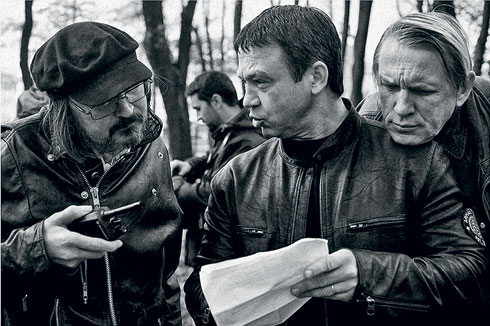
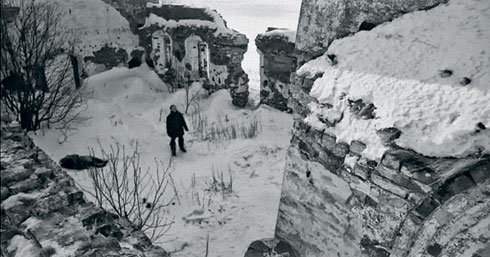
The path to happiness is the bell tower in the closed zone “between Peter and Uglich” (as stated in the film), where eternal winter came after the disaster at the nuclear station. There are rumors that someone is accepted there (in a world of happiness), but someone is not. At the entrance to the zone, immediately behind the barrier, which the soldiers guard, late spring (during which the film begins) and really moves in the winter. The soldiers say that the Patriarch (!) Ordered to let everyone into the zone, but they warn that no one was returning from it. Then begins a journey through abandoned snow -covered places, dotted corpses, clearly addressing to the zone
From the Stalker Tarkovsky (which is part of the top ten Balabanov’s favorite paintings, according to the survey conducted in 2002 by the British film magazine Sight & Sound). By the way,
In Stalker, which is very different from the first-and-first novel “Picnic on the side of the Brothers Strugatsky, they also searched for a room where dreams are made.
As a result, the bell tower accepts the world of happiness (do not scold for issuing secrets: if you go to watch a movie, it will not hurt you, but otherwise you can’t understand what Balabanov is today and whether his film is the last) musician, a prostitute and a young man. For various reasons, an alcoholic and his father are along the way. He does not accept the bell tower of the bandit, as well as the person met at her foot, whom Balabanov himself depicts. The person seems to be: “I am a director. Member of the European Film Academy. " The bandit and the director eventually die.
For life and death
Balabanov is also unique in that his whole life, his thoughts and ideology is a continuous myth. He is a minimum man. He ignores the rules of good tone: even at foreign festivals dresses like a miter-bomb. The PR's creative people are needed today. And when he still pronounces some words publicly, they often sharply contradict his work.
He talked about the fact that he traveled with his wife a number of provincial churches and was married to her. Orthodox, however! But in his "Zhmurki" the bloody killer is baptized, taking off his sins, with any form of domes, which is actually a satire. And in the film “I also want” (here we must finally clarify what is meant: I want happiness, I want life) The question of the fact that a character about the bell tower of happiness was told by a certain Father Philip, and the Patriarch approved the entrance to the closed zone, where the bell tower was approved. But the story itself is not at all Orthodox, and even more so is not canonical. This is really heresy. Or rather, a fairy tale.
He often spoke so that he could be considered an ultra -nationalist: he recently said that Kumarin was in vain in St. Petersburg, because after that Chechen and Dagestan diasporas began to host the city. But in most of his films, it is Russian bandits that are the main villains.
He assures in an interview that he is respecting serious peasants who, in Afghanistan Lee, in gangster showdown, put a bunch of people. And that is why he took off to “I also want” (and not for the first time) real (not actors) Alexander Mosin and Yuri Matveev. But at the same time, it is the Bratan, along with the director, does not fall into his new film in paradise of happiness.
He says that he shot the last film, but recently shared his intentions, including those involving shooting far from Russia - in Africa, for example.
PS The detail, which was especially surprising after watching the film, in which it is clear that everything was invented and all the legends about the bell tower of happiness are an unjust fairy tale. In the final credits, gratitude to Father Philip is expressed. This is what the priest who told him about the bell tower calls him the main hero-Banditus. New strangeness. New myth.
Photos: kinopoisk.ru