
Translated material
"Theater is the last place where there is no ideology"
Luke Perseval - about time and about himself
The performance based on the novel by Hans Fallas “Everyone Dies alone” in the production of Luke Perseval was the event of the Berlin festival Theatertreffen (“Theater meetings”). The New Times asked the famous director that today is modern on stage
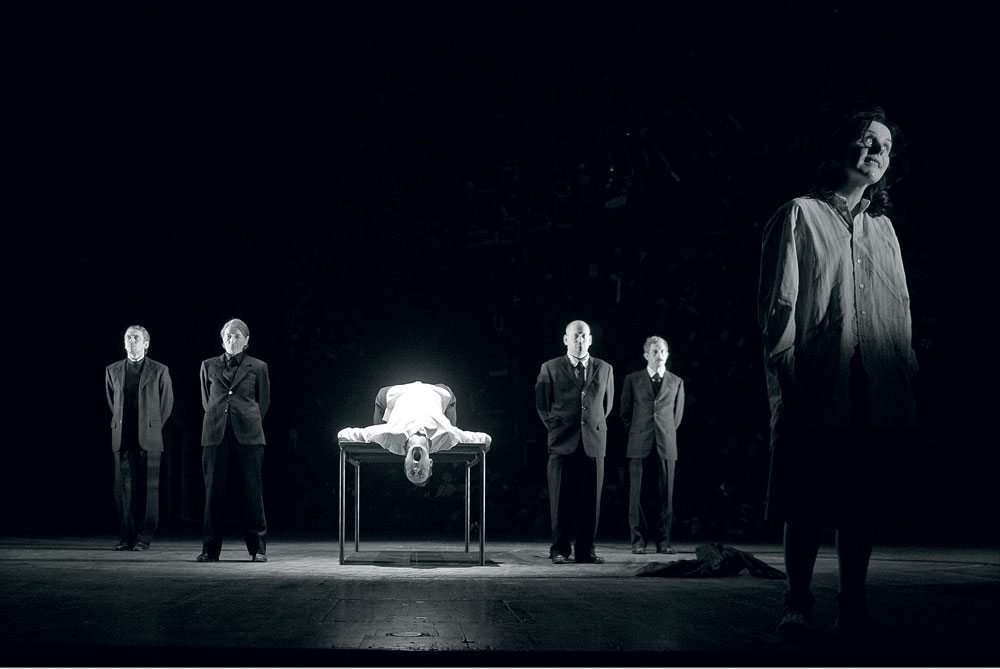
"Everyone dies alone" in the production of Luke Perseval
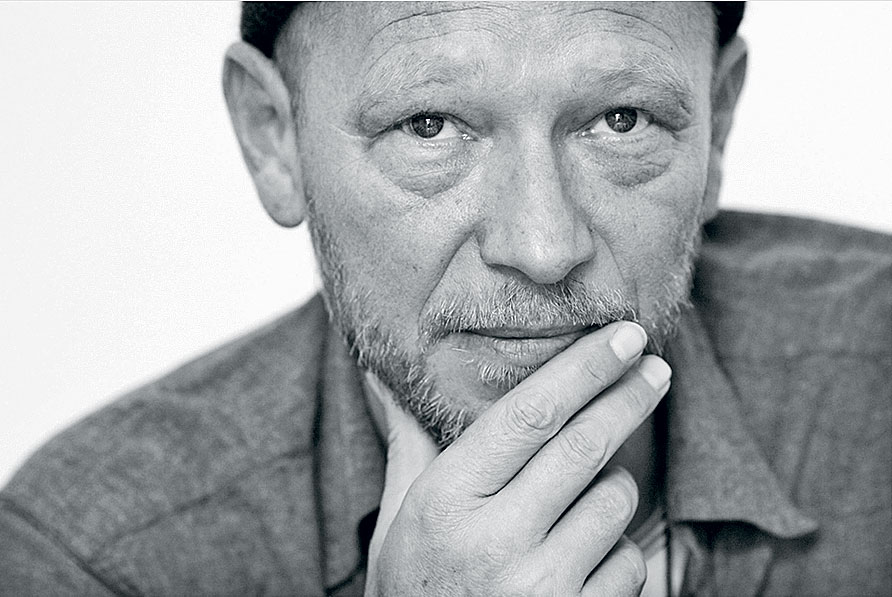 |
| Luke Perseval is one of the most famous theater directors in Europe. Belgian by birth, for the past ten years he has been working in Hamburg in Thalia Theater. In Moscow, as part of the Stanislavsky season in October last year, he with great success showed his productions of Othello and Cherry Orchard |
The topic of individual resistance to the political system, raised in your performance, is very relevant in Russia. I think if he was shown in Moscow, he would cause a storm of emotions and comments. But for Germany and for Europe as a whole, this topic, in my opinion, is not so topical.
But in my opinion, on the contrary. Why do you think the totalitarian system in Germany was indestructible and disappeared only because it was destroyed from the outside? Because totalitarianism is based on fear, and it is very difficult to overcome, and it is on it that today's society stands: people are afraid to be unnecessary, unclaimed, marginal, and strangers. Now, of course, everything is not so bloody, but the essence has remained the same. It is scary to be outside the system - without work, earnings, sensations of need. For this, they go to countless compromises. And in this regard, life in Europe has become even more severe than in my youth.
When I was young, I wanted to make a revolution along with my like -minded people, we rebelled against all the norms accepted - in society, in the theater. What is the young people doing now? Rebeling? But she is supposed to rebel, otherwise there will be no movement in art. But the situation in cultural life is now such that any actor reads the role in some idiotic series and get a fee for happiness. That's the whole rebellion (laughs).
As for the topic of the Third Reich, I, as a Belgian, see how seriously the Germans work with their history. They accused the whole generation of a crime, practically declared millions of their fellow citizens by criminals - in one way or another. And the book of Hans Fallas shows that they are both criminals and victims. These are people who are in many years of fainting. They do not know what to do: resist - you will die, do not resist - you will also die in a certain sense.
Koshmar compromise
Do you have an image of a fighter, the overthrow of theatrical norms, but there were situations when you yourself compromised, inferior to the requirements of the system?
Undoubtedly! Very often! When I graduated from theater school in Antwerp, I was 23 years old, I had no work, but I had a little son. The money was needed, and what did I do? He began to play in terrifying series! (Laughs.)
This did not stop you from starting to rebel.
Yes, but the time was different. Nevertheless, I worked as an artist for eight years in the "National Theater" of Antwerp. It was a nightmare. The artists indifferently performed their work, not interested in the theater or life. Only one thing worried about them - will they not lose their work? The director did not show any imagination at all. No one was interested in the most important issues that, as it seems to me, should constantly worry every actor and director: what is the theater? Why am I doing it? What is the point, what is the goal? Is it just work? And in 1984, I myself decided to become a director to find my way.
Then you created the “company of Blue Monday”, the purpose of which was - I quote - “the fight against dead performances, from which it smells like from corpses in the morgue.” How do you determine which performance is alive, and which is dead, in addition to, of course, the smell?
(Laughs.) Well, this is the main point ... The most important thing is when you take the play, to understand that your goal is not just to put it. It is important to determine a personal attitude to the topic, to understand how relevant this text is relevant for you, and then treat it as intuition and experience, life and theatrical. The most important thing is a person on stage. He should be alive and sincere every minute. Let the actor give himself a classic text, even say it in his own words, understandable to both him and the viewer. If you do not perceive every setting as very personal, about me, about us and for us, then we will simply report the old plays to the viewer. Or new plays. But this is longing.
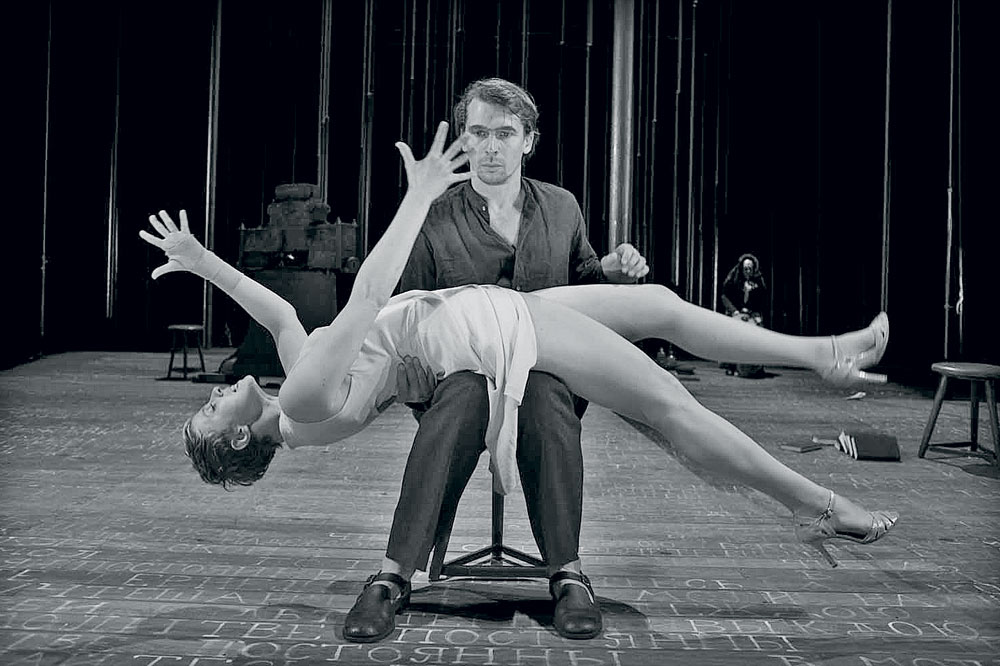
Scene from the play "Brothers Karamazov"
Russian hall
You once admitted that in your youth the father told you: "If you do not like it, go east, to our enemies." Did you really believe that enemies live in the east?
We showed films from Eastern Europe, and I immediately noticed: this is a world without advertising. I really liked it. In my youth, I became interested in utopian socialists, including Russians. And dad, seeing that I was fascinating more and more, said that if I lived in the USSR or in the countries of the Eastern Bloc, it is not known what they would do with me there. He urged me not to be seduced. Well, when I got it completely, he screamed so that I would roll east (laughs). In fact, my father dreamed of socialism, but thought he was unattainable. And how socialism was realized in the USSR, my father was simply scared.
But, of course, I could not think that there are enemies, primarily because of Russian literature. When I read Chekhov or Dostoevsky, I have the impression that this life is familiar to me. I know these people suffering from their own imperfection. For me, as a person who was born in a small village in Belgium, Russians are much closer than, for example, Americans. In American culture, winners are important, it is so important to be happy in it! This culture does everything to make people feel good and comfortable. And the European one, in which I include and Russian, does not engage in such things. And when we brought our performances in Chekhov to Moscow, I saw how emotionally how the Russian hall reacts brightly to them!
What should be the ideal reaction of the public to your performances? And what is terrifying you?
The worst is indifference. There is nothing worse than the viewer tired and cynical. There are often critics. So if the audience politely patted and parted, this is a nightmare. This is much worse than the audience anger, when the audience wants to just tear the artists! If they scream from the hall with displeasure, I am glad about this. I like the anger of the audience, especially if it is common, because the theater is a place where people can experience the same emotions. Theater is a place of unity. Even if they are against me, if they shout "Buuuu!" But they are together. Of course, success is better (laughs). Of course, it is better when the hall is silent with admiration for either sorrow, or from horror - for the heroes, for themselves. Then there are seconds of such silence that we are deprived of in life. When the audience begins to love one of the heroes, in this love she also reaches unity. And when the hall is indifferent, then it is disconnected.
Theater is alive and dead
You are talking about the fight against stereotypes, with the so -called traditional theater, with the dead theater ... And with what are you fighting in yourself? And what can you defeat in any way?
I have been operating for thirty years. If I were pleased with my work, I probably would have abandoned the theater for a long time. You can’t be admired by your work and continue to do it, it seems to me. I continue because I hope to put better. And I'm self -taught. I myself mastered the directorial profession. How can you study? Only on the mistakes that I naturally continue to do. I had many mistakes, and now they are. And after the premiere, I continue to correct errors, I do not leave the actors alone. I had the premiere of the Karamazov brothers in Hamburg just a week ago. They gave us only two months to rehearse, but I warned right away - "I am not enough for me!" And it turned out. Now that I will come to Hamburg, we will continue to work on the performance.
"
If you do not perceive every setting as very personal - about me, about us, then we will just report the old plays to the viewer
"
In general, we have a wrong attitude towards errors. They are necessary. I believe that until thirty years, young directors must make a very, very many mistakes. They will then commit them, they will commit them all their lives. But at this age, they are simply obliged to experiment and fill their bumps. The path in the theater can be anything: for example, we are engaged in yoga during a rehearsal, play the ball. What tricks I just do not go, so that the actors relax, forget the text and begin to speak their own words in the role. Other directors look at me as abnormal (laughs).
And it never was such that you were just delighted with what you did?
Of course, when the audience is grateful, when success, when I see that the hall is completely involved in what is happening, I am happy. Yesterday's performance went just like that. But this is only one evening. Just evening. And each new performance is a challenge. Today's success does not guarantee me success tomorrow. And the fact that I was pleased with myself today does not mean that from that moment I will do only what I will be pleased with. And I, like any director, work with people. For example, in Hamburg I see how it is difficult for actors to survive a long winter, how they yearn without the sun, and this cannot but affect work.
High -haired man
The heroes of your performances - whether Shakespeare's or Chekhov - always our contemporaries, unsettled, unhappy, who are uncomfortable, difficult to live. Is this feeling close to you?
You see, we, Catholics, have been inspired from childhood that a person is something imperfect. And it stays with you forever. When you grow up, the feeling is intensified that you are some kind of unworthy, that you are to blame for people and God, that you should work tirelessly on yourself ... And in the end you dream of freeing yourself, you dream of getting into paradise as soon as possible (laughs). But that is why I love the theater: a person is still preserved here in all his restlessness and absurdity. And television and Hollywood cinema are not just a lie. This is also a grand provocation for a person - what he is. An illusion of a happy world is created on the screen, from which the viewer becomes uneasy. It is difficult for people to be like that, it is difficult to follow these film and television forms. Most people are unfortunate and unhappy. At least they very often feel like that.
The theater is the only one of all the arts where a person is accepted as he is. And they show this - with his complexes, fears, problems, depression, with his unheard of imperfection. Here you can see people who are looking for their own path in this life, look and are constantly mistaken. The theater is the last place where there is no ideology. Only here there is a meeting of a person with a person.
Photos: Kraft Anger, Reinhard Winkler, www.lukperceval.info