
Translated material
The nature of Gilyarov
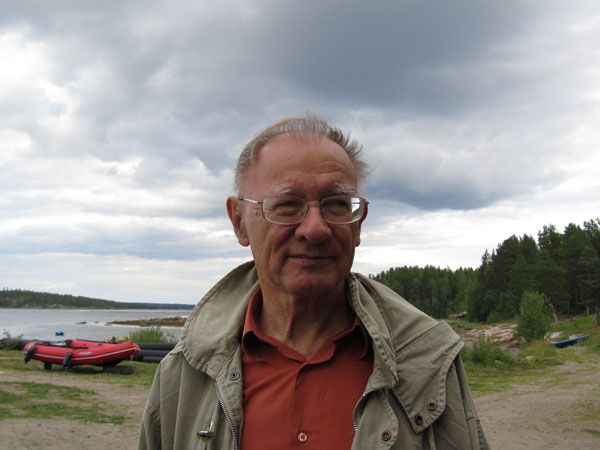
On May 19, 2013, he is 70 years old, a remarkable scientist and a person, a doctor of biological sciences, professor at the Department of the General Ecology of the Biology Faculty of Moscow State University Alexei Merkuryevich Gilyarov . We publish congratulations to the hero of the day and an interview with him about educational literature. Talked by Natalia Demina .
* * *
The composer and theorist of music Vladimir Martynov : “Dear Alexey Merkuryevich, congratulations on your anniversary! Very often I remember you. You belong to those people whose presence supports others. You came to me at a lecture, and your presence gave me a lot, I am very grateful to you for those books that you passed on to me, and for those aims that you gave me your remarks. I wish you health and hope to continue our cooperation. ”
Astronomer, popularizer of science Vladimir Surdin : “They say that many of the knowledge from many knowledge. And in fact - rarely in one person combines knowledge, conscience and optimism. Moreover, for friends and colleagues, the one whom nature and fate was awarded with these qualities. Happy birthday, Alexey Merkuryevich! We love you! ”
The biologist, scientific secretary of the Institute of Biophysics of the SB RAS (Krasnoyarsk) Yegor Zeroeev : “Dear Alexei Merkuryevich, only yesterday we remembered you several times during the defense of the candidate dissertation of my first graduate student and subsequent banquet. Work - on planktonic crustacean. It discusses the issues of coexistence of species. We remembered you as one of the best Russian aquatic ecologists. From the very beginning of my scientific work on my table, your book has always been on the dynamics of the number of planktonic crustaceans. And your recent review of the hypothesis of neutralism and issues of coexistence of species has become a “desktop article” when writing a dissertation. I sincerely congratulate you on your birthday and wish you many more and fruitful years of active life. I always tell students about you at lectures as an extraordinary, bright and interesting person! On the anniversary! ”
* * *
What books in childhood and youth had the greatest effect on you? What did you like to read from 5 to 18 years old?
18 years old is the first course, right? Then I read the black two -volume Hemingway two -volume, read the whole remark. Perhaps these books. Before that, the big stories of Chekhov. In general, basically, read poetry.
Poems - whose, which ones?
Oh, I belong to those, it seems, 8 percent of people who are in any country who is able to perceive poetry. I read a very wide range of poets. In addition, in grades 5, 6, 7, of course, I read books about animals. I was a young naturalist. If you are interested in my favorite popular science books, then this is N.N. Plavilshchikov “Life of the Pond”, S.V. Gerd “Aquarium at School”, A.N. Prompov “Birds in nature”-these are perhaps the three most interesting books. Later “Six Days in the Forests” by A.N. Formov. He is the "trace of the ranger."
These books were brought to you by parents, or did you find them on a book shelf, or took them in the library?
These books were bought by parents, but I already bought Birds in nature myself, because I knew that this book should be in my library. And the "life of the pond"-I was still a very small, primary school.
A.M. Gilyarov at the lecture "What is common between the world of wildlife in the representation of ecologists and the world of music created by composers of the Baroque era?"
Please tell me, as you think, what components should have a good popular science book?
You know, I, perhaps, cannot formulate the secret of a good book. I try to recall what was in common with the popular science books that captured me in childhood and youth, and I can’t remember. As I already said, among the most beloved were the books of Polivilshchikov, in addition to the "Life of the Pond", he also had "young lovers of nature." There were two books by N.M. Verzilina: “In the wake of Robinson” and “Journey with Plants”. These books are really very good and really popular science. They talk about what you can see nearby. So, "... domestic plants" refers to indoor plants that are grown in pots in apartments. It seems to you that you know all about them, and there all sorts of interesting stories are written there: where did they come from and so on.
The book “In the wake of Robinson” tells about ordinary plants that can be found in the suburbs and generally in the middle lane: how can you make gastric coffee or something else interesting, how to make bread from the rhizome of a white water lilie, from what is incorrectly called water lily.
Do I understand correctly that the main subject of your reading was books on biology? Or did you still read books on chemistry, in physics, for example?
No, I didn't read it.
That is, your interest in life has formed early?
Yes, it happened.
In moments of leisure A.M. Gilyarov loves to draw.
Do you now notice the gap, meanwhile, the knowledge that scientists possess, and those that the public exists? It seems to you that this gap can be overcome? Can popular science literature help this?
Scientific and popular literature, of course, can help. Of course, television can help most of all, but it somehow turns out to be with it. I will still talk about books about nature. We now have no such books about the nature that surrounds us.
At one time, I collaborated with the English publishing house, which had a branch in Russia as a scientific editor. And so I saw a book that was released in England, all of the chic photographs, I don’t remember what it was exactly called English. But this is approximately the "life of the pond." There were photographs of aquatic plants, insects that are found in reservoirs, fish. And when I looked at her, I saw that these are the same plants and animals that we have found. I suggested translating this book into Russian, but they told me that it is unlikely to have great demand, and it was not translated.
Then I collaborated with some different publishers, for example, Mahaon, edited encyclopedias with pictures, which were a lot of, and they repeated each other. I also offered them to make the book “Life of the Forest”, because you can find zoologists and botanists who write well. You can find professional photographers that are very well shot, and make such a book with photographs that the schoolboy will take and go to the forest. She will help him to understand the traces not only in the snow, but also in traces of life, and of course, in birds, insects, plants that he will see.
But the publishers told me that they just could not do it. It is much easier for them to translate into Russian the next encyclopedic , as they believe, a book about everything in the world where the whole text comes down to small signatures under the pictures. And the task of the editor is to make sure that these signatures are translated correctly, and sometimes catch an error in the original text.
Forest on the White Sea. 2011 Color pencils. Figure A.M. Gilyarova.
How do you think that you can do to publish such books became profitable? Can subsidies be helped for publishers either for scientific journalists or scientists?
There must be a publishing house that would really be interested in the publication of such books. And they must already find and persuade the potential author, say that they will pay for his work, and then in cooperation with him to make such a book. There must be an initiative from the publishing house and a specific person, a specific editor who will undertake to make such a book. Of course, it is good that he understands something in this: in biology, if this is a book on biology, in physics, if this is a book on physics.
I understand the publishers - the publication of such books is very difficult to organize, because if they announce a competition of publishing projects, then all sorts of crazy or people with great ambitions, but not capable of real work, will run up. In fact, the work on the publication of such books is quite difficult, and I am not ready to blame the editors that they are not active enough.
Tell me, how can you encourage scientists to write popular science books? How to make such books write more scientists?
This is a difficult question, because everyone is looking for some kind of earnings, the salary of scientists is very small, as you know. Therefore, a person who is engaged in science or teaching needs to leave his affairs and focus on this new work, moreover, it is not known how much it will be guaranteed to earn money.
I think that now there is some forward movement: there are wonderful books by Alexander Markov, which are sold out. In general, the success of the Non-Fiction Book Fair last year struck me when I saw huge lines standing in the artist’s central house. This is a very good trend.
Tell me, do you now manage to read any popular science books?
Now I generally read few books. Moreover, books that have had a great influence on me in recent years are not belonging to the category of popular science, they belong to something average between memories and reflections about what is happening. These are the books of composer Vladimir Ivanovich Martynov : his Autoarcheology, Alice's Time and Planty Jacobi of Jacob. The three of these books had a great influence on me, because I always find that Vladimir Ivanovich was right in his reasoning.
With composer Vladimir Martynov 
When you come to the book, how do you determine, is it worth buying a book?
I invented a good way myself. And then once he joyfully found out that M.V. Rozanova, the widow of Sinyavsky, writer. I take a book, open it in the middle and read it entirely one turn. Sometimes I read three pages in a row. Then I open it somewhere-and I also read a piece in a row. And this, as a rule, is enough.
That is, if you are captured by the content, then you can safely buy a book?
First of all, I perceive the language that the book is written. And this is already a lot. So everything is very simple: to open and read 2-3 pages in a row, and then from another place the same way, that's all. This is enough.
Good recipe, thank you very much!
See also: