
Translated material
Euro Nitmark
Why are the Germans unhappy and what threatens the old light
The Party of the Alternative for Germany (AFD) is gaining popularity: it was born just a month ago and already has seven thousand members. Her goals are a return to the German brand and the cessation of financial assistance to the south of Europe. Why are the Germans unhappy and what threatens the Old World - the New Times found out
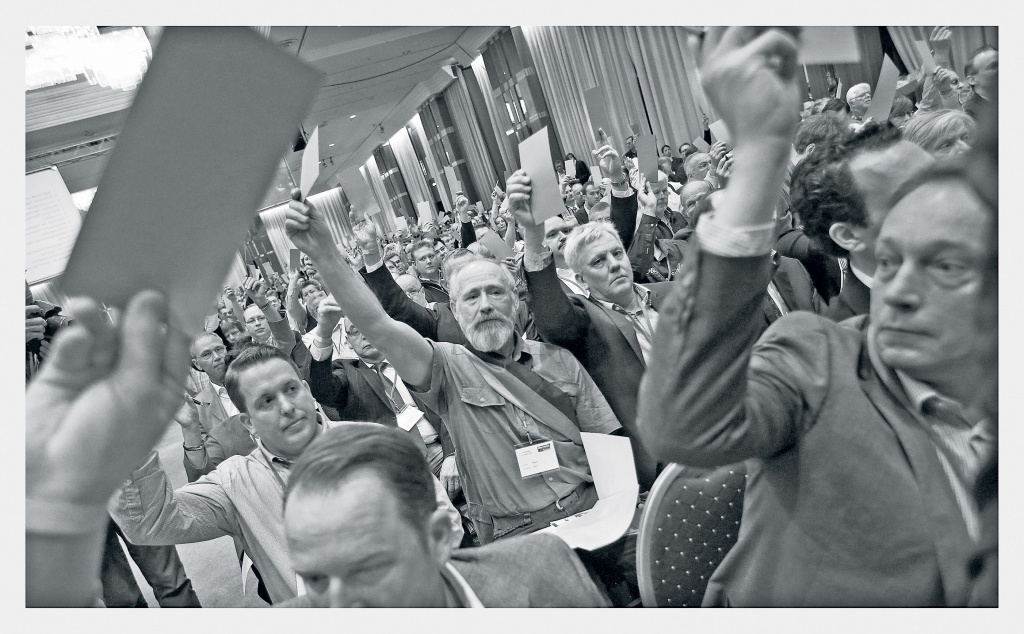
During the Constituent Congress of AFD in Berlin
“Look: Germany is desperately fighting for the salvation of the euro, but what do we hear in response from the inhabitants of the South of Europe? They are not embarrassed to compare us, Germans, with the Nazis! " - The professor of macroeconomics from the University of Hamburg Bernd Lucke is outraged in a conversation with The New Times. It is he, together with the former editor of the policy of the newspaper Frankfurter Allgemeine Zeitung, Conrad Adam founded the AFD party. “A single currency has suffered a fiasco, it is becoming increasingly difficult to believe in this fairy tale,” Professor Lucke assures us. Germany is quite capable of getting out of the crisis, abandoning the euro and payments to the EU stabilization fund, but the German establishment, the professor complains, stubbornly ignores such a scenario. There is only one way out - to create a real opposition in Germany that they and Adam did.
Move away from tradition
All parties presented in the Bundestag ultimately occupy the same platform and differ only in the opinion on the question of when, to whom and how much to pay money, Professor Lucke believes: “The euro is considered sacred. The one who holds a different opinion is immediately called a populist or ridiculed. ” Meanwhile, 54% of the participants in the survey conducted by the German weekly Der Spiegel in July 2012 do not see the point of spending hundreds of billions in order to preserve the euro. “Europe not only does not receive any benefit from the euro, but, on the contrary, is slowly destroying,” says Professor Lucke.
In order to bring their ideas to life, the leaders of “Alternatives for Germany” offer to move away from traditional decision -making in parliament: Lyukke plans to achieve national referenda in the Swiss model, including regarding the measures taken by the European Union on the allocation of packages of economic assistance to other countries.
According to the latest survey, 7% of German residents are ready to vote for the Lucca -adam party in the September elections in Bundestag and 17% of the respondents are seriously reflecting on this opportunity. And this is no longer a joke. Angel Merkel, experts note, will have to “go along a very narrow path between those who have already been tired of the constant need to provide assistance to the poorer countries of the Eurozone, and those who still support Germany’s efforts to maintain a single currency.” First of all, these are, of course, large corporations.
Meanwhile, Euroskepticism has a very serious economic and psychological basis in Germany, on which, in fact, “alternatives” are based.
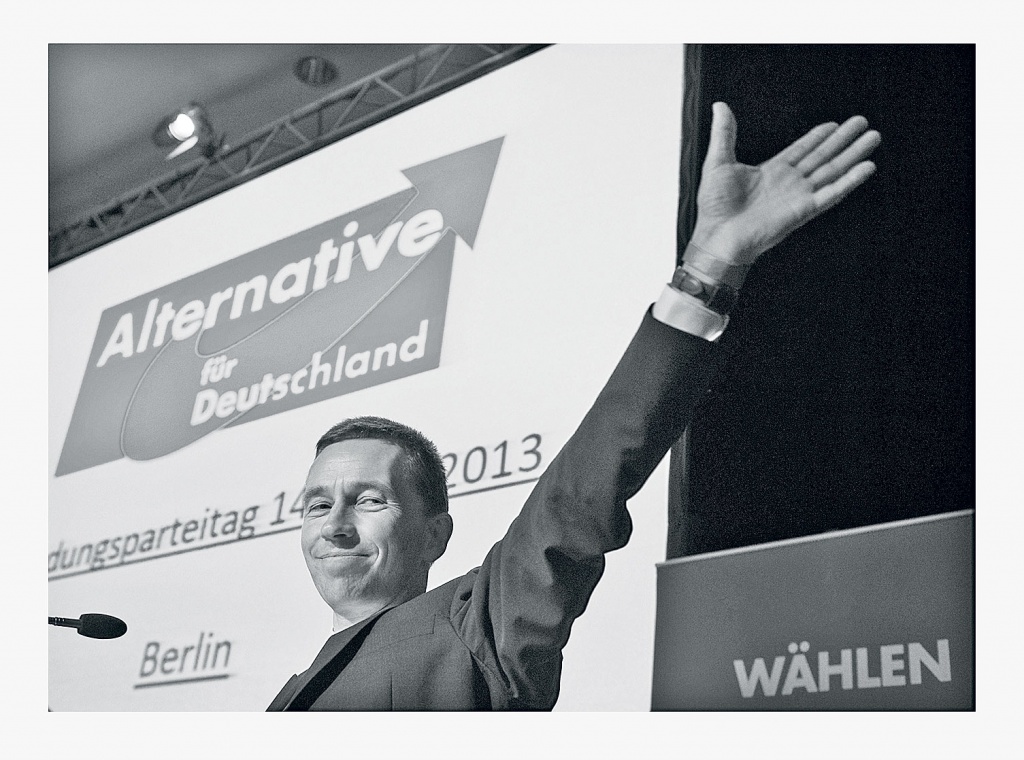
Professor Bernd Lucke: "The way out of the crisis is in the rejection of the euro"
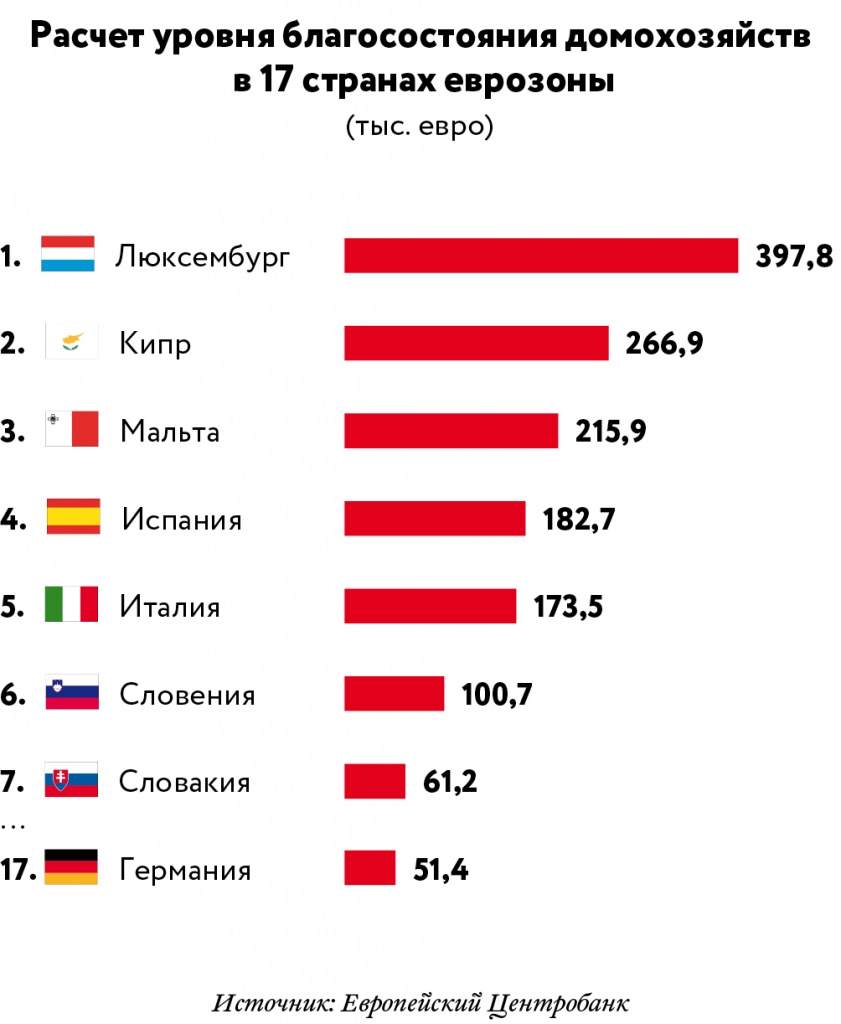
** Poor Germans **Everything that will be written below is not an exaggeration. The European Central Bank (ECB) first calculated the level of welfare of households - an indicator that includes the market value of assets: real estate, cars and other values, minus debts and loans. It turned out that German families are officially the poorest in terms of property among all Eurozone countries.
Free assets of the average household in Germany make up only € 51.4 thousand, while in Greece they reach € 101.9 thousand. Moreover, Greek families are not much more German. According to Eurostat, on average they consist of 2.6 people, while German - of two.
Luxembourg lives most in the Eurozone countries (€ 397.8 thousand with an average household of 2.5 people). In Cyprus that prays for help, this indicator is € 266.9 thousand (2.8 people), and in Malta - € 215.9 thousand (2.9 people). In Spain and Italy, accumulations are somewhat more modest - € 182.7 thousand (2.7 people) and € 173.5 thousand (2.4 people), respectively. Even the Slovenes are overtaken in terms of the volume of property of the Germans - € 100.7 thousand (2.6 people) and Slovaks - € 61.2 thousand (2.8 people).
Germany occupies the last line not only in terms of welfare, but also in the total number of households that have at least something behind the soul. 19.8% of them do not have free assets at all - they are forced to spend all income on current expenses, while they have no more or less significant property. In Greece, such households are 7.8%, in Spain - 4.7%, in Cyprus - 4.2%, and in Italy only 2.3%.
Germany looks even worse against the backdrop of real estate ownership. A total of 44.2% of German families are homeowners. In Spain, this indicator is 82.4%, in Cyprus - 76.7%, in Greece - 72.4%, in Italy 68.7%.
Frightened by their numbers, the ECB experts decided to warn readers from “hasty conclusions”, having come up with the following wording: “The Germans as a whole have wider access to public benefits, therefore they are less interested in accumulation, as well as the acquisition of real estate and other property.”
"
*The euro did not enter the German mentality to the end. Residents of Germany still store billions of cash German brands in piggy banks*
“ Mark under the mattress according to the testimonies of the Germans themselves, the euro has not yet entered the German mentality. The inhabitants of Germany still keep billions of cash German brands in the piggy banks. Nostalgia, forgetfulness, or maybe strategic thinking, no matter what the reason for maintaining cash DM, there are, according to the settlements of the federal bank, and ten years after the transition to the euro in German houses remains 13.45 billion! Coins and bills are stored in a trap and in battered purse, they are unexpectedly found in the pages of the old jacket or between a long-read book, where the activity of the Bundesburger for the exchange of cash stamps for the euro has been hidden from 2008-2009. The Federal Bank was accepted for the exchange of 162.8 million marks - almost a third less than this happened from 2002 to 2007.
Psychologists say about the conscious traction of the Germans to the former national currency. According to the survey of the independent sociological service of Emnid, almost half (49%) of Germany residents wish a return to the German brand as a single payment fund. 51% is not satisfied with the euro, and 77% believes that the pan -European currency has reduced the level of their well -being - all this is the potential electorate of “Alternatives for Germany”. Only 17% of respondents announced “personal benefit” from the transition to the euro. It is significant that the popularity of the euro has recently fallen greatly among young people who previously defended it. If in 2009 72% of the country's residents aged 18 to 24 spoke for a single currency, then according to the latest analysis of the youth data of the Federal Statistical Department of Jugendstudie-2012 there are now less than 40%.
Against the background of the European crisis of non -payments and radical measures to save a number of countries from bankruptcy, 67% of the German population expresses doubts about the stability of the euro, 57% fears inflation and 54% characterize the degree of confidence in the unified currency as extremely low.
Pros for pockets
The idea of a return to the brand is also supported by the financial guru George Soros. He believes that Germany itself, and as soon as possible, should leave the euro zone. In his opinion, tied to his stabilization dogma, Germany captivates the whole of Europe into the gap of economic depression. “Germany’s exit from the currency union may have become more kind than evil,” Soros believes. Its argument is shared by other large figures with Wall Street. It is Germany, and not the peripheral countries of the EU, who should leave the currency union, said Kenneth Griffin, founder of the Citadel investment union. “The euro without Germany will instantly fall in price, and peripheral states will immediately become more competitive. Only in this way they will be able to survive the euro and with it the European Union. If the largest economy in Europe leaves the Eurozone, then the debts of the remaining countries will instantly be reduced due to the weakening of the euro, ”the economist predicts in a conversation with The New Times.
Finance experts analyze the ways and mechanisms of the new currency reform and declare: it is quite real. “Not a single currency association is forever,” explained to the New Times Professor of the Department of Economics of the University of Darmstadt, consultant of the federal government on financial issues Wolfgang Hercu. - From 1873 to 1924, the Scandinavian Cash Union lasted between Denmark, Sweden and later Norway, an attempt to merge the “Latin Mint” of France, Italy, Belgium, Greece and Switzerland in the 19th century was unsuccessful. The euro theoretically can also be sent to the shelf of history. ” The pluses for the German pocket from returning to the past, according to Gerke, are obvious. First of all, with the rejection of a single currency, Germany will lose its obligations on financial assistance to debtor countries. At the same time, the import of raw materials, energy and consumer goods will become much cheaper (in case of stability of the new-old brand).
"
“The euro without Germany will instantly fall in price, and peripheral states will immediately become more competitive. This is the only way to survive the euro itself and the European Union "
" The third world
According to the former Minister of Finance of Germany, Theo Weigel (namely, he belongs to both the idea and the word “euro”), returning to the brand would become a serious problem primarily for German exports: German goods would significantly rise in price and lose competitiveness. In addition, the ordinary consumer may well in this case lose a large part of his savings, which are placed in many foreign banks through insurance and investment funds. And the technical re -equipment of ATMs, payment terminals and printing of new bills can cost a German taxpayer € 60 billion - an amount that is 2.5% of GDP.
“In the first five years, you need to expect huge problems in any case,” the director of Deka-Bank, Ulrich Crater, warned The New Times. “GDP losses can become even more significant than after the bankruptcy of the American bank Lehman Brothers in 2008-and then the economic damage of Germany amounted to 5%!”
In addition to economic consequences, experts speak of political risks. “The release of Germany from the eurozone is able to lead to such large political conflicts with the rest of the European states that the German economy may lose access to the European macroeconomic market,” said Jorg Kremer, chief economist of the German Commerzbank, the chief economist of the German Commerzbank. - And then it will be possible to talk about the collapse. But the main thing is that Germany is unlikely to want to destroy Europe for the third time in a century. ”
Obstacling opponents, Bernd Lucke constantly repeats that it was under the influence of a single currency that Europe was divided into poor south and a prosperous north, recalling that the economic take -off of Germany occurred just with a German brand. At that time, the ability to regularly devalue its currency in the peripheral countries such as Italy, Spain or Greece worked better than any credit injections. The introduction of the euro, according to Lucke, was a historical mistake that the time came to fix. The politician emphasizes: “We want to stop the obvious violation of democratic, legal and economic principles. The Angel Merkel government turned out to be wrong, saying that there was no alternative for his policy. There is an alternative - and this is us. "
It remains to convince the voters of this, but until September there is still enough time.
Photos: Reuters, AFP/East News