
Translated material
About the width of the strips
Everyone who has been in Europe paid attention to how cute and friendly, almost toy, their roads seem to be. The pedestrian near them feels like a master, not a guest, and crossing the road is not difficult. Compare two 4-lane roads: in Eindhoven and Moscow:


The difference is not only as a performance or trees. The main reason why their roads look more friendly is the width of the strip. We have 3.5 meters with our standard for cities, they have 3. In the former countries of the socialist camp, even in Minsk and Kyiv on the central streets 3-meter stripes. And Russia, as usual, is behind the planet. Why, if you think from the point of view of common sense, and not GOSTs and SNIPs?
It was not possible to find a specific answer to this question, but it is quite possible that the wide stripes are the result of the sharpening of roads to the USSR for public transport and freight transportation. This has its own logic, because the passenger car will pass wherever it passes the cargo. But the opposite effect is not taken into account. The width of the strip, comfortable for a truck is too wide for a passenger. What does it mean - too wide a strip?
A little theory
Transport scientists have long drew attention to the connection of the width of the strip and speed of movement. In the book "Organization of Traffic" G.I. Klinkovstein and M.B. Afanasyeva gives the formula for calculating the optimal width of the lane:
The width of the strip = estimated speed*0.015 + width of TS + 0.3.
According to the given dependence, the speed with which the average qualification driver can lead a car for a long time and confidently is approximately: when driving a passenger car and a strip of a strip of 3 m about 65 km/h, and with a strip of 3.5 m strip about 90 km/h; When driving a car with a dimensional width of 2.5 m and a strip width of 3.5 m about 50 km/h.
It turns out that 3.5-meter stripes in a city with a predominantly passenger traffic (the share of trucks in Moscow is no more than 10%, as many still three-tollabus buses), they allow you to go at a speed of 90 km/h, which many do on wide roads. Moreover, often this happens involuntarily, because the speed is not felt.
Please note that this formula allows you to calculate a safe corridor for long and confident driving. That is, when the driver conditionally does not notice the car in other stripes, they do not bother him. There is a plus in this - the driver can calmly go, following the situation ahead, without thinking about what is happening around the edges. In the same minus. Vigilance is reduced, the driver forgets that he travels along the road of complete dangers and either involuntarily accelerates, or his brain passes into an automatic regime with reduced energy consumption. That is, when suddenly an unusual situation occurs on the road, which must be responded to quickly, the brain must first exit the automatic regime and only then start reacting, so we are arranged. Therefore, it is important to find a balance between confident driving and a state of light voltage, in which the driver will not miss. So the formula is good, but rather for highways than for cities, where attention is required many times more.
There is another minus of wide stripes. On two 3.5-meter stripes, 3 cars may fit (the average width of the car with mirrors is 2.10 m). What this leads to, we all know: the extinguishing between the rows at the traffic lights, dangerous overtaking in the marking strip. 3-meter stripes solve this problem.
Moscow practice
Sometimes the width of the strip is selected exclusively in the width of the carriageway. The 16-meter passing part in the inheritance, on which it is necessary to make four stripes, because before the intersection there are also four-well, and nothing, a lot. Let them be three each, and the right - everything that remains after the marking. And all the same, they hinted that this area could go faster and provoked chaotic movement and parking. There are a lot of such examples in Moscow, even within the garden ring. For example, colored boulevard. He just has everything as I wrote. Pay attention, what a humiliating width of the sidewalk, also with the masts of lighting.

According to our domestic GOSTs and foreign practice, the width of the strip should be chosen predominantly transport. This means that within the TTK, where the entry of trucks is prohibited and speed is limited to 60 km/h, the width of the strip should be 3 meters. Everywhere. If somewhere the width is not divided into 3, then there you need to not draw stripes wider, but give the distance remaining after marking, change it from parallel to the diagonal or even expand the sidewalk. The exception can only be for the bands of public transport, three meters are still not enough for buses, given our winter. Skeptics will say that in the center, sometimes trucks, harvesting machines, and garbage trucks sometimes drive. Yes, they go, but you won’t believe it, they fit into a 3-meter strip 2.5 meters, so nothing prevents them from. Yes, it will be a little uncomfortable for them, those who are going nearby most likely too, but there are such a scanty amount in the center, and the inconvenience is so inconvenient that you can calmly close their eyes to this. What they do in Europe, where there are always 3 meters in the city, regardless of how many trucks move.
By the way, about abroad. In the car in the USA wide stripes. Everything is measured there in feet there, so a typical width is not 3.5, but 3.6 m (12 feet). However, the latest guide for the design of roads of the NACTO association says that narrowing of the strips does not lead to an increase in accidents. And for a city with a speed limit of 65 km/h (40 miles/h), 3 meters for cars and 3.3 meters for trucks and buses are recommended. Other foreign research (who is interested - you can search for Google at the request of Lane Width Research) also confirm that a change in the number of accidents after narrowing or expansion of the bands is within the statistical error.
Putting the strip
Putting stripes is a means of huge potential for the city. Some reconstructions and extensions could be avoided if you change the width of the strip.
Take the same Avenue of Mira, on which we plan to return the tram . Before cutting and killing, let's see what is with rinsense. Wow, 42 meters! At the same time, 5 lanes are in each direction.
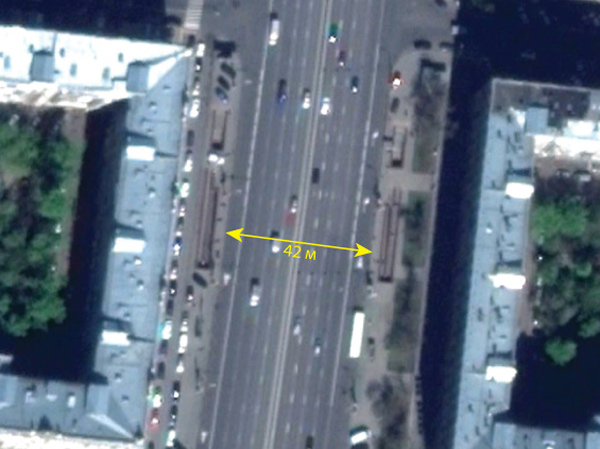
We build the street profile:

Again, stripes of 3.75 at a permitted speed of 60 km/h. In the city, and even opposite residential buildings, stripes are wider than in the Moscow Ring Road. This is fine? Let's see what can be done. Given the fact that trucks are also driven on this site, we will make stripes of 3.25 m, and the allocations on which you still cannot park - 3.5 meters each. This is what:

That is, only by changing the markings and converting the dividing chipper, we were able to get as many as 7 meters, which were just enough for the tram. At the same time, we increase safety, because the stripes have already become more attentive. The cost of implementation is minimal, you can do with local repairs, the transitions do not need to be moved. Well, is it not beauty?
And how many places can be allocated for parking, under the sidewalks, where they are very needed, under additional lanes or storage stripes before intersections? Perhaps a temporary narrowing of the bands before pedestrian crossings. It will allow us to establish full-fledged islands of security, which, according to some misunderstanding, is still not in Moscow. In this case, the speed of the car is reduced, the distance and, accordingly, the transition time, decreases. That is, in separate crossings, where the traffic lights are installed only for the sake of the transition, it can be removed, because people will need to cross two narrow stripes at a time, and not four wide. As a result, both pedestrians and drivers are waiting for each other.
Not so long ago, the stripes were reduced on the Altufevsky highway, making 3.5+3.5+5 four, 3+3+3+3.5 instead of three stripes. Thus, people were returned to the strip selected under the discharge. I would like to shake the hand of the bold traffic cop who was not afraid to do this, given that the trucks are traveling on the highway. Even I would hardly dare. On the other hand, a truck drive along the same 3-meter stripes on Berlin, why don't they ride with us? He specifically interviewed his friends, who drives Altufevka, everyone noticed that there were four stripes, but no one noticed that the stripes had already become. So there is no disaster in narrowing of the strips, if some do not even notice this.
Conclusions
So, what should be the width of the stripes in Moscow? In my opinion, the alignment is this:
Inside TTK - 3 meters, in especially narrow places you can 2.75 (even our GOSTs allow).
On highways at a permitted speed of 80 km/h - 3.5.
On highways at a permitted speed of 60 km/h - 3.25.
In residential quarters with ground crossings 3-3.25.
Strips for public transport - 3.5.
In no case do I say that I need to rush to redraw the stripes throughout Moscow. No, you just need to treat strips narrowing, as an effective means of obtaining an area useful for the city. And, if somewhere you can redraw three strips into four, expand the sidewalk, add strips for cyclists, this must be done without a twinge of conscience. 3 meters is not scary. It has been proven by Tverskaya Street, on which 3 meters stripes are already more than 10 years old. Didn't you know? :)
PS The article was written by the PROBOK.NET TERRIC_JAMS project participant. The ideas expressed in this publication may not coincide with the opinions of other project participants.