
Translated material
Not that Cyril, the wrong alphabet
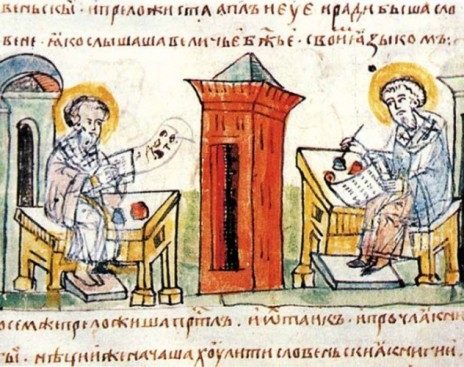
Today is May 24 - Day of Slavic Writing and Culture. On this occasion, Slon publishes a reduced version of the lecture of the Doctor of Historical Sciences, a specialist in the field of the ancient Slavic and Byzantine cultures of Sergey Ivanov “Kirill and Methodius: Losers or Vizioners?” which took place in February this year in the lecture of the Polytechnic Museum.
At the end of February or early March 863, the embassy led by the brothers Konstantin and Methodius of Solunsky left the northwest. We can say that 1050 years ago, a project of Slavic writing began, around which a huge amount of stupidity and lies were sophisticated.
There are a lot of theories that the pagan Slavs had a written writing, trampled after Christians; That there was a certain knot of writing, and the image of Baba-Yaga confirms this, supposedly she had knots. |
But there is only one serious hypothesis: it is based on the biography of Cyril himself (Konstantin), but the earliest manuscripts of this life dates back to the 15th century, before that they corresponded for five hundred years, and the original texts died.
The life describes how Konstantin, traveling with the so -called Khazar mission (he was sent by the emperor to the Khazar Kaganate as a diplomat), went through Crimea. I quote: “And I reached Kherson, and learned Jewish speech here, and took even more knowledge from this. A certain Samaritan lived there. And, coming to him, he talked with him, and brought Samaritan books, and showed him, and, having crossed him, a philosopher (Konstantin) shut himself in the house and surrendered to prayer, and, having accepted knowledge from God, began to read these books without mistakes. ” After that, the following is said: “He found here the Gospel and Psalter, written by Russian letters (with one“ C ”, naturally. - Sergey Ivanov) , and he found a person speaking in that language. And he talked with him, and understood the meaning of this speech, and, comparing it with his tongue, distinguished the letters vowels and consonants, and, creating a prayer to God, soon began to read and express them, and many were surprised at this, praising God. ”
http://www.youtube.com/embed/7f5cwgeig00
The idea that there were other, pre -Koststannovsky Russian letters that he learned gave the ground to assumptions about the existence of a once different alphabet, who died irrevocably. It is a little strange that it is called Russian . The Slavs were not called the Rus in the 4th century.
Here, linguists have long paid attention to the passage, not striking an unprepared person: he distinguished vowels and agree. In no Indo -European language, the difference between vowels and consonants is not significant. This is not the case only in the Semitic languages, where the consonants are written, and vowels exist in the form of signs of the announcement. The hypothesis was expressed that during the centuries -old rewriting of the life of Constantine, the so -called metathesis occurred on Russian soil - Mena in places of two letters. That is, in the original, apparently, the word was “Sur” - that is, Syrian, letters of the Third Semitic language.
Whose are you, Cyril and Methodius?
In Bulgaria, everyone will tell you that Konstantin and Methodius were Bulgarians, in Macedonia - that they were Macedonians, in Greece they proceed from the fact that they were Greeks. |
Meanwhile, for them, such a statement of the question was somewhat ridiculous. They defined themselves as Romans - Orthodox subjects of the Byzantine emperor. The main thing was not their language, but religion and political belonging to the empire.
In the vicinity of the city of Salonika, there were a lot of Slavs then. These were the consequences of the great resettlement of the VII century AD, when a huge Slavic wave poured through the Danube and Balkans from the north. And in the VIII century, a very slow reconquist began, the gradual submission of these Slavic territories of the empire. In the cities, apparently, the Greek population continued to live, and the huge rural district remained Slavic -speaking. Byzantium was powerful in cultural and militarily, and the unlimited Slavs were quite easily involved in her life. Due to the fact that the Slavs regularly traveled to the Tascons to trade, the Greek -speaking inhabitants of the city spoke freely on the dialect of that Slavic tribe, which most often turned out to be nearby. This language is close to the modern Macedonian dialect.
Moravian Fiasco: Imperial ambitions are to blame
Therefore, it is very logical that when the embassy from the state of Great Moravia with a request for teachers who would teach the Christian faith in our language arrived in Constantinople in 861, the gaze of the authorities first fell on Konstantin and Methodius. They, like all the Solunians, spoke Slavic freely.But it turned out that by the time the need for the Slavic letter arose, the Slavic alphabet already existed. |
Apparently, the program of the final involvement of the Slavs in the empire included several different projects, including Christianization in their own language, that is, the translation of Christian worship and scripture into the language of the Slavs.
When the work to create the alphabet necessary for these purposes ended, it turned out - this is the hypothesis of my colleague Boris Nikolayevich Florie, that the Hellenization of the Macedonian Slavs is at such a pace that there is no need to stop at the stage of Slavic Christianization. Since they all say in Greek, it is better to Christian to Christian in Greek.
Another scientific myth is that Cyril and Methodius carried Orthodoxy in Moravia. This is not quite true. By the time (in 863), the embassy of Prince Rostislav Moravsky arrived in Constantinople, the principality of Moravia - the southern Czech Republic and the surrounding lands - was already fifty years as baptized by German bishops. They really asked teachers who would translate the existing Christian teaching to them into the language understandable to the people.
What Church figures were driving Konstantin and Methodius in Moravia? The analysis of the texts that the brothers translated in Moravia undoubtedly indicates that they worked with that rite, with the liturgy that existed in Moravia, namely, West Christian.
Why do I say that Konstantin and Methodius are losers? First of all, their project in Moravia suffered a complete fiasco. In 869, after the death of Cyril, friction began with the papal throne about the Slavic Liturgy, subsequently Pope Stefan V forbade her. But it was much worse that the Moravian elite was disappointed in Methodius as in a bishop. And in his students too.
Why did they turn to the German clergy again? From the very beginning, Methodius tried to impose on Moravan the same strict restrictions in Christian behavior, which were imposed on the filed empires. As soon as he died, the activities of the students were interrupted. They were expelled from the country, and younger assistants from among Moravan were sold into slavery.
The Byzantine missionaries proceeded from the fact that the transfer of religion is the transfer of all cultural customs, they went not only to the messengers of Christ, but also the messengers of the empire, which inevitably came across opposition.
Bulgarian luck
A completely different story happened when it turned out that the students of Methodius were expelled and reached in their exile of the ancient Bulgarian state. By this time, the Bulgarian state had been Christian to Byzantium for twenty years. Bulgaria was of particular interest because it was in the historical territories of the Roman Empire. Byzantium never left the hope of turning on Bulgaria in its composition, and at the end of the 10th century it managed to win it.
As soon as it turned out that the Christianizing project of students of Methodius could help something in the inclusion of Bulgaria in the orbit of Byzantine interests, Constantinople began to act incredibly quickly. From Constantinople to Venice, where the main slave market of that time was located, a ship was sent with an order of the Byzantine ambassador in Venice to find and redeem the students of Methodius sold into slavery. They were found among slaves, redeemed, delivered to Constantinople, washed, fattened and sent to Bulgaria. We know this from the life of one of the students of Methodius, St. Naum. This is where that Slavic alphabet finally came in handy. Initially, she did not go in the lands of the empire, because everything was expelled there, then in Moravia, because everything was lacynicized there, and now her time has come in Bulgaria. The Bulgarian government, also interested in being completely dependent on the Greeks, with open arms, accepted the students of Methodius and began to introduce a new Slavic alphabet.
Glagolitic, Cyrillic, confusion
And here, in fact, we must answer the question that was supposed to stand from the very beginning: what alphabet was Cyril and Methodius created? Cyril and Methodius did not create this alphabet. Their alphabet is a verb, a very strange product. |
On the one hand, these are letters that practically do not resemble the symbols of any alphabets known to us with literally a few exceptions. One and a half hundred years, it took the linguists to try to find at least some correspondence.
What happened? By the time, when the Glagolits began to be planted in Bulgaria, the practice of recording Slavic speech in Greek letters has long existed. She is older than Christianity. And then a student of Methodius Konstantin Preslavsky decided that it was necessary to abandon the verb. Cyril and Methodius were defeated on all fronts. The language that was created, apparently, Konstantin Preslavsky, included the letters of the Greek alphabet, which were already in use, and the letters from the Glagolitsa, which were not in Greek.
One region remained with the verb - very strange, unusual. We do not know why she stayed there. This is the area of Northern Dalmatia, islands and the coast in the area of the Croatian city of Zadar. In Croatia, the Glagolitz lasted until the 20th century, and there were even plans to turn it into a separate font of an independent Croatian state. The Papal throne allowed the use of a verb in one very small region.
The Glagolitica was used as a secrecy, nevertheless, she entered Rus'. From time to time both in Kyiv and in Novgorod find graffiti on the Glagolitic. That is, there were people who knew her, but they always perceived it as a secret language, the main giant array of Slavic books brought in the process of Christianization of Rus' from Bulgaria was written in Cyrillic.
This alphabet is called Cyrillic, of course, not in honor of Cyril. This misunderstanding is caused exactly by the fact that Konstantin Preslavsky, who launched activities to create this new language, was signed as Konstantin (which is logical). At some point, when rewriting the manuscripts retroactively, it was reconstructed that it was Konstantin Solunsky. This is a mistake, but not an empty mistake: it seems to me that Konstantin and Methodius would not be against it. They were in their way internationalists - and in this regard are unique.