
Translated material
"Case" Kirovles ": nine days of the same process
In the Leninsky District Court of the city of Kirov, prosecutors continue to present their evidence in the Kirovles case. 36 witnesses of the charges - the director of the forestry and officials. The New Times analyzed the first days of the hearing
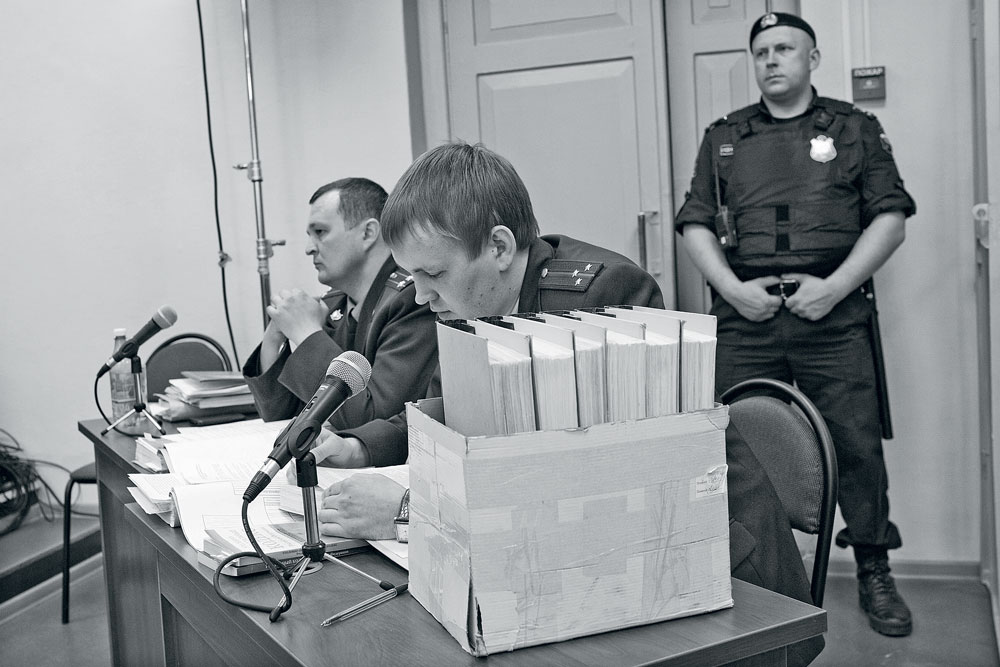
The prosecution - prosecutors Sergey Bogdanov and Evgeny Cheremisinov are trying to prove that Navalny and officers stole the entire forest in the Kirov region
| * Maria Shklyaruk is a former investigator, and now a researcher at the Institute of Law Problems at the European University in St. Petersburg. ** Vyatka forest company. |
What does the trial of Navalny show? Perhaps the non-professionals who follow the court hearings in Kirov seem to be something absurd and not related to law. For lawyers, what is happening is more understandable and logical. Specialists who know the formal rules by which the process is moving are not surprised that the townspeople are striking.
Here it is worth making the first and most important retreat. Lawyers on the question of the “case of Navalny” are divided into three groups: those who consider the accusation to Navalny justified, those who believe that the corpus delicti is, “but some other”, and those who believe that there are no crime in the actions committed by the bulk.
For any interested observer, it is important to understand several things.
The essence of the matter
First: there are some actions that Navalny performed (or did not commit). According to the prosecution, the actions are as follows: using the status of an adviser to the governor, he forced the Kirovles leshozes to ship the forest to firms that had agreements with VLK LLC **, and the conditions of shipment for the leshozes were (possibly) less profitable than they could be.
Second: how to qualify these actions - that is, are such actions are recognized as the Criminal Code of Russia (Criminal Code of the Russian Federation) as prohibited, and if so, which article of the Criminal Code of the Russian Federation? The separation between lawyers in assessing Navalny’s actions is mostly on this second issue. The discussion itself is too long, but in general it boils down to the fact that if we assume that the contract was obviously unprofitable, was the forest transmitted through it? Or was it sold? The position of the prosecution: the defendant was wasted, the position of protection: this is ordinary entrepreneurial activity, to which Navalny even had nothing to do with it - innocent.
Everything that is in the case file important for the prosecution is in a brief form stated in the indictment (by law, the accused should only be defended from the evidence that are set out in the indictment. These evidence must confirm actually perfect actions).
The order of the Russian criminal process is as follows: investigators collected testimonies of witnesses, documents, the results of listening to telephone conversations. Then they described the actions that, in their opinion, committed Navalny and K, and gave their assessment to this - as a qualification of the actions of the accused as embezzlement. The prosecutor's office agreed with this assessment, the prosecutor approved the indictment, and now his subordinates - two state prosecutors - support the position of the investigation. The position of Navalny himself and his defenders before the start of the court was expressed during interrogation as the accused and in the petitions filed by the party to the investigation. According to the prosecution, she (this position) did not create any obstacles to send the case to court. In court, the process should become adversarial.
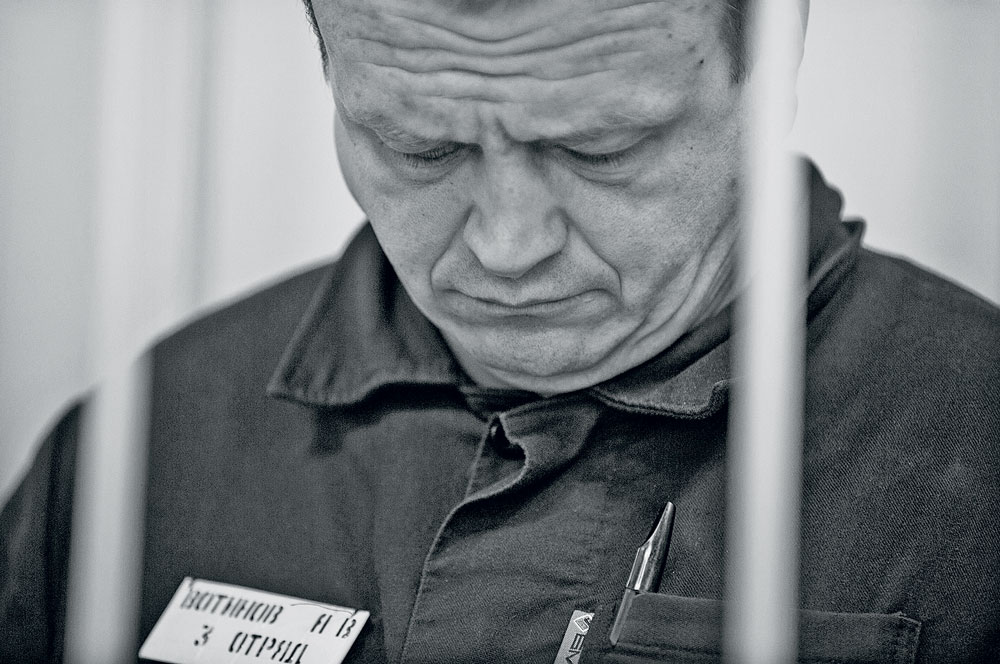
Andrei Votinov, a former adviser to Nikita Belykh, was laid to the court from the colony, where he was serving three years to receive a bribe
Court as a competition
Considering the case, the court evaluates evidence of the parties. At the very beginning, the procedure for studying these evidence is established. The prosecution is the first to represent them, the defendants may testify at any time, then the turn of the defenders will come. If, in the investigation, investigators could hide: who is questioned as a witness, what testimony he gave, what other evidence is collected, now the defense side knows everything that is in the case. Now the competitiveness of the parties to the court is ensured by the fact that prosecutors are obliged to submit each witness to the court, and the defense side may ask them their questions.
Even in those processes where the accused do not admit guilt (as in this process), the actions of state prosecutors consist in the fact that all the evidence set forth in the indictment is published in court. And it is desirable that the witnesses, giving testimony in court, do not depart from what they already said in the investigation. It would be ideal for the prosecutor to read out loud all the necessary documents and indications and thereby observe the publicity of the trial. But since there are adversariality among the principles of a modern court, you still have to bring witnesses to court.
Witnesses of the prosecution = defense witnesses?
So all that we have seen in Kirov so far is the traditional stage of the trial. The witness came-they interrogated, he/she does not remember or tells something a little differently-announced the testimony given at the investigation. The main task of the prosecutor is to ensure that the witness sounds: “I earlier remember better, I confirm the testimony given at the preliminary investigation.” This makes it possible to use interrogation protocols to write a sentence without any reservations. A little more complicated if the witness abandons these testimonies, but in this case the judge has the opportunity to use earlier evidence. As we see, during the process the state prosecutors achieve their goal - the testimony of almost all witnesses are announced. And they confirm them.
When the defense says that witnesses of the accusations became witnesses to the defense, this is a tactical course of protection.
The testimony of witnesses of the prosecution that the defense clearly delights can be grouped as follows:
- Most witnesses were not familiar with Navalny.
| *** The ex-director of Kirovles Vyacheslav Opalev was a defendant in the angular case of Kirovles, went on a deal with justice, testified against Navalny and Officer and received four years conditionally. Speaking at the trial on April 25, he stated that Kirovles was unprofitable to cooperate with the VLK - a company headed by Peter Officer. **** The deputy director of Kirovles, Larisa Bastrygin, speaking at the trial on May 16, confirmed the testimony of her chief Opilyu. |
But, according to the prosecution, this is not required of all. Opilev’s testimonies *** and Bastrygina **** enough to prove the guilt of the defendants. Actually Navalny is accused of organizing embezzlement committed by opales, that is, the direct actions of Navalny or officer in relation to directors of the forestry should not be proved.
- The agreement on the supply of forest was not free of charge (that is, they still paid for the forest, and not just abducted).
However, it is not the competence of witnesses to answer the question: whether such an agreement is considered a normal agreement or cover for embezzlement. The accusation is expecting from witnesses that they will confirm: they shipped some kind of (namely the listed of the prosecution). Whether such an agreement is embezzlement or not - the judge itself will appreciate.
- Navalny did not cause damage to Kirovles with his actions.
But this is also an evaluative category, which the court will be able to justify in the sentence with other evidence, and the answers of questioned witnesses, if he wants, can regard their insufficient awareness or personal opinion.
That is, in fact, the protection rejoices early. It is important to emphasize here: what is happening in the courtroom is not a surprise for the judge. After all, already receiving a criminal case, he gets acquainted with the position of investigation and the prosecutor's office. And - we can assume - having read the indictment, he already forms his attitude to the prosecution. And it was then that he decides: whether he agrees with the fact that the actions described in the prosecution fall under the article of the Criminal Code, which is imputed.
True, in the course of the trial, the judge may have doubts: were these actions committed? Then the position of the judge on the qualification of the article on which the defendants are accused may change. But such cases are rare. Cases in which the name of the crime changes, but the actions do not change, are much more than those where the judge does not agree with the fact that the fact of certain actions has been proven.
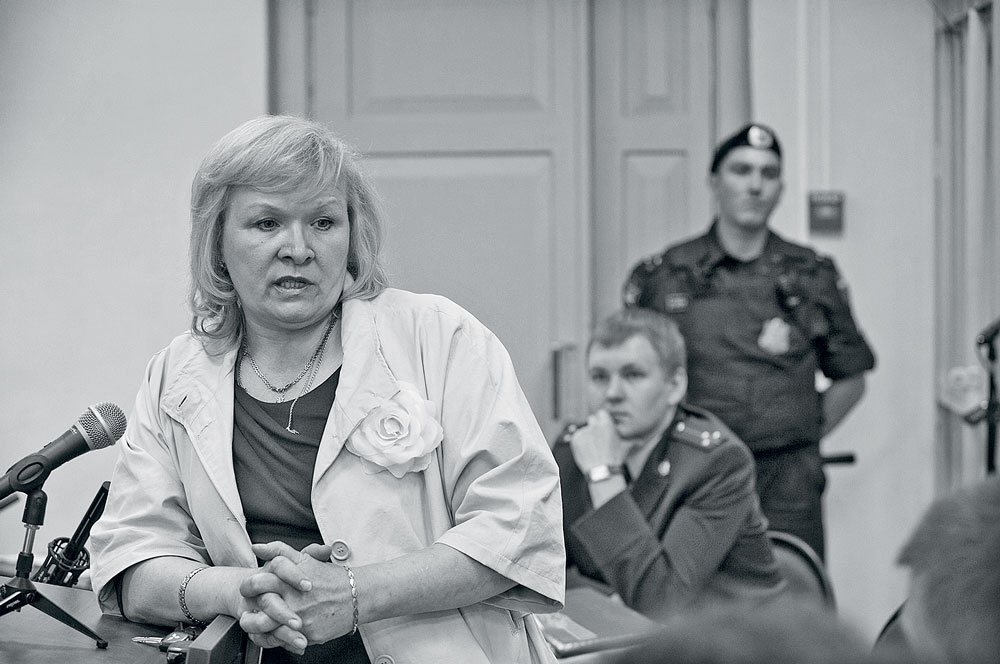
Kirovles deputy director Larisa Bastrygina said in court that the company was unprofitable for Navalny
Prejection
Therefore, nothing fundamentally new (different from the indictment) until the moment when the prosecution is finished presenting their evidence, you should not wait. But at the moment, the following questions arise for an outside observer.
| ***** The New Times No. 32 of October 8, 2012 ****** We are talking about the verdict in the case of Vyacheslav Opalev. |
What is the prejudice, which is now talked about in connection with the process, and what is the verdict of opales is dangerous for Navalny? *****
The prejudice is that if there is a decision of another court that has entered into legal force, then the circumstances established by the previous court should be recognized as a fact without additional verification. However, such a previous sentence should not predict the guilt of the person whose actions the court considers now. Here the law is faced with practice. In the previous verdict ****** it is written that Opalev was wasted together with the "Advisor to the Governor on a voluntary basis of N." (But who said that we are talking about Alexei Navalny?)
However, the danger is not even that in the verdict in the case of Opalev Navalny is already actually called the accomplice of the crime. This moment, by law, the judge may not take into account. The problem is different: in the professional environment in the Kirovles case, law enforcement practice has already been formed. Judge Blinov already knows that his colleague in the Lenin Court, who was considering the case of Opilyu, as well as the prosecutor’s office and the Investigative Committee, consider the forest products delivered to the clients “VLK”, abducted, and Opilyu’s actions with embezzlement. And it will be quite difficult for Judge Blinov to not take these circumstances when he retires to the advisory room for a sentence.

Inadmissible evidence
At the last meeting, the defense objected to the announcement of the details of the telephone conversations of Alexei Navalny and Peter Officer. And in the future, probably, will object to the announcement of the wiretaps themselves. These wirewords are needed: they confirm the version that Navalny knew the relationship of Kirovles and VLK with Officerov about the activities of the VLK. The defense believes that this is unacceptable evidence obtained with violations of the law.
Listening to telephone conversations is strictly regulated. There should be a permission of the court to hold such an unspoken event, and the crime of which the accused is suspected should be serious or especially serious (that is, to provide imprisonment for more than 5 years). Then, the procedure for providing the results of the ARD (operational-search activity) to the investigator should be followed, it is regulated by interdepartmental instructions.
| ******* Judge Blinov so far refused the defense to recognize unacceptable evidence the results of the ARD - listening to telephone conversations, promising to return to this issue at the next meeting on May 29. |
Usually there is nothing complicated in compliance with this procedure: the operatives only need to draw up a rather large package of documents. Perhaps, in the case of Navalny, these documents were drawn up not very conscientiously, without compliance with all the requirements, for example, it was incorrectly registered and outgoing documents. Protection refers to a violation of the instructions, but, without studying all the materials of the case, it is difficult to understand who is right in this dispute. Here, protection has a chance - technical disorders in the modern process are more dangerous for accusing than actual. However, in our opinion, if the protection still manages to exclude wiretaps from the case file, this will not affect the situation as a whole: the fact that Navalny is not a stranger for the company "VLK" is, in principle, understandable. ********
The question again rests on how much the actions of Navalny violated the law.
What next?
When the prosecution party finishes to announce its evidence and the defense side asks to appoint a judicial economic examination - what real damage was (and was) caused to Kirovles as a result of deliveries through the “VLK”, an interesting turn will come in the process.
There are two options here. If the judge Blinov agrees with the qualifications of such supplies as “embezzlement”, there is no meaning in the examination for the court and the defense will be denied it. The judge will justify his refusal by the fact that the examination of the value of the forest available in the case. If the judge has a different opinion, for example, that it is worth evaluating only the real damage caused by the actions of the defendants, then an examination will be carried out, the results of which will make the court hearings more interesting.
In the meantime, everything that happens in Kirov is a very typical process in which the state prosecutors achieve the voicing of the materials of the investigation and phrases: “I confirm the testimony”.
If he remains this, then the qualification of the actions of Navalny and Officer as violating the law will not change. And if suddenly the judge shows courage and appoints a financial examination, this will lead the process from a predetermined rut.
Photos: Evgeny Feldman