
Translated material
Zeki - Putin: "People Ski are smearing"
Who and how they released in Russia
The project of the economic amnesty, prepared by the business ombudsman Boris Titov, was sent for revision. Who and how they were released in Russia over the past 20 years and what are the chances of announcing a new amnesty - the New Times sorted out

“What do you say about amnesty? Who will be released? What articles will fall? Is it true that the "economists" will be released? - literally fell asleep by The New Times with questions, who called from the colony, Alexander R., sentenced to 6 years under the “rubber” article 159 h. 4 (fraud on an especially large scale). “We have some prisoners already“ skiing ”(that is, they are preparing for the release. - The New Times).”
| *A document prepared by the expert council under the authorized by the President of the Russian Federation to protect the rights of entrepreneurs, provides for the release of almost 111 thousand people from punishment; In total, 53 corpus delicti in the field of economics fall under the amnesty. |
Judging by the fact that Vladimir Putin, meeting on May 23 with businessmen in Voronezh, called the draft amnesty* raw and suggested once again “to carefully analyze everything together with the General Prosecutor's Office and make a balanced decision”, the prisoners will not need these “skis” soon. But this is not surprising: as the latest history of Russia shows, we amnesty with us every year less and less and all on a smaller scale.
Political motives
Over the past 20 years, an amnesty in Russia has been declared fifteen times. At first glance, this is a lot, because in 75 Soviet years there were only nineteen amnesties. However, experts surveyed by The New Times believe that it is more important not quantity, but the changed quality.
“In Soviet times, 60 % of convicts received real terms,” says lawyer Henry Reznik. - So amnesties were not at all caused by the calls of mercy and humanism, but were absolutely rational. The administration screams were heard from the places of imprisonment: “Our camp is designed for five hundred people, and we already have one and a half thousand, do something!” Therefore, amnesties were frequent and very abundant. ” And even if, in words, some anniversary reason was formulated, for example, “to commemorate the 20th anniversary of the Workers 'and Peasants' Red Army” or “In connection with the 60th anniversary of the Great October Socialist Revolution”, which determined the desire to clear a place for new prisoners in camps and prisons.
Now, according to Reznik, only a third of convicts are sentenced to imprisonment, the colony is no longer experienced by the acute deficiency of the free space, and therefore the reasons for amnesties have become more diverse. “There were so -called political amnesties, when with their help the issue of political and social contradictions was resolved,” recalls the former director of the Research Institute of the Federal Penitentiary Service of the Russian Federation, professor of Moscow State University Vyacheslav Seliverstov. -There were amnesties dedicated to some significant dates or, for example, to a year of women. In this case, the amnesty played the role of an act of mercy in relation to any categories of persons. ” “This is a long tradition,” adds retired federal judge Sergei Pashin. - The sovereign was born to the sovereign - we must conduct an amnesty. These are purely sacred considerations. Indeed, in the presence of important dates, it is useful to sacrifice people in some conditions, and in others to show an act of humanism. ”
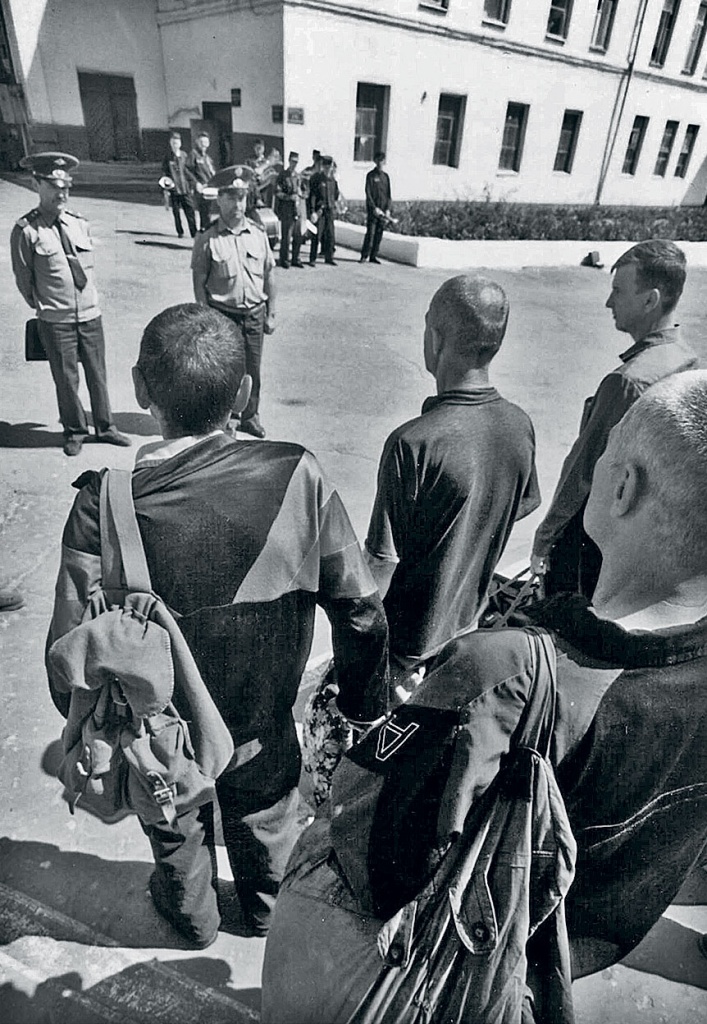 |
| The 2000 amnesty was the last truly mass (in the photo-the release of prisoners from a colony in the Voronezh region) |
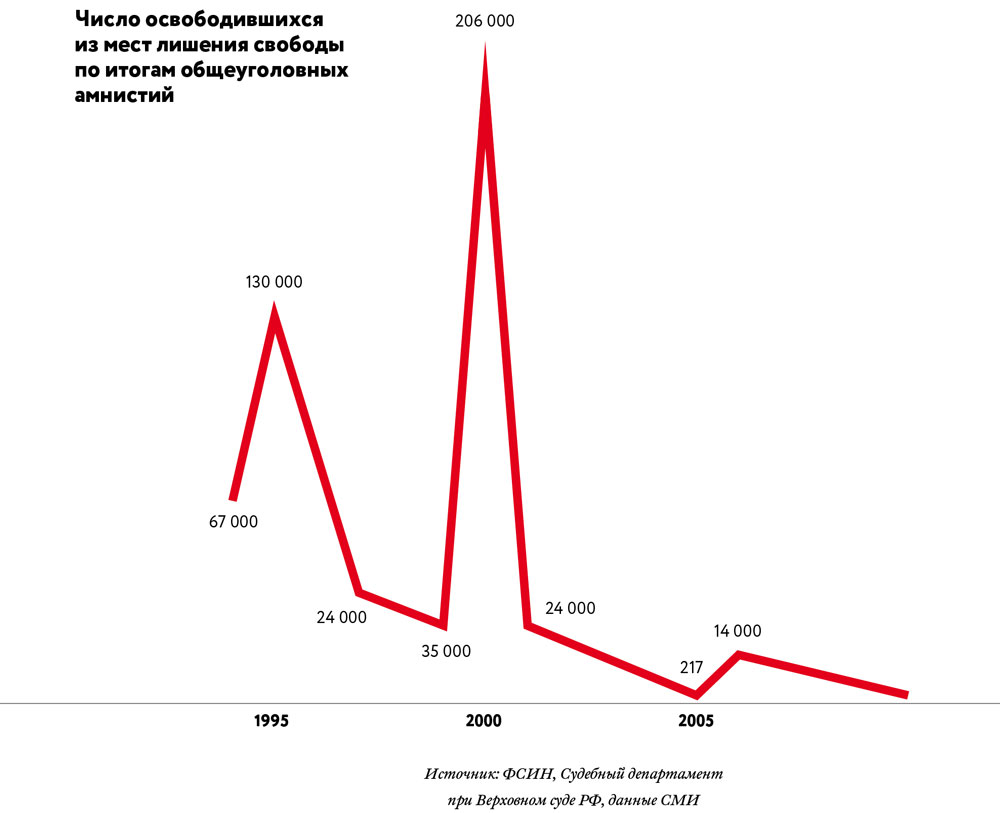
True, during the time of Boris Yeltsin, such a “sacred” amnesty on the occasion of an important date occurred only once-in 1995, to the 50th anniversary of the Victory in the Great Patriotic War. It turned out to be the most massive during this period, affecting 130 thousand people: participants in the war, disabled and women with children were released immediately, and many other categories of prisoners were reduced.
But in the 90s, “acts of humanism” were more often associated not with memorable dates, but with specific political events. So, as a result of the first in the post -Soviet history of an amnesty, declared in February 1994 a freshly elected State Duma, the defendants “GKChP affairs” and participants in the 1993 October events in Moscow from among the defenders of the Supreme Council were released. “This was associated with an agreement between the authorities,” recalls Judge Pashin, who in the early 90s worked in the legal department of the apparatus of the RF Armed Forces. - They resorted to this form, although a pardon would be more appropriate. The problem of the shooting of the White House played a role: the State Duma decided to amnesty of all participants in these events, that is, in fact, she amnestied the president and his team. "
Experts also include three “Caucasian” amnesties of the second half of the 90s, which fell under both militants and military personnel of federal forces who committed crimes and other “socially dangerous acts”. And only two amnesties (1997 and 1999) did not have any special reason and therefore touched on the circle of convicts traditional for general amnesty: participants in wars and conflicts, owners of state awards, women with children, disabled people, and those who committed the crime by negligence.
Human considerations
The amnesty for the 55th anniversary of Victory, despite the non-rounded anniversary, turned out to be the most massive for all twenty post-Soviet years-206 thousand people were released, and about half a million (including those who were serving a sentence not related to imprisonment) came to the freedom). The mass was explained by the state of legislators unheard of for the new Russia. In the list of victory, the list (veterans, pensioners, women, etc.) deputies included several more large categories: for the first time convicted for up to three years (for women - up to five), those who have left less than a year before the release, and those who have long time (up to ten years or more) have already served two -thirds or three quarters of the due. Moreover, the Duma agreed even to those who were sitting for serious crimes.
Despite the almost Soviet scale, the amnesty project was approved without much difficulty. “In the State Duma, as a rule, an amnesty was accepted unanimously,” recalls the expert of the Institute of Human Rights Lev Levinson (in the early 2000s, the assistant to the State Duma deputy from the ATP of Sergei Kovalev). - The Communists were more restrained, but supported. The Ministry of Internal Affairs did not support, but the FSIN was always with two hands "for". After all, it was in those years when a wide amnesty was needed because there was a million prisoners. ” True, it was not without a scandal: according to Levinson, after the amnesty it turned out that the list of amnesty "included obviously not any reason to get there in order to bring some people." But in the end, "they didn’t catch anyone by the hand."
The next year, a special amnesty was announced in relation to minors and women, in the preparation of which Lev Levinson took part in the preparation: “We promoted the idea that all sitting should get a discount, if not for a year, then for at least six months. Well, there was a principle that at least a little amnesty should affect all convicts - because the situation is very deteriorating in the zone when one prisoner is released, and the other remains without any condescension. ” The FSIN supported this approach, and 25 thousand adolescents were released. As Levinson notes, after that there was not a single amnesty that would so significantly affect the number of convicts.
Actually, there were only three unitations in the next twelve years themselves over the next twelve years, except for two Caucasian ones: two were timed to the next anniversaries of victory, and one more, in 2006, to the 100th anniversary of Russian parliamentarism. But the persons whom they touched every time they became less and less. Say, in 2005, the list of amnesty was limited to only two groups - directly war veterans and prisoners of Nazi concentration camps. At the same time, for the first time in many years, an amnesty did not fall such categories of prisoners as women with babies, minors, disabled people and pensioners. And in 2010, a loud scandal happened at all: at first the deputies spoke about dozens and even hundreds of thousands of amnesty, but the Kremlin eventually insisted that only veterans-63 people were released directly. 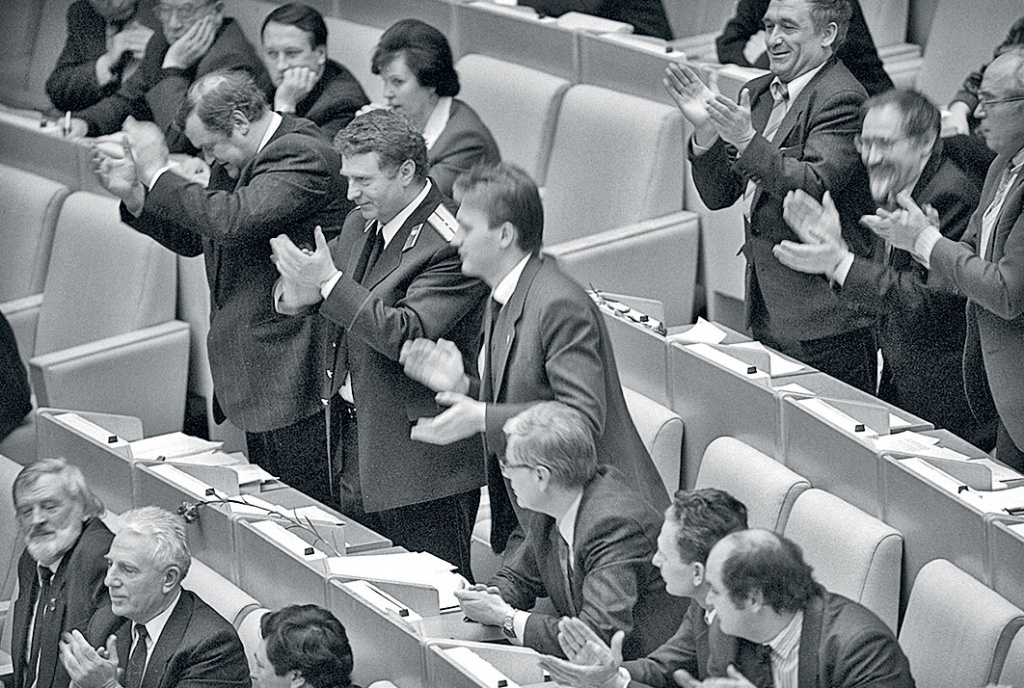
From general to private
Why did the amnesties have lost its former mass in the last decade?
“In the 90s, many people still sat on the Soviet Criminal Code. Accordingly, by changing the Criminal Code itself and the system itself, we gave freedom to those who sat back in Soviet times, ”explains Pavel Krasheninnikov, chairman of the State Duma Committee on Criminal Law (in 1998-1999 - Minister of Justice of the Russian Federation). “But in 1996 a new Criminal Code was adopted, and less and fewer people sat under the Old Code.”
A slightly different version of veterans of the penalty system. “The amnesties became very selective and small, because there is simply no one to free,” explains Vyacheslav Seliverstov. - 80 % of convicts are serving sentences for serious and especially serious crimes. Five years ago, there were 60 %of them, ten years ago - 40 %. The question is: and how to show mercy here? " According to the former head of the Research Institute of the FSIN, because of this, the leadership of the colonies even experiences serious difficulties with the selection of prisoners in the household service: earlier only those who were convicted of low crimes were taken there, and recently allowed to attract those who first sit for serious ones, but there are still not enough people in the Hozo-service. “Also with an amnesty: you can free veterans, those who are awarded orders and medals, and so on,” summarizes Seliverstov. “But the decision says that it is impossible to free malicious violators of the regime, persons who have committed serious and especially serious crimes against the personality. And we will succeed that there is no one to free. ” "
“80% of convicts are serving sentences for serious and especially serious crimes. The question is: and how to show mercy here? "
“What will be in this case with the institute of amnesty? And does the current trend mean a steady decrease in the number of emerging, that amnesties will soon stop at all? Experts have no consensus on this score.
“In general, with normal, objective and fair justice, the institution of amnesty should not be used too widely,” says lawyer Henry Reznik. - Well, what is it: a fair court determined a completely reasonable measure of punishment - and suddenly we release it a year later? In general, this is discrediting the judiciary. ” But since “normal justice” in present-day Russia is not about, an amnesty, according to a lawyer, has turned into a way of correcting unfair sentences-all the more so since the institution of pardon, which was actively used for this purpose in the 1990s, is now not actually applied. From this point of view, Reznik believes, the current amnesty project based on economic articles also looks reasonably: “The affairs of entrepreneurs were considered unrighteously very often, there are a lot of custom -made things, at different levels, where businessmen fought with their competitors.”
“If the sentences are ordered and the cases are wrong, then it is necessary to apply supervision or revise sentences,” Judge Pashin argues in absentia Reznik. - Or there should be a pardon - if a person is convicted incorrectly, but the authorities want to maintain a face. And the amnesty is the indiscriminate mercy for formal considerations. ”
“There should be amnesties, but it is better that the Criminal Code is decent,” the legislator of Krasheninnikov offers the third path. - We need to see if the judicial machine works correctly in a broad sense. And if we see that some part of people for some articles is not dangerous and the criminal situation from the amnesty will not deteriorate, why not do this? ”
However, the authorities may not fear the amnesty itself, but the reaction to it from ordinary citizens. After all, most Russians, as sociologists have repeatedly noted, ardently support the course of tightening everyone and all sorts of punishments and are clearly not prone to all sorts of punishment. And the leaders of the country are unlikely to afford to approve the measures unpopular measures in the conditions of constantly falling ratings.
Especially negatively can be perceived by society with just an amnesty for entrepreneurs. “Medium-sized businesses relate to the trust of only 24 % of respondents, a large-16 %,” explains the expert of Levada-Center Denis Volkov. “And when we asked people about the tax amnesty, only 31 % of respondents supported it - while, for example, an amnesty for Chechen militants who did not commit serious crimes, 46 % of the respondents acted.” In addition, as the sociologist emphasizes, in the mass consciousness the theme of unfairly convicted entrepreneurs, in fact, is absent. “Therefore, it can be assumed that a large number of respondents are simply difficult to answer the question of economic amnesty,” Volkov says. “But there will be a lot of those who will react negatively to her, believing:“ Once they sit, it means that it is guilty. ” 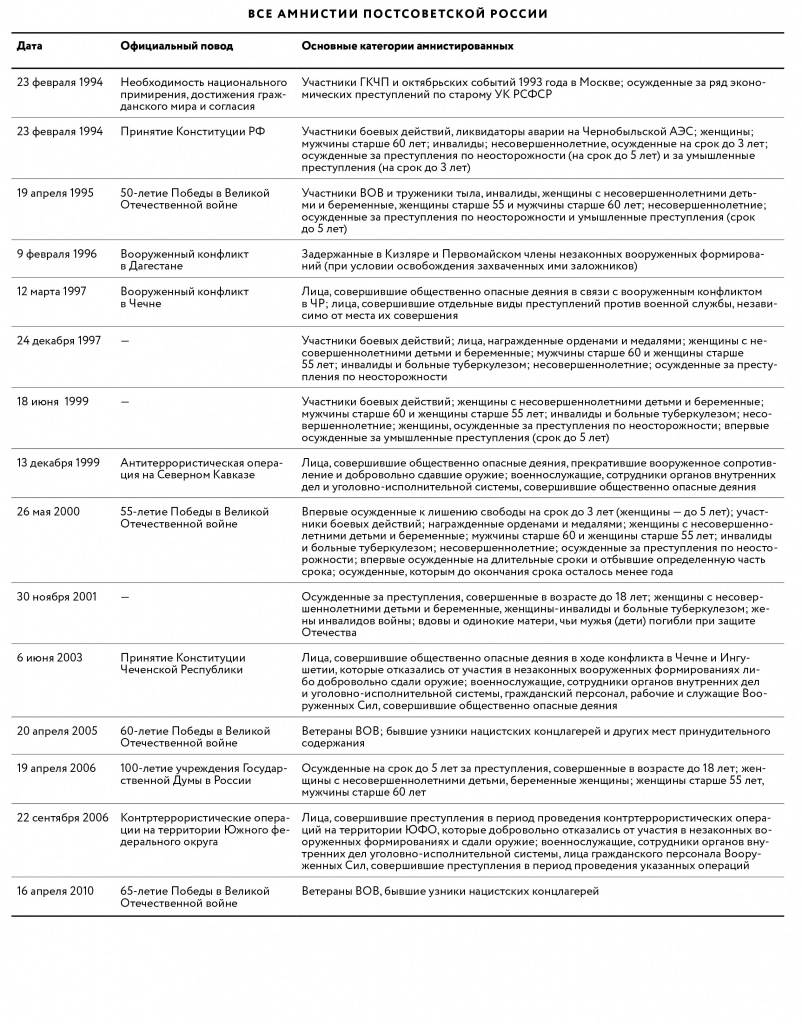

Photos: RIA Novosti, ITAR-TASS