
Translated material
On the eve of Biennale
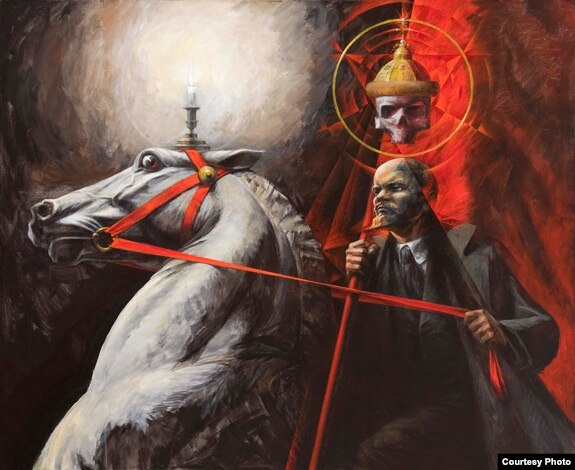
Alexander Genis: On the eve of the opening of the Venetian Biennale, the main, perhaps, a show of contemporary art, we met in our New York studio with a member of Biennale Vitaliy Komar in order to talk about the fate of fine art in different camps of different periods. Vitaly, what are you going to Venice with?
Vitaliy Komar: I participate in the exhibition, which is prepared by the Moscow Museum of Modern Art, the exhibition is called "Difficulties of translation." One of my early work will be shown, which is associated with the images of mass agitation, visual propaganda, with slogans, with texts and their possible translation.
Alexander Genis: from what translation to which?
Vitaly Komar: This refers to a universal understanding of the word "language". Because, as you know, a visual language, for example, can be a language. Dance. Painting. Many varieties of visual language. For example, a dance can be combined with a sound language, music as a kind of speech, speech as a kind of music. It understands the translation in a very broad sense.
Alexander Genis: As we know well, having lived a third century in America, the difficulties of translation are our whole life. When you arrived in America and brought here Soviet images, Soviet emblems, Soviet symbols, how difficult it was to translate this language into the American language?
Vitaliy Komar: Visual language is more universal than the national, folk language, the country's language. The fact is that, for example, the language of Soviet propaganda worked with the ideas of communism, socialism, Marxism and so on, but the very idea of propaganda and the idea of advertising, the Western idea of advertising is structurally very similar. For example, I can call Soviet slogans an advertisement for socialist ideology, an advertisement for Soviet ideology and I can name Western slogans, Western advertisements by the propaganda of consumerism.
Alexander Genis: Of course. I agree with you, because all this goes to the same source - mass art. Goebbels can also be remembered here. But it is interesting for me something else, tell me, for example, Mickey Mouse is such a powerful image that has won the whole world, it is just as popular in China or in Mongolia, as in Russia and America. But all efforts to propagate the image of Lenin did not lead to such consequences. Why does one campaign turn out to be successful, but the other is not? How do you, as a specialist on this issue, decide such a dilemma?
Vitaliy Komar: The fact is that Mickey Mouse has never been declared an American. Mickey Mouse was universal, like any animal.
Alexander Genis: But Lenin never declared himself Russian. When he was asked who he is by nationality, Lenin said: by nationality I am a revolutionary. That is, Lenin is also a universal figure?
Vitaly Komar: Absolutely, he has many names, including a revolutionary, he was a man with a mass of pseudonyms. But still, he remained in the context of exclusively the Russian revolution.
Alexander Genis: Vitaly, as one of the fathers of Sotsart, who developed this style on both sides of the Soviet border, what is the stylistic difference between the Sotsart in the Soviet Union and the Sotsart abroad?
Vitaly Komar: Sotsart abroad has become much more elitist, I would say. If we compare the early sotsart, which Alik Melamid and I began to do at the very beginning of the 70s, then we came up with the word sotsart as a designation of our project, then it became a common house. So, this sotsart dealt with exclusively street mass propaganda and campaign, with visual agitrope or, as they said, visual agitation. And that sotsart, which gradually transformed and arose in the West, was more elitist. He has already operated on with museum art. Here you need to make a small excursion into the history of art, which has not yet been digested. Visual agitation, street slogans were a branch of the Russian avant -garde, which survived in the Stalinist conservative period. In the museums, the avant -garde was destroyed, he was demolished into the cellars, his place was taken by realistic, socialist paintings. But on the street these slogans, state conceptualism, begun in the early years of the revolution, he remained.
Alexander Genis: That is, the mausoleum is state conceptualism?
Vitaliy Komar: Partly, Mausoleum is an eclecticism, it is a mixture of the Soviet socialist realistic kitsch and the Russian avant -garde. The fact is that Sotsart had two branches. One branch is an eclecticism where socialist realism and Soviet culture were considered along with other world trends of the 20th century and the previous stages of art, another branch is an appeal to advertising slogans. We had projects where Western advertisements, Western catalogs were used in the form of conceptualism until the sale and purchase of souls, and so on. But the product was as ephemeral as ideology.
Alexander Genis: Tell me, can you apply the Sotsart to the American topic? For example, I remember your work, where Reagan was depicted as a centaur, the work was very popular.
Vitaly Komar: Of course, and not only this work, there was a whole series. It was called the "American dream." We made the opera together with the composer David Solgher, she withstood quite a few productions, and there was a large press where Lenin and Washington discussed and argued whose revolution was better. They were joined by Marseille Duchan, who also did his main revolutionary thing in 1917, put the pussar, calling it a fountain, and placed it in the space of the exhibition.
Alexander Genis: Many people believe that Sotsart died with the Soviet regime, if, of course, to assume that it has died. What do you think?
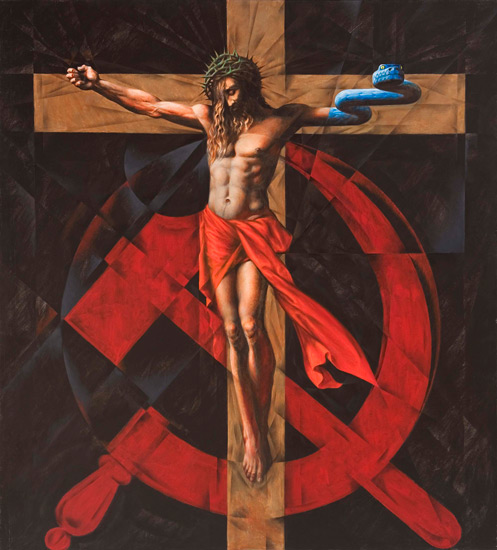
Alexander Genis: That is, the ironic gap that allows you to look at the object ironically.
Vitaliy Komar: Questionnaires can be perceived ironically. But if this is an ironic attitude by definition, then this is an early sotsart. If it is, on the contrary, praise, then the same quotes appear here. Now it is impossible to talk about any phenomenon of Soviet culture without being a socialist.
Alexander Genis: That is, you do not give the art of exit: it can be either a conscious Sotsart or an unconscious Sotsart.
Vitaly Komar: Yes, conscious or unconscious sotsart. But Soviet culture itself is already in the past, and therefore this temporary distance acquires a certain intonation that has never found in genuine texts and images.
Alexander Genis: I understand your words well by comparing them with the German experience of the Ostalgia: nostalgia for the east.
Vitaly Komar: We made a series of nostalgic socialist realism, if you remember, it was 81 years old.
Alexander Genis: Yes, I often recall the statement of Maria Romanova: “Emigration is a drop of blood taken for analysis.” We, in Russian America, because everything happened earlier. I remember that I brought one Soviet writer to the brownton beach to perestroika, he looked at luxurious stores with sausage and said: “We will not be allowed this vulgarity.” Allowed.
Tell me, how much is the Sotsart international phenomenon? For example, you worked with Chinese artists. It seems?
Vitaly Komar: Chinese artists, of course, were under the strong influence of Sotsart. The book about mosquito and melamide without copywriting was transferred to Chinese without permission, and are still sold in many Chinese museums and bookstores. Young Chinese artists admit that acquaintance with the works of Russian Sotsart made a great impression on them. But, I think, Chinese colleagues surpassed us in size and investments. The fact is that for Chinese artists, for Chinese culture, there was never an avant -garde as a protest against a certain old European culture. They came to modernism, when modernism was quite respectable, bringing large incomes. Therefore, they never had avant -garde, underground, causing non -conformism, and therefore did not manifest itself of self -destructive instinct.
Alexander Genis: That is, the avant -garde was part of Western art, perceived without protest, without war, without scandals?
Vitaliy Komar: In those years when modernism was allowed in China - after the death of Mao Zedong, in the late period Gorbachev - modernism was not an avant -garde, it was not a revolution, it was expensive among the bourgeoisie, among respectable museums, respectable circles by direction in art.
Alexander Genis: How do you feel, for example, to the work of the artist Weivey?
Vitaly Komar: He is a wonderful artist. When he was in prison, I gave my work at the auction - the money went to the campaign to be released.
Alexander Genis: Recently, you performed in New York with a lecture on your work, which can be considered to be summed up of intermediate results. Yours, both jointly with melamid, and individual creativity is extremely protein, you are constantly changing. What remained unchanged throughout all these years?
Vitaly Komar: I think the sotsart certainly changed. But the main two directions of the changes were very clearly outlined-this is the sotsart, understood as conceptualism or, rather, the conceptual pop art, since we put forward a rather unexpected understanding of the agitprope of visual as state social conceptualism.
Alexander Genis: That is. How can Bank Soup Andy Warhol, a portrait of Lenin can serve as the same object of painting?
Vitaly Komar: Rather, not the bank itself, but advertising of this can, advertising this soup. Because we always deal with double reflection, with a reflection of reflection. Still, the conceptual pop art is not the product itself, but this is an advertisement for this product.
Alexander Genis: Recall that Andy Warhol is also not depicted by the soup, but a bank with a soup.
Vitaly Komar: Of course, but the bank itself can be on sale as a volume that can be opened and eaten. And another thing, a flat image of a can on an advertisement for a soup.
Alexander Genis: That is, this is pop art in a square.
Vitaly Komar: This is an image of the image.
Alexander Genis: That is, this is what is called a simulacra: a copy without the original?
Vitaly Komar: In a sense, one can call it so, this is absolutely true.
Alexander Genis: And the second direction?
Vitaliy Komar: The second direction is the realization of Sotsart as one of the styles of the history of world art. It was a very important transition to eclecticism, which made it possible to really change. If you formulate simply, this is a different understanding of an individual style. The fact is that we confuse the concept of individual style and the concept of a collective historical style. Both that and another in the history of art is called style.
Alexander Genis: In one case, this is a style, in another case - it is rather a school.
Vitaliy Komar: Manner, School. Nevertheless, the word "style" here is quite correct. What is the essence of this discrepancies or the use of synonyms, but with different meanings, which very often in the language indicates an important point. Individual style can be attributed to the collective style, for example, impressionism or cubism. We see the cubism of Picasso, the cubes of marriage, but nevertheless, in the framework of the collective historical style, the named cubism, we see the individuality of Picasso.
Alexander Genis: Although it is difficult to distinguish from each other in a particular example.
Vitaly Komar: No, I'm distinguishing. It depends on how long you learned the language. Like any other language, visual language requires complete immersion in it. I always distinguish a person who is somewhat superficially familiar with the history of styles, and a person who is simply interesting to do regularly and so on, not just as a general education gesture, namely a person plunges into it.
Alexander Genis: I'm just the same amateur who is all interesting ...
Vitaly Komar: There are talented amateurs who simply very easily study the language by sound, without delving into its meaning. There is a huge number of various approaches. Take a wide variety of impressionists, many, even my colleagues do not always distinguish an impressionist sisleya unprecedented to them from some landscapes, suppose, Pissaro, but nevertheless, if you have loved and were interested in it, you are caught the difference in intonation.
What I actually lead to-for the first time, starting with impressionists, appeared in the same city, for example, Paris or in New York, at the same time, for example, at the end of the 19th century or today, the simultaneous existence of different styles. This has never happened. For example, in the age of Caravaggio, all artists are more or less mannerists and everyone was influenced by the Caravague Light effects. What is happening today is a completely unique picture. You are walking around the Gallery area in London, in France, Paris or in New York, and you see that in this gallery they sell abstract art, in that gallery geometric abstract, in this expressive abstract, in this photorealism, and here the Greek icon is sold, and there are excellent schools, there are excellent schools. Here the stylization of conceptualism or even videoart is sold. And every person who loves one or another goes to the gallery that he likes. You will not buy chicken in a furniture store.
Today it was this unique opportunity, since the style began to play the role of the genre. There was an opportunity to express the same author’s individuality in different styles.
This is what our proteinity that you talked about was explained. You distinguish Picasso not only as a cubist, but a Picasso symbolist in his blue and pink period from other symbolists. This is the whole charm. There is an opportunity to show your individuality, our individual intonation just as we now use words from the dictionary, not we invented them. Suppose Alik and I came up with the word "sotsart", but we take most of the words from the dictionary. However, our voice, the pronunciation of these words is individual.
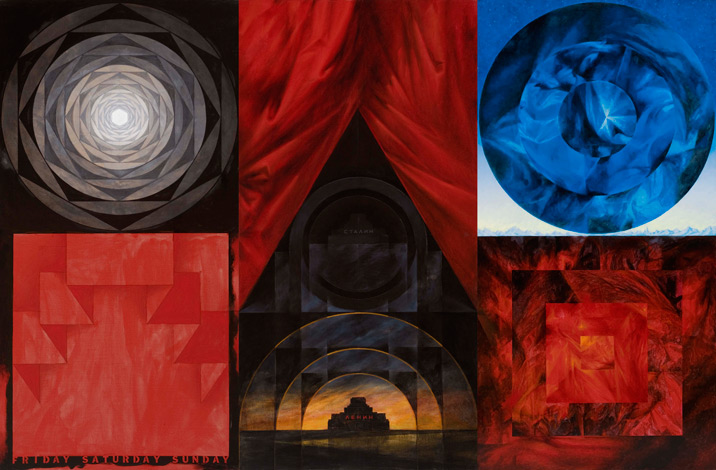
Vitaly Komar: You can say anything, the words are sometimes powerless to describe a difficult situation. I think in the history of art we meet artists, for example, Kurba, which could make large compositions, portraits, still lifes, and landscapes. The same thing with multi -facet artists, the possibility of which only now appears. Because Picasso changed periods at different times. Now there is an opportunity for artists, who at the same time, in fact, are returned to one or another style during one year, depending on the mood. I think this is the highest freedom even in the Buddhist sense.
Alexander Genis: It is always interesting to talk about history with you. Once you said that artists know the story well, because every artist the heir to the whole tradition at once. And your Buddhist ideas about the protein artist fit very well into the eastern tradition. So the Japanese every 7 years changed the names and manner in order to become a different person. This update, of course, is uncharacteristic for us in the West.
Vitaliy Komar: This is closer to Picasso, he had periods. But I'm talking about the fact that for literally a year a person can work in different styles - genres. My favorite example with Kurba and with large artists who worked in the genre of still life, wiped, large compositions, landscape. I think. That more and more names appear, who realized this freedom of work with different styles, who realized art as a dictionary of intonations, as a kind of encyclopedia. After all, every dictionary, like any encyclopedia, is an eclectic apogee. Today we lose the line between eclecticism and synthesis, we simply connect things, we connect Darwin and religion and do not think about contradictions. Even pronouncing these words is different in time. You cannot simultaneously utter two different words, it is impossible to do this to one person, but you can do it in a row.
Alexander Genis: Do you think that today's art can comprehend this state of things?
Vitaly Komar: I think this is a very important process, because eclecticism should sooner or later eradicate the Aristotelian tradition of dualism: thesis, antithesis and synthesis as a combination of some two contradictory elements, and roughly speaking, a compromise, especially at the level of politics and diplomacy. In the East, in particular, within the framework of the tradition of Zen, the existence of the third, suppose, of an element that is equally opposite to both the first statement of the opposite and the second opposite, is not excluded. In the European tradition, it is very difficult to imagine the third statement, which is equally opposite to two contradictory statements.
Alexander Genis: In the East, this is also difficult. They have been tormented by the Coans for years.
Vitaly Komar: Of course, this is a special tradition. But it seems to me that it is in the language of art that this eclecticism is now ripening. And in politics too. Мы видим странное смешение элементов социализма, понятого как большая корпорация, и капитализма, понятого иногда как криминальную анархию, и в Америке это смешение происходит, и в России, но, конечно, пропорции разные.
Александр Генис: Это как рецепт паштета из рябчика - одна лошадь, один рябчик.
Виталий Комар: Бывает и так.
Александр Генис: Виталий, давайте вернемся из теории к практике. Ведь это не первое ваше явление на биеннале, какое было самым памятным?
Виталий Комар: Самое памятное было участие на биеннале, на котором я не был. Дело в том, что я, как и многие художники, работы которых были уничтожены во время «бульдозерной выставки»,. А «бульдозерная выставка» включена во все списки и книги, посвященные самым интересным выставкам 20 века. Я уехал из России в конце 77-го, буквально зимой. Мой соавтор Алик Меламид получил разрешение раньше, и он смог попасть на “диссидентское” биеннале 1977 года. Я, к сожалению, не смог попасть. Мне было очень интересно само участие такое эфемерное. Затем второе участие в биеннале в интернациональном павильоне в Арсенале - это был, если я не ошибаюсь, 1995 год. А в 99 мы с Аликом Меламидом представляли Россию на первом этаже павильона, на втором этаже был петербургский художник Африка (Бугаев). Русский павильон в этом году представляет художник Захаров, совершенно замечательный концептуалист, который всегда очень интересен, он мне кажется. обладает очень хорошим историческим подходом. Теперь национальные павильоны сопровождается большим количеством павильонов с групповыми выставками и, в частности, выставка, организованная московским Музеем современного искусства «Трудности перевода» — это та выставка, где я участвую, и я еду еще раз взглянуть не столько, откровенно между нами, на картины, сколько на саму атмосферу, где смешиваются произведения искусств с людьми, с самим городом, с питием кофе и рассматриванием потока людей так же, как отшельники когда-то рассматривали поток воды. Вот это удивительное ощущение больших международных выставок: ты находишься в толпе и в то же время каждый одинок. Это, кстати, возвращает нас к идее проявления индивидуальности в рамках коллективного стиля.
Александр Генис: Виталий, а правда, что вы собирались слона привезти на биеннале?
Виталий Комар: Конечно, он был запланирован, безусловно. Выставка была посвящена соавторству с животными. Вы знаете, что художники всегда работали в соавторстве с животными, возьмем даже такой пример, как изготовление кистей: без меха, взятого у животного, иногда на время, иногда навсегда, вообще ничего нельзя нарисовать.
Александр Генис: Правда, у животных не спрашивали.
Виталий Комар: У животных не спрашивали, конечно. Но Вы знаете, я вам скажу про выставку, это была моя старая работа, и меня не спрашивали, взять или не взять, просто взяли у коллекционера, а мне сообщили задним числом, что не просто взяли, но и сделали ее символом. Это была приятная новость в любом случае.
Александр Генис: Но как со слоном обошлось?
Виталий Комар: Русский павильон был превращен в павильон животного царства. Кроме шимпанзе Микки, которого мы учили сначала работать с поляроидной камерой, а когда он осознал процесс появления изображения на плоской фотографии, то потом уже и со старомодной камерой, но там и слоны участвовали.
Дело в том, что с незапамятных времен слоны испытывали и испытывают до сих пор странную потребность, зажав в кончике хобота какой-нибудь кусочек камня или деревяшку, рисовать странные линии на пыльном грунте, на пыльной или сырой поверхности земли. эта любовь к линиям. Эта любовь к линиям необъяснима, и факт видимо, ждет своих исследователей. Может быть творческий инстинкт гораздо древнее, чем нам кажется.
Александр Генис: Леви-Стросс говорил, что если пение делает человека человеком, то я согласен считать людьми даже птиц.
Виталий Комар: Я полностью согласен с этим, это очень правильно. В том проекте соавторства с животными были, например, проекты плотин вместе с бобрами, дома термитов, которые, безусловно, задолго до Гауди нашли этот архитектурный стиль. В частности, что мы сделали с Аликом: мы заменили кусочек камня или кусочек дерева, который слон может найти в лесу или в поле, на нетактичные, на водной основе, краски, и дали кисти. Слоны стали делать очень интересные картины, которые условно можно назвать абстрактными картинами.
Александр Генис: Я помню, вы мне показывали эту работу и говорили, что у слона есть непредсказуемая линия, что чрезвычайно ценится у абстракционистов. Но послать слона не удалось в Венецию?
Виталий Комар: Так же как не разрешили привезти звезду московского цирка Микки. Общество охраны животных и защитники прав животных весьма преуспели, особенно в Италии, в последние годы. В зоопарках появляются только те особи, которые были рождены в зоопарке. Запрещено привозить животных в неволю из других стран, вырывать из первобытного контекста.
Александр Генис: Традиционный вопрос: какие ваши планы - ближние и дальние?
Виталий Комар: Я сейчас продолжаю проект, где соцарт сливается, перерастает, развивается в символическое искусство. В свое время не только я, но многие обратили внимание, что пионеры авангарда и модернизма в ранних работах были под сильными влиянием символизма. Ранние работы Пикассо, ранние работы Малевича, Кандинского и так далее. Символизм был общим местом в живописи того времени. И идея модернизма, авангарда, идеи разрушения старых традиций возникали одновременно с марксистскими идеями, с социалистическими идеями, только они имели дело с визуальными традициями искусства, а не с проблемами устройства общества. Влияние символизма, в частности, Бодлера мы можем найти в бакунинском переводе первых строчек «Интернационала»: призрак бродит по Европе.
Александр Генис: Призрак - это фланёр Бодлера?
Виталий Комар: Безусловно, мы сейчас недооцениваем насколько и Маркс, и ранние авангардисты были детьми вот этого символизма, детьми символистского понимания красоты и мира. Вот я и пытаюсь немножко вернуть соцарту корни символизма, привить ему легкий мистицизм.
Александр Генис: Мой последний вопрос связан с датой. Мы только что отметили 75-летие со дня рождения вашего соратника Вагрича Бахчаняна, которого, увы, уже нет с нами. Каким вам представляется творческое наследие Бахчаняна сегодня, что в нем кажется сегодня ценным и актуальным?
Виталий Комар: Я всегда испытывал большую слабость к работам, к искусству Вагрича и к нему, как к человеку. Он был удивительно обаятельный, остроумный человек. С ним было очень приятно общаться. Я даже с трудом отделяю контекст его личной жизни, личной истории от того, что он делал. Вообще художнику, мне кажется, трудно отделить альбом по истории искусств от семейного альбома, мы все на одном дереве находимся генеалогическом в этой истории искусств. И в этом смысле мы с Вагричем были не просто отростками от одного ствола, но, я думаю, отростками на одной ветви. Неслучайно и его, и Комара и Меламида, и Пригова, многих других художников, например, Сашу Косолапова, такие критики как Гройс и другие известные критики, живущие в России, причисляли к соцарту. Это вдвойне делало нас родными.