
Translated material
In Moscow, an exhibition of winners of World Press Photo, including a scandalous photo winner, opens
The exhibition of the winners of the 56th International Competition World Press Photo opens in a chocolate workshop on Red October. About 200 photos were selected from 103 thousand pictures of 6 thousand authors from 124 countries of the world, RIA Novosti reports.
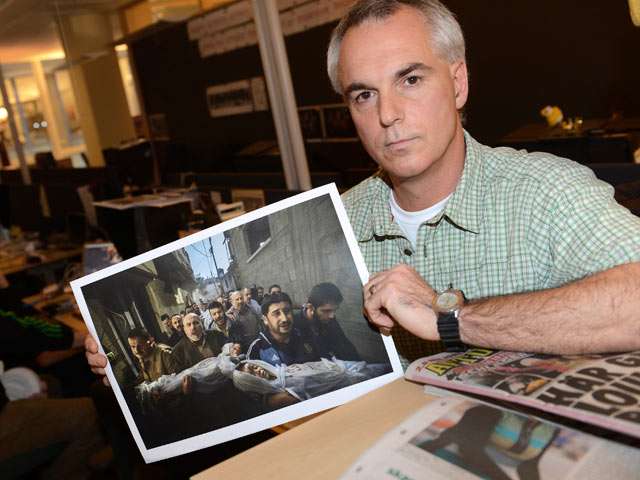
The exposition presents, in particular, the best picture of last year , in which the Swedish photographer Paul Hansen captured the funeral of two Palestinian children - brother and sisters who died in the gas sector as a result of a missile strike from Israel.
This picture caused experts at the installation and admissibility of such processing of photographs.
Among the presented works are the winners in the nomination "News", "Events", "Sports performances", "Sports essays", "Problems of modernity", "everyday life", "documentary portrait", "staged portrait" and "nature".
Among the works of the winners who were chosen in nine nominations, there are also Russian Ilnitsky made by Russian - he was awarded second place in the “Sports Event” nomination for photographs from the summer Olympics in London.
The attention of photojournalists last year attracted such problems of society as crime, sexual operation, conflicts in the Middle East.
In the nomination "News", the first places for a single frame and a series of pictures were received by photographers from Italy and Argentina, who illuminated the conflict in Syria. Like a picture of the year, the best work in the Emergency Message nomination is highlighting the situation in the gas sector.
For everyone, the exhibition is open until May 30.
Experts doubted the authenticity of the photograph "Funny in Gaza"
Two weeks ago, the organizers of the World Press Photo announced that the experts had doubts about the authenticity of the Swedish photographer Paul Hansen "Funny in Gaza", which received the Grand Prix of the competition in 2012, reports Newsru Israel with reference to The Independent .
The picture taken on November 20, 2012 during the Operation Cloud Pillar depicts the residents of the Gaza, who follow the mosque in the mosque, holding two children in the burial saves in the arms. Sukhab Hijazi two years old and her older brother Muhammad were killed as a result of the blow of the Israeli Air Force on Gaza. Foid Hijazi - the father of the kids - died as a result of shelling, and the mother fell into intensive care. The children of Foad had to bury the children, which are depicted in the picture.
Doubts about the authenticity of the photo arose from the expert of the site Extremetech . Independent expert Neil Kraus using the technologies used by the criminals, found that several photographs were connected in the picture presented to the competition. According to him, other images were imposed on the original three times. Moreover, the last time the photograph was edited on January 4, 2013, two weeks before the last deadline for applying for the competition. And he suggests that the "photomontage" was made specifically for the competition.
It should be noted that after the results of the competition were announced, Paul Hansen, working in the Dagens Nyheter newspaper, in an interview with AP complained about the technical problems that prevented him from conveying the emotions of the crowd. According to him, the picture could be even more expressive. Now, after experts generally had doubts about the authenticity of the photograph, he says that he only processed the original for more expressiveness. Mainly in order to “pull out” some details that turned out to be too dark.
The organizers of the competition said that Paul Hansen and previously said that the picture was processed using the "permitted" methods. And the jury has no reason to doubt his honesty. However, in order to avoid further speculation and gossip on this subject, the controversial picture was studied by independent experts.
Experts involved in the World Press Photo accused Neil Krauz of ignorance of the work of the Photoshop program. In particular, the forensic scientist Eduard de Cam came to the conclusion that "each pixel of the competitive photograph corresponds to the source." At the same time, he admitted that the photograph was subjected to significant processing, which, apparently, explains its "incredible lighting."
Nevertheless, the organizers of the competition announced the tightening of the rules for receiving photographs, obliging the authors to provide sources.