
Translated material
Understand the sound of the book
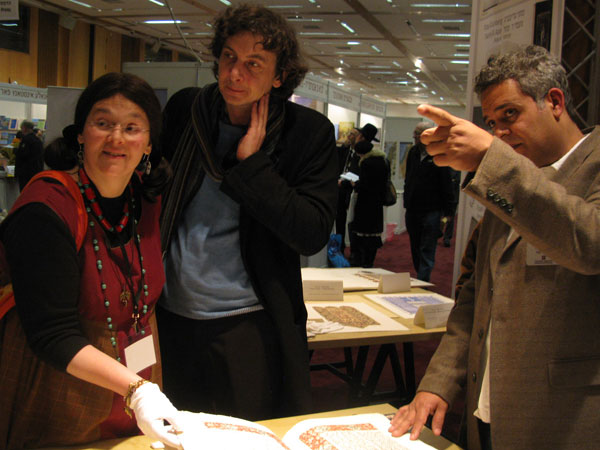
Our conversation with the famous artist, illustrator of books Andrei Bondarenko took place at the 26th International Jerusalem Fair in the framework of the project “Book-Knowledge”. Talked by Natalia Demina .
Do you remember how you learned to read, and what was your first book?
I don’t remember the first book at all. It seems to me that I read it all the time. I have already read four years. About five years, the door from the locker, where toys were stored, fell on me in kindergarten, and I do not remember anything that was up to five years old, nothing at all. Everything flew out of my head, separate scenes only remained.
I always read a lot, and it somehow happened that my grandmother in the Rabfak diploma had a “scribe” profession, such a purely Jewish profession, and I somehow naturally began to read books. Parents worked a lot and could not devote much time to me, and I began to read "ahead of schedule." I remember that I read the “three musketeers” somewhere already in the second grade. I tried very hard to read everything that was at our house, even those books that stood behind other books that parents apparently did not want me to see. For example, somewhere in the class in the fifth I already read a textbook on the treatment of trichomoniasis. And Maupassant, Zola, and so on, went in the classroom, and so on ... somehow very quickly grew all kinds of adventure books and very thoroughly ... My dad was a very thorough person and, when he and his mother met, she asked: “What are you reading?”, He replied: “Romain Rolan”. She clarified: "And what exactly?" “It is the eleventh volume.” - "Do you like him?" - "No". “Why are you reading it?” “Because there are only three left.”
By the way, I composed the first crossword puzzle in the first grade at the request of my friend-Huligan Seryozha Surikov, and the first word that forms the word vertically: “Surikov’s sister”-“prostitute”, and then 27 more dirty words, very beautifully compiled, as it seemed to us, obscene.
And here I am about the same: I read the whole “human comedy” of Honore de Balzac, from beginning to end. I read the Old Testament very early. The New Testament did not really interest me, and the “dilapidated” was completely struck. The size, enormous lists ... I read it in a row. I think that such a rare child will withstand. But I really loved to play alone, one read, it was a whole world. Reading was included in this world, therefore, with regard to very children's books - I just don’t even remember when I read them. Apparently at the very beginning.
At school, I read everything ahead of the lead, then I had such a specific institute-the Moscow Art Theater School, we were taught as theatrical artists. We had a brilliant teacher Inna Solomonovna Pravdina. The questions on the exam, for example, were: "What hung on the left stick of the fence at Ivan Ivanovich?" And it was necessary to say for sure that these were blue trousers that very much decorated the view ...
It looks like a modern exam?
No, the idea was that the theater artist, reading, should grab visual images. And it helps me a lot in working on books, because I am very attentive to visual details. I read books at different levels. In addition to any visual data, style is very important to me.
For example, I have done the same Umberto for the fourth time, and every time I need to re -read the book. Although IVF seems to be a “head” writer. But still, I need to re -read it every time in order to re -understand his “sound” at this time. In a couple of years, the context changes, the “sound” itself changes.
Cover A. Bondarenko
How did you not become a theater artist, but an artist of the book? What was the first book you have made?
In general, I myself wanted to be a book artist from the very beginning. But then it was impossible to enter the printing institute. I came there after the tenth grade, began to talk. They tell me - and who is mom? I say: "Mom is a translator." They are so joyful: "Oh, translator!" And mom is not a book translator, she is just a written translator in the Intourist, not literary. And dad is an aircraft designer. And this is somehow the wrong area at all ...
They took people to the Polygraph either with work experience, or if they have experience in the family. This was called "blat", but in a sense it was correct. What can a 17-18-year-old boy do with a book? In principle, nothing, it is like directing - the main thing - life experience. I went to the theater because there was a blat. Then I plunged headlong into the theater and studying at the Moscow Art Theater School-Studio I was insanely interesting. But in parallel, I always engaged in easel graphics and manuscript books. There were a lot of all kinds of underground exhibitions - the underground life was seething. It was the mid-1980s.
At the diploma, in 1986, I worked as an assistant to Valery Yakovlevich Levental at the Bolshoi Theater. He taught me how to work 24 hours a day. Often spent the night right in the workshops. The theater itself as such as a structure, I did not really like. Plays are more interesting to me as reading. In the theater, as it seemed to me then, the artist’s very low efficiency, his work is almost not visible, although I always worked with the excellent director Mikhail Mokeev, and the performances in Moscow were rattling. And in the book your work is always “in sight”, and the dependence on the team is minimal.
But theatrical education helped me “enter the book” as if from another door. When I began to engage in a book, I began to play for myself a book as a performance, turning it into a stage inhabited by characters. This was especially interesting in the children's book, the first of which was the book of the Milligan “Cup in English” in the translation of Grisha Kruzhkov, for which I even received in 1991 the ministerial prize “Book of the Year of the USSR”. This was the last prize in the USSR.
Is there a difference between the design of the children's book and the adult?
These are just different things!
And what?
The children's book, thank God, has not yet lost the concept of an artist, but an adult book ... For example, I have never considered myself a designer, because this is another profession. I considered myself an artist, and when I made adult books, I began to “grow” the books from the inside out. Even to such books, it would seem, purely intellectual. I was always interested in manual art work. Now no one needs drawing for a long time. Only covers remain, a kind of industrial packaging of the book. Then all this came down to a computer and “Design”. And in the children's book the concept of the artist remains and the priority of “drawing” before the “design” remains. In the children's book, the author and artist act as equal creators.
How long does it take to work on each book? And in general - how does this happen? The author or publisher comes to you and says: "I want this and that?" Or says nothing?
Absolutely different. I have two or three publishers with whom I have some constant plans for the future, but there are authors or publishers who come. Some remain "longer", some do not.
How is the idea of a book born? “What kind of Sora are the verses from”? Maybe you will tell you about some kind of book in more detail?
Everything is very different. Sometimes the idea of design comes right away, sometimes you are tormented and doing something ... Here is the book of Sasha Sokolov-a book for adults with magnificent illustrations, as they used to do in the Soviet years, it was richly illustrated and it was very pleasant to work on it. And the other book of Sasha Sokolov is a magazine publication of poems-not of poems-and it was necessary to make a book, come up with a genre.
Each time, the work is different. Sometimes this is work with the author, who brought some materials for the period in which the novel takes place, and someone needs to come up with something. Books are always completely different, and this is joy. And the joy is that the book quickly comes out ... I make a lot of books at the same time and for me this is such a mosaic of creativity.
It turns out that every writer you have in some color?
In some, yes. Each book causes completely different emotions.
How many design options are you born?
I, as a fool, make many options. It is often said that there are no many options to show the customer, sometimes it just ruins my relationship with him in the future, because it is difficult for the customer to choose himself, in fact. But I am such a person, I hesitate all the time, I myself am not very sure, I suggest, then I understand that this did not have to be offered ...
Lev Rubinstein, Andrey Bondarenko, Andrey Usachev and Maxim Amelin in the Old City (Jerusalem)
Modern parents complain that children read little. Do you have a prescription how to interest a modern child with reading?
Firstly, reading should not be imposed on anyone. And it seems to me that in families where parents are really focused on reading, reading good literature, on the fact that reading for them is breathing, children also read. There are no new recipes here, you just need to read with the child, give him time to say something. It seems to me that if the child feels lonely, then the book can become a friend for the child.
It seems to me that many children feel lonely and because of this become creative people. It was like that. This is not a computer game. My children survived this computer syndrome without any prohibitions. I would not say that they are especially reading. At first, my daughter read little, and now she is studying on a biologist and realized what she was missing - in recent years she reads and could not stop. For a while she lived at a distance from me. He says that he regrets that she read so little. And the son is vice versa. In childhood, I read a lot, but now I do not notice that he read. Everything is different.
Are you, as a book artist, are you afraid of electronic books or vice versa?
Vice versa. I believe that e -books are just a form of book. And the form is very correct, necessary. Moreover, it is needed so that the book ceases to be what it is now. And now in Russia a book is a great misunderstanding. Books should remain in the form of aesthetic objects that are pleasant to pick up, leaf through, inhale. Half of the books, especially information publications, just need to be translated into electronic form, this applies not only to reference books and dictionaries, but also to just “read”. This is also useful for vision and in general ... Books themselves will divide into those that can exist in electronic form, and which can exist in paper form.
Do you agree with what was expressed here at the fair, on round tables, that the paper book will remain only for some kind of elite circle of people, that this will be an expensive thing? How do you see the future of the paper book?
I think that the percentage of the so -called "people of the book" will remain. Previously, they talked a lot about the “most reading country in the world”, but we understand that reading the “waste paper” was not an indicator of high intelligence. Only a small percentage of people reads a smart book. Well, maybe they will become even smaller. But I am sure that people will remain who will read everything: electronic, paper - there is no difference. Because the electronic books will be completely different, it will be the same paper pages to the touch, they will rustle ... Why not?
Dmitry Vedenyapin, Lev Rubinstein, Elena Kostyukovich and Andrey Bondarenko in the Old City (Jerusalem)
Swing, maybe they will?
I don't really like the books glow. I do not have very good vision, I cannot read books with luminous files. I think that thousands of ways will invent thousands of ways to make an e -book no worse than paper. Even if there is no paper book at all. After all, an electronic book gives a much greater opportunity to illustrate texts, comment, cross links.
In addition, even the paper on which books are printed in Russia are so bad that it would not be better.
In the sense-in all publishers without exception or in different publishers differently?
In all publishers, without exception. Because, in fact, there is practically no good paper and in general such a culture of a book in Russia.
Is it lost or not acquired?
How is the art of creating a good car - it is lost or not acquired?
A good question ... I believed that at least in the publication of books we hold on a world level ...
No. I'm not talking about content now. As for the quality of printing ... When he first went to America in 1991, he brought his children's books publishers Children's Literature. Everyone admired how I managed to choose the paper of two hundred years ago so successfully, how technologically the paint did not break out on such paper ... But it was a paper on which the best books were printed. Well, this is a laugh to the chicken.
Look at the books published in the West. They may not be so hot in terms of design, but there is a certain culture of paper, a specific cover culture, super cover. During the Jerusalem Fair, we were in the Israeli printing house, I was amazed at how technologically everything was done there. I can’t say that everything is fine, but what works works to the fullest. I, I am afraid, will never happen to us.
And because of what? Because there is no money or for some reason?
Don't know. Even if people are trying to do something expensive, it still turns out something secondary and cheap.
Why? No technology? We do not know the subtlety of professions?
We save do not on what you need. We want to save on the artist, on the technologist ... “Why do we need this? We will take and do it ourselves. We will do it, as in the West, but it will certainly be in its own way. ”
Do you, as an artist, are engaged in the design, and the cover material, and paper? Or are you only doing design?
By and large, I always try to engage in the entire layout. As a rule, I refuse to engage in a book if they tell me that "we have already done the layout." As a rule, then I refuse such work in general. It was many times when the book comes out, and there is not even my layout. Although I made a layout. No, publishers are different about this. Previously, in the nineties, there were small publishers who determined the “modern” and “prospects” of the market. Now they are practically destroyed: ruined or absorbed by monopolists. And these monopolists are typical glory, colosses on cash legs. They have one national idea - to do everything against the world tradition, because the main thing for them is money. And what to sell - books or diapers - all the same. We are still a third world country.
The cover of A. Bondarenko’s book: “When we released Derrida“ On Grammatology ”, he sent an enthusiastic letter, writing that our Russian design was laid in the Aidos of his book, written in 1967” ( see more details ).
I think that these large paper publishers will die rather, who make crazy money on books, but do not think about the prospects at all, and this, their weakness, by the way. There is a chance that electronic publishers will rise, again from the "small", completely new. Maybe the Western will come, maybe their own form. Because completely different problems arise, completely different ways of sale, a completely different attitude to texts, to rights - to everything. A completely different way to make money.
Do you have an idea of which cover is more in demand? I heard the opinion of one editor of the glamorous magazine, he said that "we have more blondes with a big bust." Are there any such know-how for the artist of the book, do you take this into account?
Now everyone says that the main buyers are women, that it is necessary to make covers for women, and I think who books, as Ranevskaya said about cinema, is “spit to eternity”, so I try to be the books sold, but not to such an extent. It is clear that if you put any aunt on the cover, then the book will immediately begin to be sold. But who will become its buyer? There are some world traditions in advertising cars, which began with the pyrell tires, they usually use naked women there. I do not think that this should switch to books.
Do you go to bookstores? Or do you, as an artist, send manuscripts?
Of course I go. I like to read. And the manuscripts are sent to me for work.
What markers help to distinguish a good book from a bad one?
I consider it how it is made. As a rule, I don’t take bad, I just pass by ... There are no special markers. Of course, I monitor what is happening on the market, what other artists are doing.
It may be that you do not buy a book if the artist’s bad work, if you do not like it, how is it made?
I do not think that design is the most important thing in the book. Rather, if I am interested in a book, I will even buy it in a bad design. Well, perhaps she, well, is completely unreasonable.
That is, the text is primary for you?
Yes.
The last question: what are you reading now? What caused your greatest interest, what would you recommend?
I am now reading mainly for work, unfortunately, sometimes twenty books a month. For yourself, mainly on vacation, mainly non-fiction, and poetry-at night. I work with the Publishing House "Corps", this is a former publishing house "Foreigner" - excellent translated literature, as well as with the beautiful Jewish publishing house "Scribes", it is "Lehaim", and it is partly the publishing house "Text". I advise everyone to read their books.
Thank you!