
Translated material
The flood gradually leaves the Czech Republic. Now they are preparing for the blows of the elements in Hungary and Austria
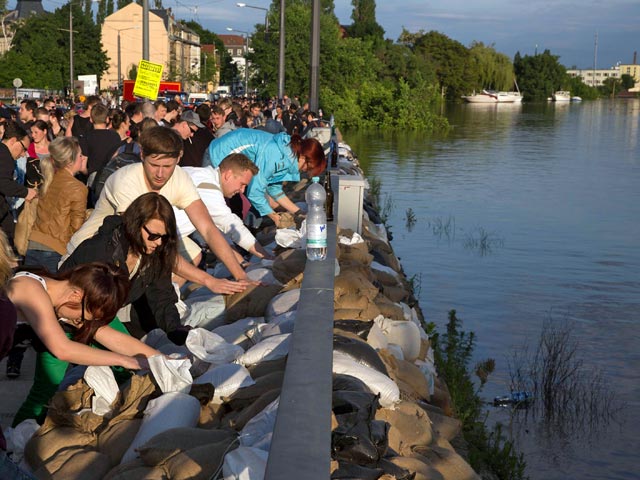
The strongest flood in Europe does not stand still: its pressure weakens in some countries and intensifies in others. So, the Czech Republic survived the peak of a natural disaster, Prague can exhale in relief - all the barriers withstood the pressure of water. However, the situation in Germany is still difficult, the capital of Austria is waiting for the impact of the elements, more difficult than in 2002, and the growth of water in the Danube can lead to the evacuation of part of Budapest.
Comfortable reports came from Prague: as expected, on June 4 there was to be a flood peak , and already on June 5, the water level in the Vltava slightly decreased. The authorities of the Czech capital decided to resume the work of the subway, however, only five stations. Traffic on some roads will also be open.
"The Museum station will be opened on the line on the line at the Smikhovsky Station station, Kolbenova, Vysochansk and Czechmaravska, - RIA Novosti reports with reference to the Czech Czech Czech Czech Czech Krjistek. The decision to open the metro station for passengers will curl up from the situation on the Vlta and its tributaries.
According to preliminary estimates, the damage from the flood in the Czech Republic amounted to $ 270 million. "We will request part of the funds from the European Solidarity Fund. But we must understand that the consequences will still need to be eliminated by our own. So most of the money will have to be allocated from the national budget," the Czech Republican of Peter Nechas "Vesti" reports.
According to meteorologists, 3210 cubic meters of water per second flowed to the peak of floods through the Vltava. "Currently, the flow rate is 3190 cubic meters per second and the water level continues to gradually decrease," said Roman Finco -Roman Finco Magistrate.
On the eve of the protective barriers in the capital of the Czech Republic were strengthened with the calculation to withstand the onslaught of water of 4160 cubic meters per second. The normal volume for VLTAVA is considered 149 cubic meters per second. During the flood of 2002, protective barriers could not withstand the pressure of the elements. Then, 5.3 thousand cubic meters of water per second flowed through the Vltava.
Unfortunately, now the number of flood victims in Europe was 10 people. On the eve of the Czech rescuers found the body of a man who was listed as missing. Search and rescue work continues.
In total, seven countries suffered from a natural disaster. While in Prague the water is declining, the capital of Austria Vienna is preparing for the strongest flood over the past decades.
“The situation is the same as in 2002. But this time we have prepared better. We are proud of soldiers, firefighters and volunteers who help to cope with the elements. Whether protective structures with water pressure will cope, but we will do everything that is in our power to avoid destruction,” said Austria Chancellor Werner Haymann.
Also today, a state of increased readiness to combat a natural disaster in the capital of Hungary is announced. Budapest, standing on the Danube, fears that due to the constantly growing water level in the river, it will be necessary to evacuate part of the city’s inhabitants, ITAR-TASS reports. According to the Ministry of Internal Affairs of Hungary, the water level in the river will reach Monday 875 centimeters, which is 26 centimeters more than when the 2002 flood.
“The authorities are doing everything possible to protect the city, and they will cope with this task,” said Viktor Orban Prime Minister Viktor Orban. He added that in the coming days it can be announced to evacuate a part of Budapest, since the mass of water moving to the city, according to him, "poses a danger to people's lives."
Now along the embankments in the Hungarian capital, embankments of sandbags are being erected. The zone along the Danube is closed for automobile and pedestrian traffic. 3.6 thousand police officers and 8 thousand troops are already ready to provide assistance to the population.
In Germany , cities standing on Elbe suffer. For example, in some Dresden’s houses, electricity began to be disconnected earlier, as Elba continues to rise. The water arrives in the river, the level reached almost 9 meters, and experts fear that the water level did not increase much more, because in the next few days the water masses from Vltava will reach the elba. In 2002, this water level was enough to flood the storage facilities of the Dresden Gallery. Also in the flood zone were Maissen, Radeboil, dozens of villages around Leipzig, the city of Hulle in Saxony-Anhalt and several chemical enterprises.