
Translated material
Brotherhood of enlightened rebels
Exhibition "Pre -Raphaelites: Victorian avant -garde"
In Moscow, in the Pushkin Museum on June 10, a unique exhibition “Pre -Raphaelites: Victorian Vanguard”* was opened
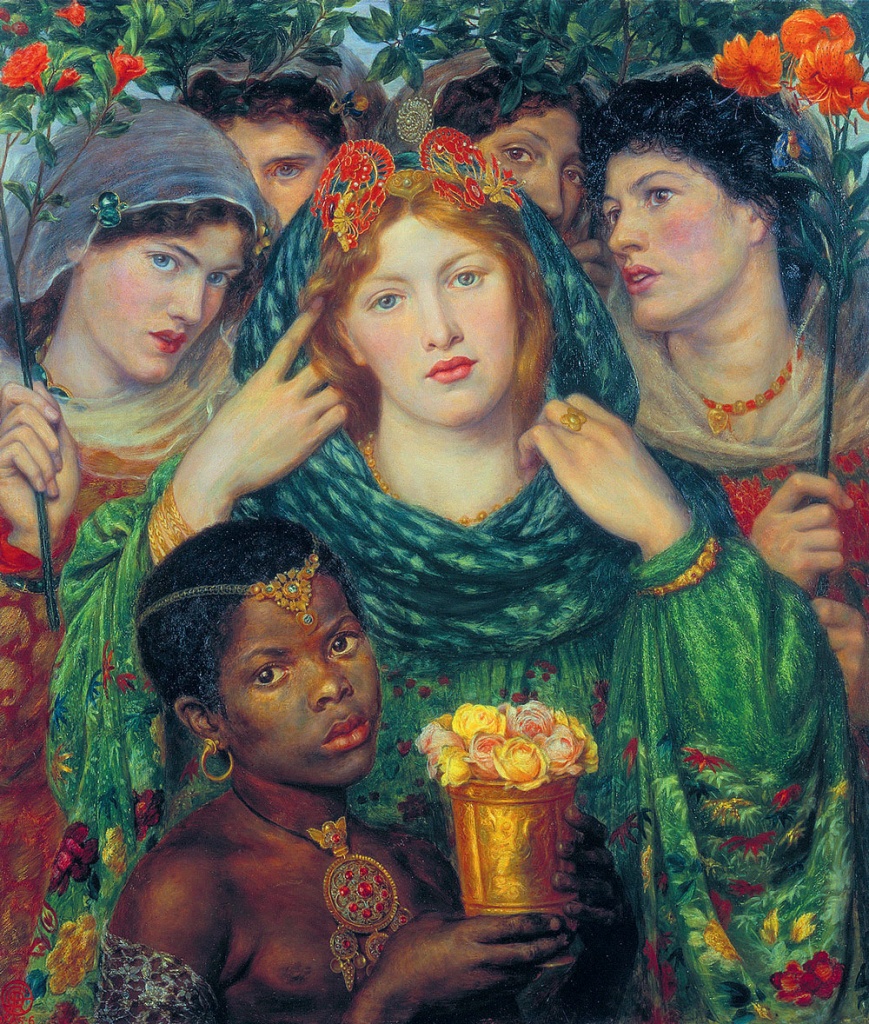
Dante Gabriel Rossetti. "Beloved"
| *Pre -Raphaelites in Moscow - a project implemented jointly by A.S. Pushkin, London Gallery Tate, Alisher Usmanov’s charitable foundation “Art, Science and Sport” in cooperation with the British Council. |
This is the largest exhibition of Preseparataalite artists over the past thirty years. Last year, it was shown in London and Washington. More than 80 canvases from private and museum meetings were brought to Moscow, including such pearls of the Tate Gallery as Ophelia and Marianne, John Everett Milles, “Beloved” and “Proserpin” by Dante Gabriel Rossetti. Great painting that changed the era - this could be characterized by the work of these artists who preceded the French impressionists, and largely inspired them to artistic exploits.
Mysterious letters
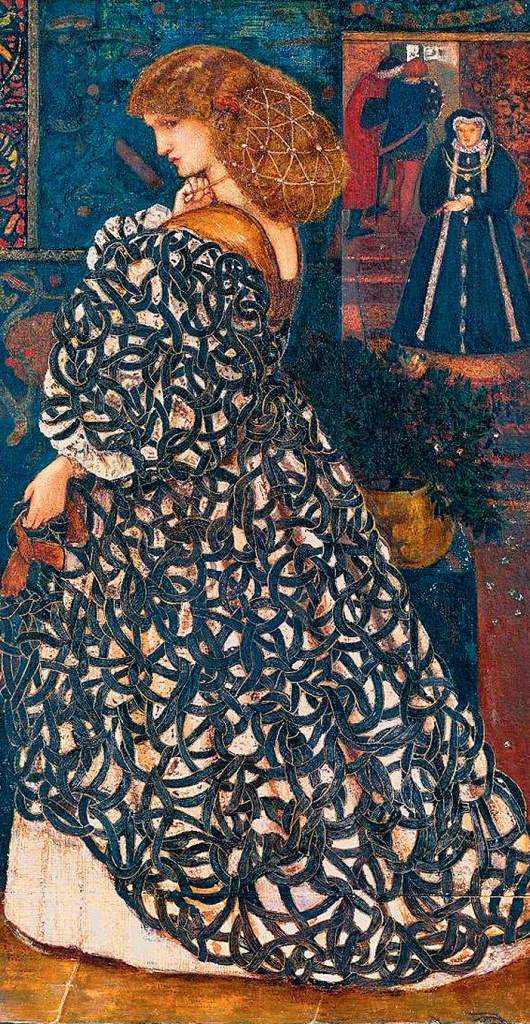 |
| Edward Bern-Jones. "Sidonia von Bork" |
In 1848, in London, at the exhibition of the Royal Academy of Arts, a novice poet and artist of Italian origin (his father was a carabinet) Dante Gabriel Rossetti approached the student of the Academy Holmun Hunt and introduced himself as an admirer of his work. “Roscette came up to me,” Hunt recalled later, “and began to praise my picture loudly, announcing that this is the best thing at the exhibition, which was very embarrassing. He was especially enthusiastic about the fact that I took the plot from Kitsa’s poetry. ” It was about a rather classic manner of execution of the work “The eve of St. Agnes”, based on the plot of the same name by John Kitsa about two lovers escaping from a feast. From here, the picture had another name - "The flight of Madelina and Porfiro from a drunken waist."
Rossetti was then twenty years old, Hunt was a year older. Young people quickly became friends. Rossetti introduced Hunt to their peer - “Young Genius” John Everett Milles. He began to draw at the age of six. Seeing the boy’s talent, his parents moved to London, and in 1840 at the age of 11 he entered the Academy of Arts - this was the youngest student of the Academy for the entire time of its existence. At the age of 17, his work “Pisarro has been captured by the Peruvian Incas” was recognized as the best at the 1846 academic exhibition, and the next year he received a gold medal for another picture.
Young people easily converged with each other on the basis of rejection of academic painting. Having gathered, they decided to unite in the secret "Brotherhood of the Pre -Raphaelites." The name (pre -Raphaelites, that is, before Raphael) has an explanation. Artists tried to restore the medieval simplicity and purity of art, lost, as they believed, in the Renaissance. Hunt helped Rossetti to finish his work “Youth of the Virgin Mary”, which was exhibited at the first exhibition of pre-Raphaelites in the Hyde Park in 1849. For the first time, three mysterious letters were used on it-PRB (Eng. Pre-Raphaelite Brotherhouse), the same initials were noted by the paintings of Isabella Milles and Ryenzi Hunt. The next year they published their manifesto in their own journal Rostock, which lasted only four months. Then the “brothers” became larger: Madox Brown, Walter Crane, Arthur Hughes, Edward Bern-Jones, William Morris, John William Waterhouse were added.
Ophelia
All artists of the brotherhood during this period were few over twenty, which means, like most young people of this age, they were characterized by love adventures, violent novels, romantic tragedies. Moreover, this was generally consistent with the ideology of the pre-Raphaelites: sensuality, sadness, romanticism, the image of an unhappy woman, combined with aesthetics and eroticism-all this became the key moments of the art nuvo era and subsequently gave the world such a delightful selfish “flower”, which was the poet Oscar Wilde. Love and tragic stories were superimposed on another and immediately reflected in picturesque canvases. Perhaps the most famous and mysterious of them is associated with the painting “Ophelia” (1852) John Milles (Arthur Hughes also turned to the same plot). It depicts the favorite model of Rossetti, who later became his wife - Elizabeth Siddal.
She was born in a poor family, managed to become a modist, and then a model. Pale -skinned and red -haired, she personified the female ideal for the Pre -Raphaelites. Milles had long planned to write “Ophelia”, all 1851 he made numerous drawings from nature on the banks of the Hogsmill River in the County of Surray, but the very figure of Ophelia began to draw only in winter. Elizabeth Siddal posed to him, lying in the bathroom, the water in which was heated by lamps located below. Once the lamps went out, and the model was seriously caught up. Later, the girl’s father issued an artist an account of £ 50 from a doctor. The poet and critic Theophilia Gauthier wrote: “I must admit that Milles’s“ Ophelia ”from afar is a little like a doll that drowning in a bath; But approach - and you will be amazed at the wonderful world of details. The canvas will come to life and will move in front of your eyes. It will seem that you are lying on the shore, and now, in front of your eyes, thousands of images are gradually opening, which you first took to mixed green. ” The picture combines the naturalism of the image with the symbol of the plot. Critics learned to read the Aesopov language of the famous picture: in the language of buttercups - a symbol of ingratitude or infantilism; The crying willow, leaning over the girl, is a symbol of the rejected love; nettle denotes pain; Chamomile flowers near the right hand symbolize innocence, scarlet and similar to Mac Adonis, floating near the right hand, symbolizes grief.
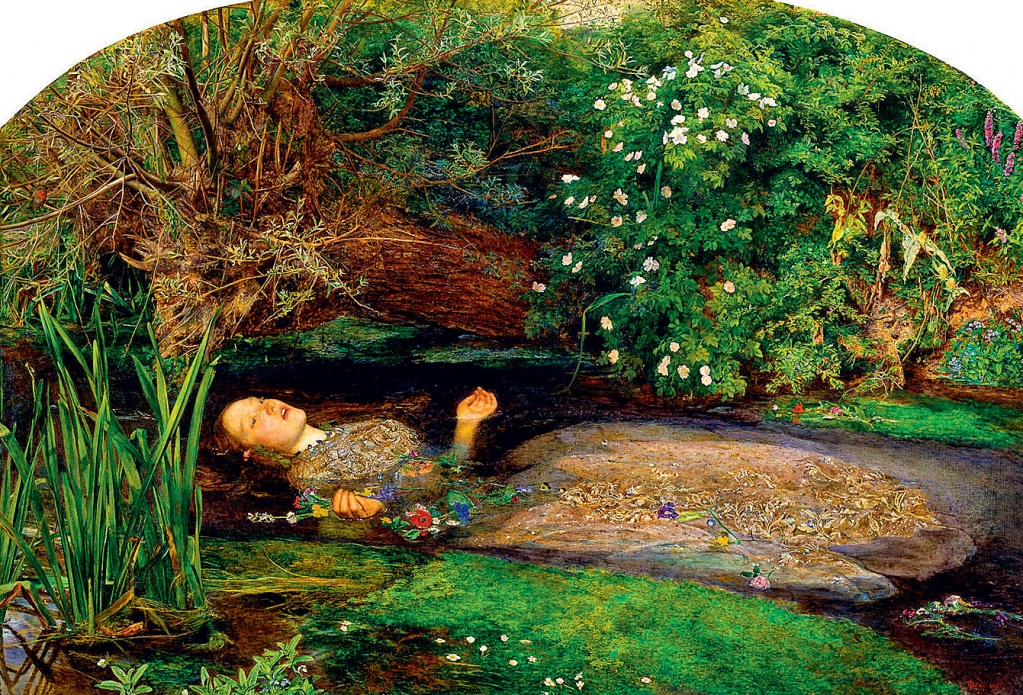
John Everett Milles. "Ophelia"
Love and passion
Almost each of the young artists of the fraternity stretches a train of love tragedies. Rossetti met Elizabeth Siddal during her sessions with Milles, soon young people began to live together. Rossetti painted many paintings with Elizabeth, the plots of which he most often took from the classics: “Paolo and Francesca da Rimini”, “Love Dante”, “The appearance of Dante Racheli and Leia” ... Elizabeth began to write poetry, draw and soon became a rather successful artist. Rossetti, despite all the love, did not at all throw his other girlfriends for her, including Annie Miller (Hunt's mistress). In 1860, he still married Elizabeth. The next year, she gave birth to a dead child, fell into depression and in 1862 died of an overdose of the medicine. Some believe that it was a conscious overdose of opium. By the end of his life, Rossetti was tormented by remorse and found reassurance in drugs and alcohol. His lifestyle was quite exotic: the house was filled with Chinese porcelain and many antique trifles, owls, vombata, kangaroo, parrots and peacocks lived in the house, at one time there was even a bull, whose eyes resembled Rossetti's eyes Jane Morris. At the funeral of his wife, in a fit of exaltation, he put a scroll with his verses in her hands. But after a series of years, he decided to publish these youthful texts, for which he opened the grave and took out a scroll, which shocked all his friends.
Another beloved Rossetti was Jane Berden. It came from a poor family, but thanks to Rossetti entered the circle of converteri. She had beautiful thick black hair and large dark eyes that emphasized the pallor of her face. In this circle, she met William Morris and became his wife, learned to play piano and entered social society. “Women without crinolines, with fluttering hair ... Unusual, like a feverish sleep, in which magnificent and fantastic images slowly move” - as the women who sang the pre -Raphaelites. But not everyone was lucky with marriage. Many paintings of these years depict the laundress of Helen Smith, which Rossetti “picked up” on the street. Her career of the model broke when the random sailor broke her face with a knife, after she refused him reciprocity. In 1873, she came to one of the artists with a request for money: she said that she had married a coachman, but there was not enough money - and offered herself to the laundress ...
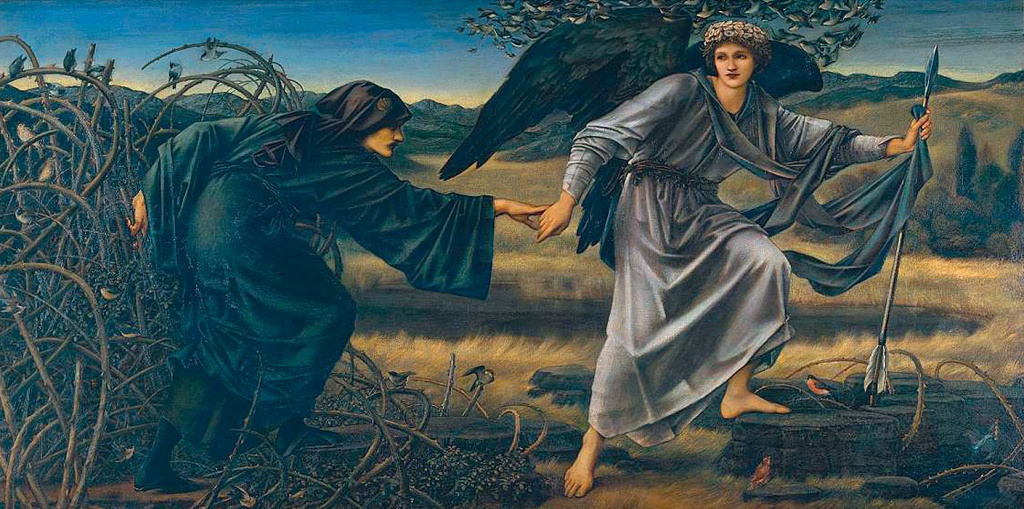
Edward Bern-Jones. "Love leading Pilgrim"
Androgins
The success of the pre -Raphaelites has become possible thanks to the support of the critic John Reskin influential at that time, who was the first to support their paintings and many of them even bought in his collection. He stated that their work could “lie in the basis of an art school, more magnificent than everything that the world had known the previous 300 years.” One of those to whom he began to patronize was Milles. This hobby came out sideways. In the summer of 1853, he invited the artist to relax in a family company. As a result, Milles and the wife of RESKINA Effie fell in love with each other and after the scandalous divorce of Effie and Reskin got married. After marriage, Milles completely renounced the ideals of the Pre -Raphaelites, became one of the most expensive English artists and the first of the painters received the Baronet title. In 1896, he was elected president of the Royal Academy, where he once entered at 11 years old and against the foundations of which he spoke in his youth. RESKIN identified his paintings of this period with a “disaster”.
Perhaps the main thing that the pre -Raphaelites brought to the art of the second half of the XIX century is a different type of beauty (which, by the way, was partially connected with the technology of painting: their paintings were many times brighter than the paintings of adherents of traditional painting). Male and female images on their canvases are often so similar that they can be often confused. Loofing luminous hair, delicate contours of the face, languid heavy glances from under the eyebrows. This is especially noticeable in the works of Bern-Jones, the student of Rossetti and the successor of the pre-Raphaelites. So, for example, both men and women on his canvases are given the features of Elizabeth Siddal. Criticism notes that his St. George is so feminine that he can be mistaken for Jeanne d'Arc. In the film “Perseus and Gray” (1892), a devastically gentle hero is courageous much less than archetypal women daringly deceived by him. The young man in Pygmalion has the same face as the girl in Danae. Lovers "Cupid and Psyche" are mirrored in each other. Octave Mirbo wrote about the faces of Bern-Jones: “Circles under the eyes ... the only ones in its kind in the whole history of art; It is impossible to say whether they are a consequence of masturbation, lesbian communication, ordinary love or tuberculosis. ” These exhausted eyes with black circles are the eyes of a painful Siddal.
Beauty is the only power
Having existed for five years, the brotherhood of the pre -Raphaelites has exhausted the internal resource. When in 1853 Milles became a member of the Royal Academy of Arts, Rossetti declared this event with the end of the brotherhood: "The round table is now loose."
But in fact, their influence turned out to be much deeper. Wilde’s aesthetics grew out of pre -Raphaelitism, his “aesthetics above criticism” has become a serious anti -bourgeois position: “I write because writing is the highest artistic pleasure for me. If a few chosen ones like my work, I am glad about this. If not, I'm not upset. "
The works of the pre -Raphaelites became the basis of the collection of the London collection of the Tate Gallery (now Tate Britain), named after the founder - the sugar magnate Henry Teit, a collector of works of art of the Victorian era. It is here that the largest collection of British artists is stored, for which many tourists come to London.
The Tate Gallery is the largest art museum (since 2000 - a group of museums) in London. This is the world's largest collection of British art from 1500 to the present day. Was founded by industrialist Sir Henry Tate. In May 2000, in the converted building of the former Bankside Power Station power plant on the southern shore of Thames, opposite the Cathedral of St. Paul, the largest gallery of modern art of Tate Modern was opened. After that, the “maternal” gallery with a collection of classical art was renamed Tate Britain
Illustrations are provided by the Estaculation of A.S. Pushkin