
Translated material
The whole agent army
In Bulgaria, the archives of the political police are declassified
In Bulgaria, a large array of the archives of the political police and intelligence from the communist regime is declassified in Bulgaria: among the former GB agents, bankers, media magnates and government officials are now. If we take into account that Bulgaria was known in the social camp by the most diligent student of the USSR, we can imagine what secrets are stored in the archives of our Lubyanka
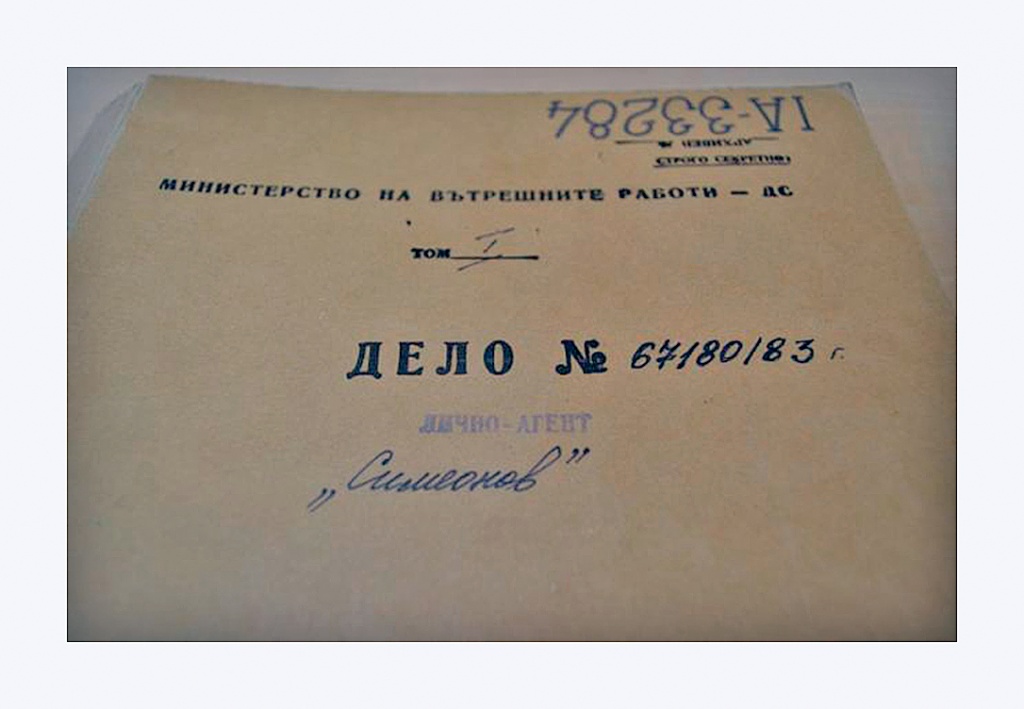

From the archives of Bulgarian state security: the personal file of the Simeonov agent (Bulgarian Patriarch Neophyt)
Names, names, names ... bankers, insurers, exchange brokers, business consultants. Hundreds of names are emphasized by a blue pencil - “one or another degree of cooperation”, dozens - red (“worked closely or a regular agent”). The Commission of the Former State Security Agents (“Dossier Commission”), headed by the ex-deputy of parliament, Evtim Kostadinov, processed data on 10 thousand “subjects of economic activity” in less than a year. The so-called “credit millionaires” are held in a separate line in the documents-those who easily received unsecured loans in the 90s. Huge amounts were specially issued to the “proven people” who had gone to business for a specific purpose: take control of the national economy.In the memory of many, the Bulgarians also surfaced these days in the mid-90s: then the verification of the two banks brought to bankruptcy showed that the largest credit debtor was the boss of the Baby Business of Mudfchiy, who was dripping more than $ 4 billion (tens of millions of dollars at the then rate). Now it turned out that since 1980, the Mutafysky was listed in the register of special services as an agent nicknamed Mikhailov. “The money does not smell,” the businessman says in response to exposure today and clarifies: “Yes, I worked for state security, but I didn’t report to friends.” The same thing is said in their defense and some of his other business colleagues - they say, the time was ...
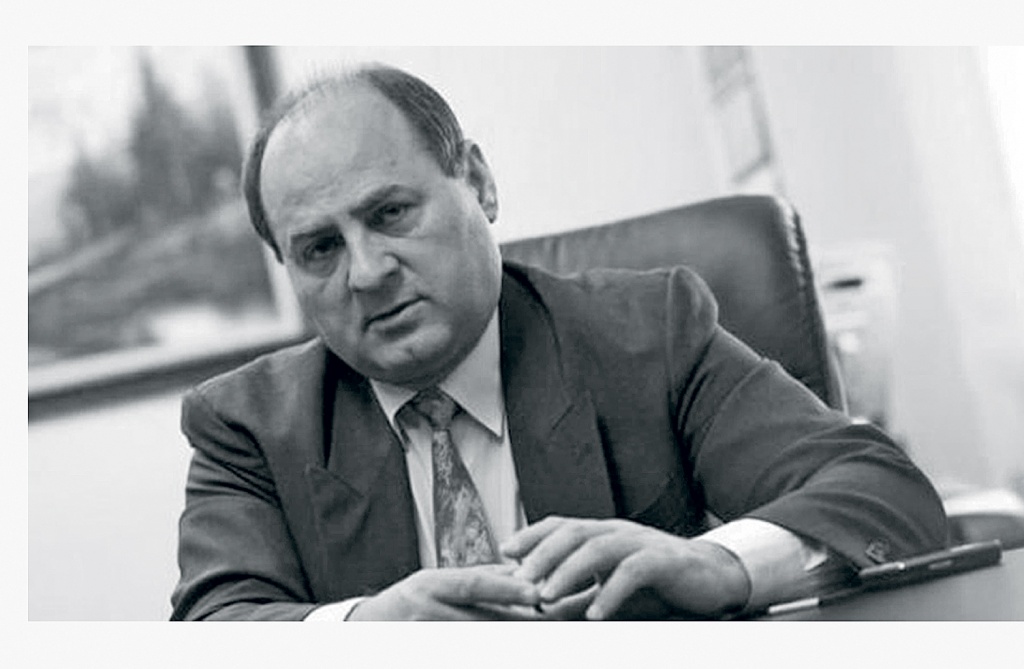
Head of the "Dossier Commission" Evatim Kostadinov
** Operation "Lenin" **The beginning of 1990, Sofia. Todor Zhivkov has already been shifted, but the Bulgarian Communist Party has not yet abandoned the monopoly on power, protests are continuing in the country with a demand for political reforms. From the buildings where the most secret divisions of state security (“Committee for the Sigurnost Sovereign”) are located, trucks with a mysterious load are leaving and keep a way near the capital of Pernik. More precisely, to the metallurgical plant with the symbolic name "Lenin" - the first -born of the industry, erected at one time with the help of the Soviet Union. But this time, Lenin had a special mission: his domain stoves had to turn tens of thousands of documents from the archives of communist special services into ash. No wonder: if these materials gathered for decades began to have the property of the rebellious people, one can only guess about the scale of indignation. After all, it was also about the confirmed facts of the physical destruction of dissenters. Trucks safely reached Lenin - the operation lasted three days. Its organizers believed that they destroyed all the evidence. But they miscalculated. In fact, about 40%, according to various sources, were destroyed. The structure of the special services turned out to be more cumbersome and branched than their leaders themselves thought - kilometers of the dossier stuck in the regions and reached them only now.
But it was not for nothing that state security in the communist Bulgaria was called “state in the state” - in total, it even exceeded the country's regular army: 300-350 thousand full -time employees plus approximately half a million army of freelance “sexots”. In the 1980s, the population of Bulgaria was 8 million-it turns out that more than 10% of the population reported to the neighbor. Of one million employees of state institutions, an average of 10% were agents of DS. That is why, after the overthrow of Zhivkov in November 1989, the threat of counter-transmission was quite real. General Atanas Semererjiev, appointed to the revolutionary time by the head of the Ministry of Internal Affairs, carried out a reduction and total reorganization of the Ministry of Internal Affairs. But he did not want to do the same with GB. Tens of thousands of Bulgarian Chekists calmly served, and then went to a citizen - in politics, business, the media ... Before the May elections to the parliament, the commission began to check candidates for deputies and found 142 names of former headquarters GB and military intelligence (in total in the Bulgarian parliament of 240 places - The New Times).
“The Bulgarian state security interacted with the Soviet KGB more closely than many others in the social camp. Until the beginning of the 50s, the agents of the Soviet MGB directly participated in repressions against the “bourgeois opposition” and “enemies with the Partytake”, ”says the professor of the G.S. Military Academy of the Military Academy Rakovsky Yordan Baev. - There was a period when 40-50 senior officers and generals of the Soviet special services were simultaneously in Bulgaria. And in 1949, during the trial against the popular figure of the Communist Party, Triyo Kostov (he eventually passed a death sentence as a “foreign agent and traitor.”-The New Times), the NRB secretly threw a battalion of the Dzerzhinsky division. ”
| *According to other sources, General Kostromin worked in Sofia until 1995 as a representative of the foreign intelligence service of the Russian Federation |
Even after the overthrow of the regime of Todor Zhivkov, the Soviet KGB did not change the format of cooperation with the Bulgarian colleagues, continuing to trust them completely. In particular, in the summer of 1991, a month before the Civil Code of the State Emergency Committee, a new bilateral cooperation agreement was discussed, and the last official representatives of the KGB-General Kostrin and Colonel Kazankin-left Sofia only in October 1991*. In fact, only then the era ended ...
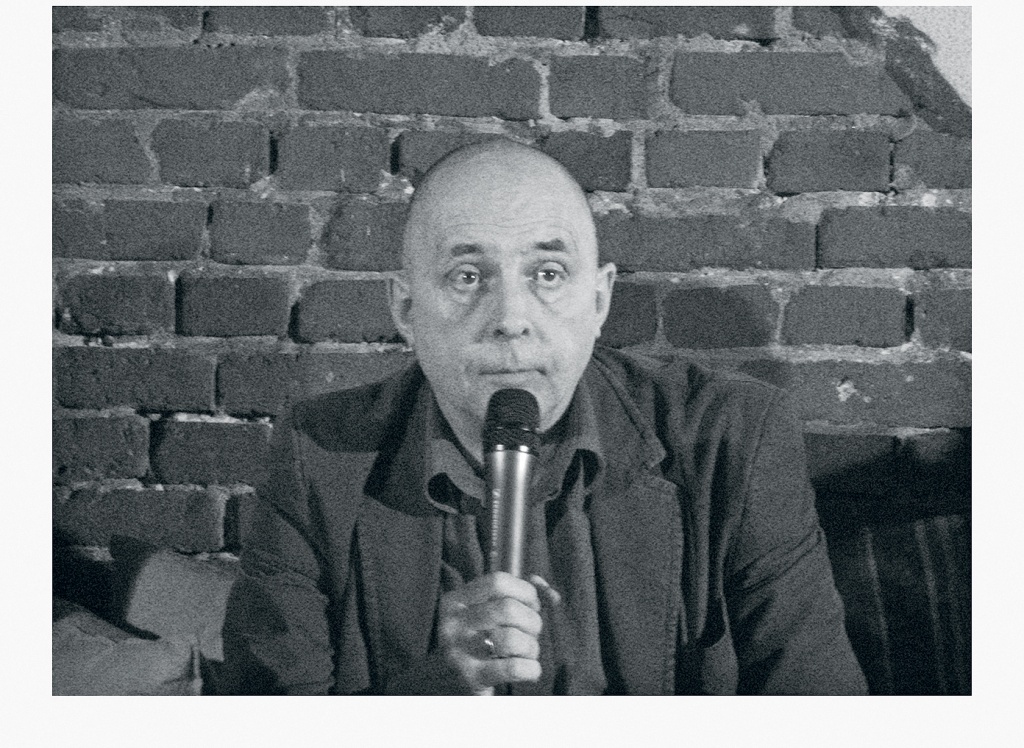 | 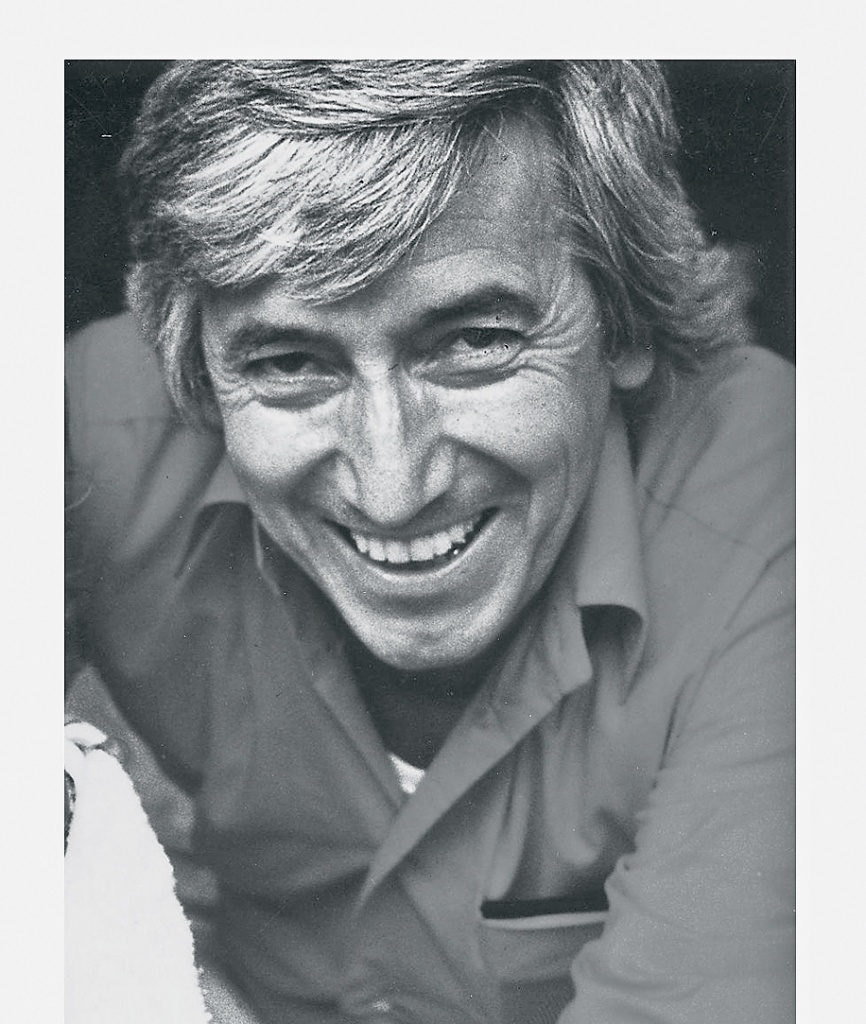 |
| Popular publicist George Koritarov, former GB agent | Dissident writer Georgy Markov (in the picture) made a deadly injection umbrella on September 7, 1978 in London |
Both the President and the Patriarch
The leaders of the new democratic Bulgaria began to get acquainted with GB materials in the early 90s; Even then, secret data were penetrated into the press about, for example, that approximately 10% of employees of almost all scientific, educational and legal institutions and organizations, as well as the media, diplomatic and military departments in the past collaborated with GB. In 1990, the opposition then headed, and subsequently, the President of the country, the vote, requested from the head of the Ministry of Internal Affairs of Semergiev the personal file of Pyotr Beron, a famous opposition, about his cooperation with the political police under the Boncho, the posters stuck in Sofia reported. “I was shocked by reading the dossier,” Zhelev recalled years later. “I felt bad, and I barely read it to the end.” The scandal flared up - Beron then immediately stopped practicing politics and left the public sphere. But many other "former" - no.
“The political class in the 1990s imposed on the society allegedly“ consensus ”, but in fact a deeply erroneous strategy: they say, let's not take the country in the accounts-it is better to do this selectively, in accordance with the political conjuncture. As a result, the special services managed to “clean” and destroy hundreds of thousands of personal dossiers, ”Professor Baev explains in a conversation with The New Times.
And only in 2006 was the law on the declassification of the entire documentation of the special services for the period 1944–1991 was adopted. inclusive. The “Dossier Commission” has been working for the sixth year - ten volumes of “declassified cases” have been prepared, which anyone can get acquainted on a page on the Internet - it has already been visited by over 2.5 million people. And by 2014, the new President of Bulgaria Rosen Pleneliev decided to completely declassify all the archives of the special services by 2014.
“There are interesting episodes of the Russian-Bulgarian“ friendship ”in the declassified dossiers,” says Professor Baev. “It turns out that during the first meeting with his Bulgarian colleague, General Solakovov in May 1968, the then head of the KGB Yuri Andropov, admitted that his department is seven to ten years behind the CIA in terms of new information technologies, and it is a strategically important task to receive data on new generations of American computers.” And during a visit to Sofia in November 1969, the same Andropov informed the Bulgarians: after a six -day war of relations with Israel, the KGB’s activities in this state.
But the most interesting in the archives is of course names. In the lists of former GB agents - many representatives of the Fourth Power, including the famous publisher Toshu Toshev, head of state radio, Vyacheslav Tunev, publicist Georgy Koritarov. The former editor-in-chief of the Bulgarian Playboy, the publisher Anthony Georgiev, was also exposed-he was recruited in 1988 under the agent name Boyko in order to monitor the "artistic and creative intelligentsia."
The counterintelligence agent "Taneyev" was
The creator of the first mobile operator in Bulgaria Krasimir Stolmirov (recruited in 1984). Strosev received a license for commercial activities for $ 40 thousand in 1992, in 1996 he sold the company to Russian businessman Grigory Luchansky, another year after the termination of the transaction, the company was acquired by another Russian oligarch-Mikhail Cherny. The well -known financier Vladimir Zheglov is declassified as a GB agent, the Bulgarian “daughter” of the Italian Bank Unicredit was brought to clean water.
The full dossier of Ahmed Dugan was also released - until recently the permanent leader of the party of the Bulgarian Turks. As an agent "Angelov" he has been working on GB since 1979.
Further - more: 11 out of 15 metropolitans of the Bulgarian Orthodox Church were GB agents. Even the recently chosen Patriarch Neophyte, it turns out, since 1983 served the organs where he was known as “Simeons”. Finally, Georgy Pyrvanov, the president of the country from 2002 to 2012, as it turns out, also visited the role of sexot (the nickname "GOCE", recruited on October 4, 1989, was removed from the operational report on July 16, 1993). He himself in every possible way denies his involvement in the organs. Nevertheless, Tsvetkov has recently stated in one interview that Pyrvanov "knew who was working for who was working."
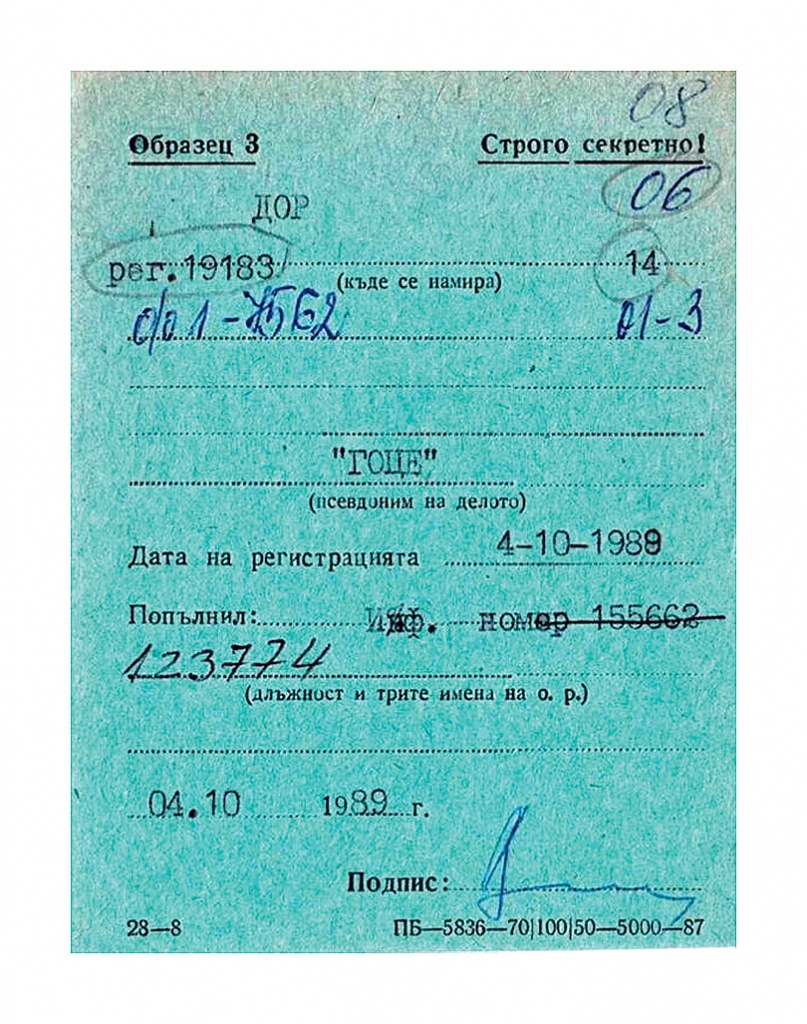 | 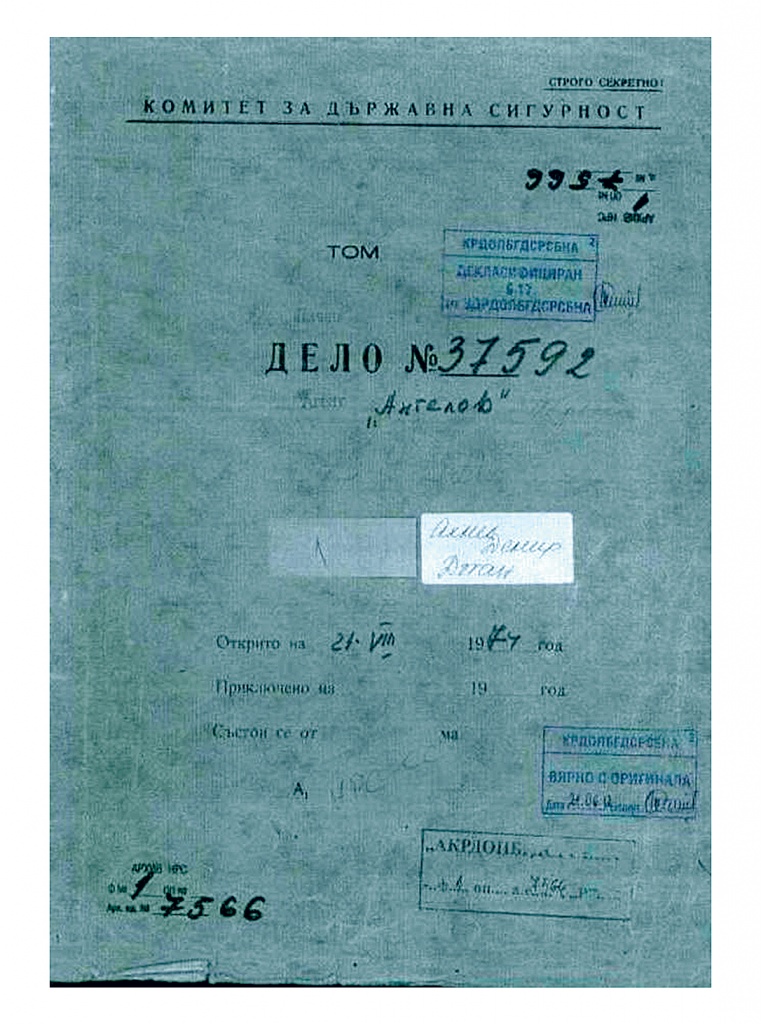 |
| From the archives of Bulgarian state security: the personal file of the agent "GOCE" (ex-president of the country Georgy Pyrvanov) | From the archives of Bulgarian state security: the personal file of the Angelov agent (ex-leader of the Turkish community Ahmed Dogan) |


Project SOUD
| ** In Russia, it was nevertheless established that the operation to eliminate Markov was led by the ex-General of the KGB Oleg Kalugin, who left for the United States in 1995 |
The commission of Kostadinov and more than 100 Soviet-Bulgarian joint operations of the Cold War was declassified. True, documentary confirmations of the famous version have not yet been discovered that the writer-discident Georgy Markov was killed in London in 1978 by order of Todor Zhivkov with the help of the invention of the KGB-an umbrella shot down a miniature fractions with the holes through which Ricin's poison flows. It is possible that the materials regarding this case have already been destroyed **.
The longest reconnaissance project of the SOUD (a system of combined data accounting), which started in 1978, was the longest-Bulgaria participated in it until 1991. Within the framework of the project, they created a database of “enemy organizations” - later it was divided into 15 categories. The base in Moscow was stored, where information about more than 260 thousand persons were transmitted. Directly in Bulgaria in the file cabinet there were personal data about more than 55 thousand people, of which 17 thousand were considered "especially dangerous criminals and terrorists." Military intelligence of the Warsaw Treaty states also carried out a similar project under the code name “review”, directed against NATO countries.
State security - the topic for Bulgaria is painful. The sooner it becomes the prerogative of historians, the better. Today, those whose involvement in the activities of the bodies has been established react differently to public accusations. Some highly say that they served the homeland. Others are trying to go into the shadows. Someone is eagerly repenting. There are obviously random victims - their zealous GB personnel were included in the lists “for a checkmark” in order to fulfill the agent plan that was launched from above ...
Time will tell what other “surprises” will bring declassified information of the Bulgarian special services. Although the whole truth, of course, can only be found in the KGB archives, whose brainchild became Bulgarian state security. And these archives are still a secret, which, judging by the political situation in Russia, will not open soon.