
Translated material
Jonathan Litell: “Never again? - This is nonsense "
Exclusive interview The New Times
The famous author of “good -pricks” - about the wars that he chooses, about the genocides of the former and the present, about Hitler, Stalin and Assade and about what Putin is right
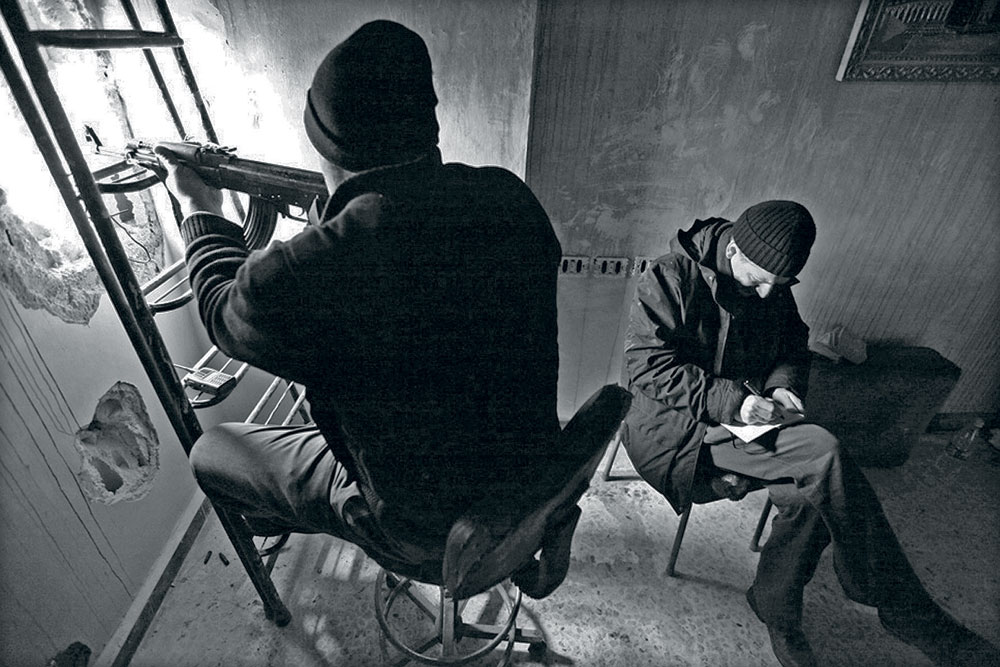
Jonathan Litell (on the right) in Syria, during fighting in the city of Homs, February 2012 (photography - Mani)
Jonathan Litell is like Kerensky. Something in the structure of the face, in the swiftness of gait, in the profile-in the photo is not like, but in life-it seems that very. Or is it all about the green Austrian hunting jacket with brilliant buttons under a standing collar? “Any dirt, even blood, leaves this fabric at a time,” he explains. Of course, it has nothing to do with Kerensky Litell, although his ancestors lived in the territory of the Russian Empire, somewhere near Vilna (now Vilnius): they left in the first half of the 80s of the XIX century, when, after the murder of Tsar Alexander the Second, a wave of terrible Jewish pogroms lasted almost five years. But Littlel knows the Russian language not at all because somewhere someone once ... He not only worked in Chechnya-at first as an employee of the Humanitarian organization “Movement against Hunger”, and then he already came as a journalist: he lived for several years in Moscow and-attention! -It was here in four months that he wrote his famous 800-page novel “Forestment”, the material for which he collected for five years. Here, of course, to ask Littlel himself, why a novel about Ada through the eyes of one of the ministers of Satan, the CC officer, Dr. Aue, was so well written in Russia in the early 2000s, but Littlel categorically does not like to talk about himself and even less-about his motives and experiences.
Having rummaged on the Internet, you understand that such a thorough guards of personal life is a family tradition: his father, the famous author of the espionage novels Robert Littlel, in the 60s, is a journalist of the American weekly Newsweek, who wrote a lot about the communist Europe, about the USSR, including the country on a car, which was almost for the Cold War for the Cold War for almost a line for a line possible), in rare interviews, he also refuses to talk about himself - only in the context of his novels, among which are such a bestsellers as “Amateur: Roman about revenge” and “Roman about the CIA”. (The son, I must say, went around his father: only in France more than 1 million copies of “goodwriters” have already been sold.) However, the little that the father tells about himself allows you to better understand his famous son. For example, constant readiness, if not to say-the passion for the risk of the author of the “goodwriters”: Littlel Sr. managed to take out of the communist Czechoslovakia a study of Czech historians about the realities of the occupation of Czechoslovakia by Soviet troops in 1968 (it was called the Black Book of Czechoslovakia-the text was re-re-re-released In the lining of his coat. Or some painfully defeated relations between Jonathan Littlela with the country, where he was born and where he then graduated from Yale University, the USA: to the question why at the very beginning of the 70s Robert Littlel moved to live south of France, the rival Le Carre on the Niva of Spy Romanov replied: “At that time there was Nixon in power,” that is, there was a shameful war in Vietnam, a split country and a split country and a split country and a split country and a split country. The policy crawling into the obscurantism in Washington. With the Nonsense of Skepticism, Littlel-Sr. also spoke about the policy of the Republican administration in the United States after the events of September 11, 2001: “Churchill once said that“ we can hope that America will act correctly-after it has through all other opportunities and alternatives. ” So I hope that the country will still come to life. ”
Littlel Jr. left France, where he lived from a child, under the conservatory of Sarkozy, but France of the socialist Olland, it seems, does not attract too much, but to the author’s question: where is his house (more precisely, the question sounded like this: “You are an American Jew, write in French, live in Spain. So who are you, where is your house?”) question".
And then he suddenly said: "Do you know my second name?" - "?" - "October. This is the father so wanted. " October is, of course, referred to the October Revolution. O Lord - it was only left to say.
So, Jonathan October Littlel is in an exclusive interview with the New Times.
What brought you to Moscow now?
I came to support the Memorial: it is difficult for them now, they are under the blows of the state, and I have great respect for their activities. Well, besides, in two or three months, my book about Syria will be released here.
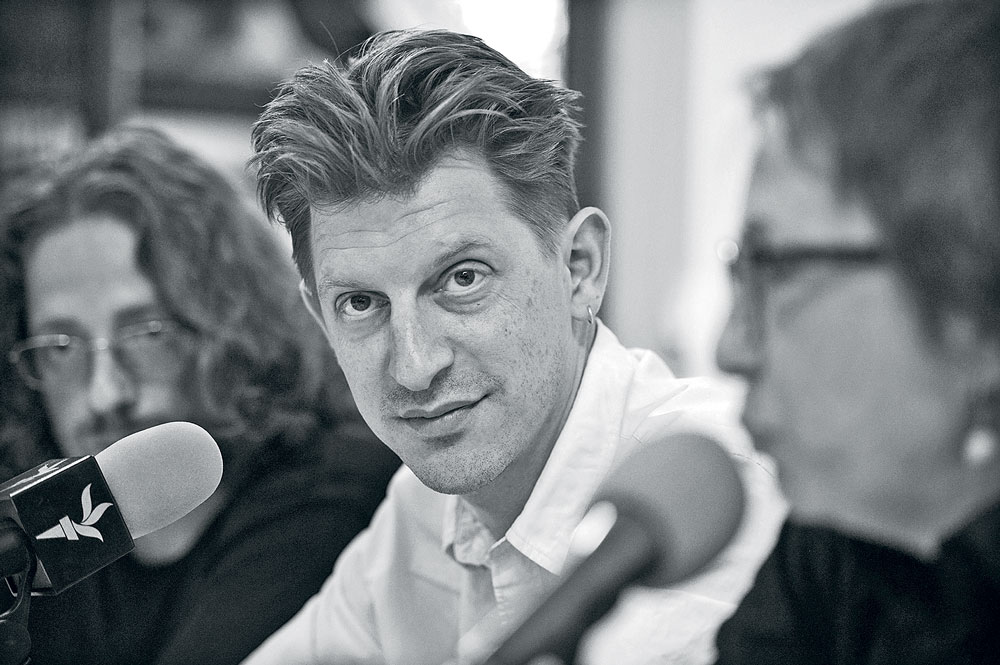
Jonathan Litell on the discussion "Banality of Evil" in the office of Memorial in Moscow, June 13, 2013 (photography - Mitya Aleshkovsky)
His war
| *“Three Chechnya Jonathan Littlela” - the name of the interview, which The New Times published in No. 39 of November 26, 2012 |
One of the discussions in the “Memorial” in which you took part was called the “banality of evil” - the allusion to the famous book of Hannah Arenidt about the trial of Eichmann in Jerusalem, about the nature of fascism, etc. It was about war crimes, about what was happening in Chechnya - on both sides, about why the horrors became the norm. You talked about this in our magazine* - I will not repeat those questions. I am interested in something else: what does the war attract you so? Bosnia, Chechnya, Georgia, Congo, Syria, Sudan - you constantly find yourself where they shoot, where blood, nightmare, grief. Your “goodwriters” are at all 800 horror pages, which, as one of the critics wrote, literally climbs under your skin. By the way, did I list all your wars or forgot something?
Some. There was, for example, even Afghanistan: I arrived there in the 96th, exactly a month before the Taliban took Kabul. But there is a big difference between those wars where I was as an employee of the humanitarian organization, and those where I worked as a journalist. There are journalists, especially photographers who spent much more time in the war than me.
Yes, I remember them in Chechnya: shelling, everyone is hidden, and they are in full height and remove. It was dangerous to be near them-especially next to those whom the children did not expect at home: there was something painful in this fearless. Then I had to read that some people develop an addiction to adrenaline, which fits into the blood with a fountain in the conditions of war. Do you also have this addiction to war?
This is a personal question.
Do you write about something other than the war?
As a journalist - no. But I would say that I am writing about conflicts - in the broad sense of the word. But I would not say that I have some kind of painful craving for war. It’s just that war is the most extreme form of human experience, and that's why it is interesting. It is interesting to observe the behavior of people in these conditions.
"
“My second name is October. This is the father so wanted. " October is, of course, referred to the 1917 revolution. Oh Lord - it only remained to say
"
Most people repel violence, it seems to attract you. Actually, a number of critics who did not like your “goodwriters” have not attracted you to accuse you of the fact that in the novel there is an excess of violence.
And for someone, for example, the rejection was caused by sexual scenes in the novel ... I would not say that violence attracts me: I am interested in it as a subject of study. Why? Don't know. Maybe I became interested in violence, because my professional life has happened like that, and maybe my life has developed like that because I am interested in this subject.
And you are not afraid of a year after year to go to where they shoot and may, Jonathan Littlela, and not the subject of your description, kill you?
Well, these are just the realities of the life in which you find yourself. When you are in the war, you or someone else, you try to protect yourself from what is happening around. That is, you understand that people around you are killed and you can be the following, but it really comes to you already when you write about it. And there, in the war, these thoughts are secondary.
Hell
When you wrote the “goodwriters”, you did not feel that you were in the middle of this hell under the name “Second World War”, “Holocaust”?
Everyone asks me this question. Answer: No. Just like an artist, when he writes a picture, he thinks not about an object, but about which colors to choose, so the writer thinks about words - that’s all.
But your novel is written in the first person - on behalf of the SS officer, who participated in executions. To write this - and I, like the reader, had an absolute feeling of the reality of what was happening, only I was from the other side - you probably had to get used to the image of your main character? When you wrote, you did not have the feeling that you are crazy?
The book is written and published. All.
And you are not returning to her?
No. The only thing that interests me how badly these parts are written and how I could write them better. But it does not seem to me that it is worth continuing to talk about it.
How many copies of "good -pricks" are already sold in France?
Million.
Why did you write a book in French, although English is also dear to you?
Probably because I really love French literature.
Do you think French or English?
In both languages.
How was the book accepted in Germany?
Just like everywhere, there is a lot of disputes.
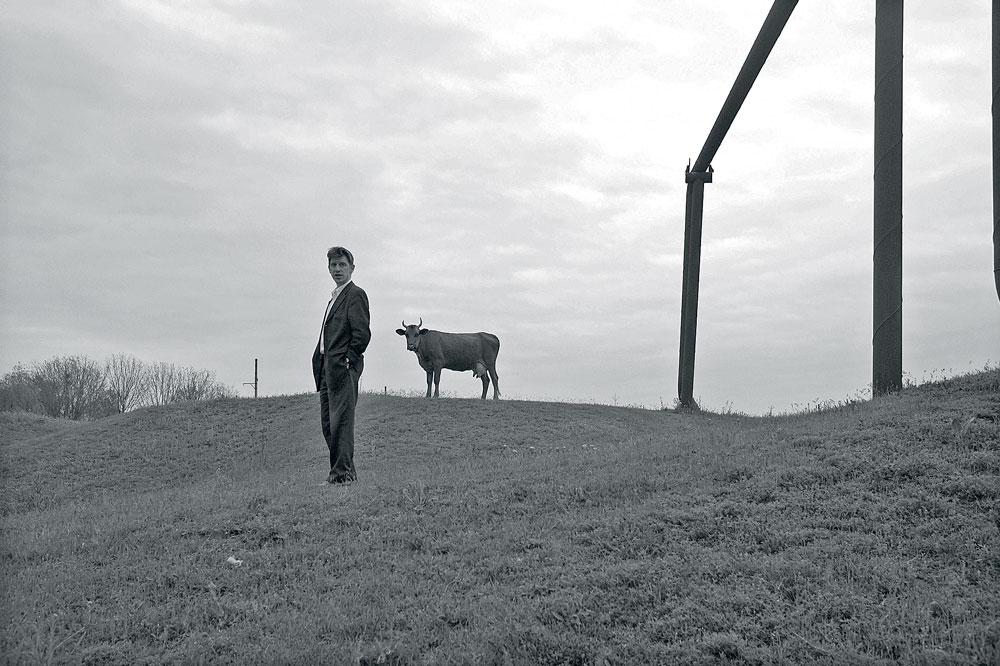
Litell in Chechnya, 2009 (photography - Thomas Dworzak/Magnum/Grinberg Agency)
The rationality of evil
You collected the material for five years, read more than 200 books about the war and disaster, did you understand why the Germans still destroyed the Jews so systematically?
| ** Daniel Goldhagen, Hitler's Willing Executioners. Oordinary Germans and the Holocaust, New York: 1996. *** Christopher R. Browning, Ordinary Men.Reserve Police 101 and The Final Solution in Polantion, New York: 1992. |
There are at least two glances. One: the Germans killed the Jews because they hated them - Daniel Goldhagen ** writes about this in his book “Voluntary Assistants of Hitler”. I do not agree with him. It seems to me that another researcher describes another researcher-Christopher Browning in “ordinary people” ***, and the same author draws their so different conclusions on the same material-the documents of the 101st reserve battalion of the police, who was entrusted with killing 1,500 Jews in the Polish village. So Browning shows that the Germans killed the Jews, because it was a way to prove to Hitler loyalty and devotion and, accordingly, advance up the career ladder. If Hitler also would like to destroy all gays, then they would also be destroyed.
But they were killed, hanging on flagpoles in the camps.
Himmler hated gays, and if his will, not a single one would have left. And Hitler did not care about them, and this gave the possibility of bureaucracy, including a military, among which there were enough homosexuals, to resist the wishes of Himmler. Hitler’s role, his personal hatred played a huge role in the scale of the Holocaust.
And you do not see a rational message for this? The small people-by 1933, Jews in Germany were less than 1%, many bankers, insurance agents, jewelry owners: Nuremberg laws allowed Non-German neighbors to remove competitors, take their property and money, and saturate military production inhabited by military production, demanding long money.
Agree. Many Germans gladly took the property of the Jews with pleasure, but this does not explain why all this resulted in a massacre. I found a publication in Catalonia, which was not known before - probably because Catalan few people know. So, this is an interview with Hitler in 1924 - he only left prison, his game was just beginning. Hitler to the question "What do you think of Jews?" answers: “This is a difficult question. It would be ideal to kill them all, but the Germans will never accept this, so we must find a more compromise version of the Jewish policy. ” It is obvious that the destruction of the whole people, and a very specific people, was his dream long before the Nuremberg laws. Then it became possible. But, of course, the Holocaust, its scale cannot be explained only by Hitler’s anti -Semitism and the desire of officials to make a career, showing their zeal in the murder of Jews.
Just war is the most extreme form of human experience, and that's why it is interesting
"
I think two factors played a key role.
First: remember the map of Europe in the first half of the XX century. Ten powerful countries are the Austro-Hungarian Empire, Great Britain, Belgium, Germany, Italy, Holland, Spain, France, the Russian Empire and the Turkish Empire. There were still the United States, but they did not have colonies. Why is it so important that the countries I had listed had colonies? Because there, in the colonies, people - Africans, Arabs were killed in incredible, crazy scale. But no one was interested in anyone, because they were considered subhuman. In Europe, Europeans said, we do not allow ourselves this, with our own we are waging civilized wars - what was the war between the French and the Germans of 1871. But with others, with those who were considered lower peoples, allowed. That is, the mass destruction of people-only somewhere far-in principle, for Europeans, it was permissible. This is the first factor.
The second is the First World War, which adopted completely barbaric forms, when the consensus that existed before: what we do in the colonies, we do not allow ourselves to do in Europe - was ruined. Colonial barbarism has become European. When the war ended, in three European countries - in Germany, Austria and Russia - mass violence becomes the management principle, society has adopted violence as a policy of politics. Why only in these countries? Because they were losers. Those who won managed to stop in the use of violence. The losers are not. In Germany, those groups of the population who further defended from true Aryans - Jews, gypsies were destroyed. In Soviet Russia, violence went horizontally: they killed a class of strangers. But it is important that both there and there the destruction of entire population groups, entire peoples have become an acceptable way to solve political, social or some other problems. The Germans brought this idea to a logical end: you can kill all Jews. Exactly just as they calculated how many Soviet people could be left as labor. Goering calculated - 35 million, so much, he believed, will create a rational balance between the number of cultivated land and slave force for its cultivation. Another report indicated the figure of 51 million. That is, the rest of the tens of millions should have been killed. In other words, this concerned not only Jews - the mass murder of people not on the battlefields became an absolutely acceptable idea.
People who are considered millions, like firewood ... Therefore, it scares me so when Putin speaks of “cultural”, and not the ideological difference between Americans and Russians - the first, he said, individualists, the second is characteristic of the “collectivist consciousness” - millions of pieces begin ...
However, in the last part of the “good -priests” there is no trace of this German rationality. You give disputes between the people of Himmler and the people of the Minister of Industry Speer. The latter needed slave labor, albeit Jewish, and he asked everyone not to burn in gas chambers. Himmler insisted: everyone!
Yes, it was not only irrational - suicidal. And this returns us to my first argument: the bureaucracy, which sought to please Hitler, received more resources under its control, more power - even despite the fact that they understood that it was destructive for the Reich. After an unsuccessful attempt on Hitler, army generals lost their influence, the top took CC. This does not mean that the army generals wanted to get in front of the Fuhrer or were smaller anti -Semites, but they waged a war and could not afford to not count the pros and cons. For example, do you remember the story with tatami, with mountain Jews? Why didn't they kill them? Yes, because the generals knew that German troops would not go further to the Caucasus, but on the contrary, they would go exactly the other way, and they did not want to have highlanders in their rear, who would take revenge on them for the murder of the Tats, who were their neighbors. In the Crimea, the same generals did not prevent the killing of mountain Jews - there they did not give a damn.
But by the end of the war, the rational elements surrounded by Hitler became smaller, especially after the failure of the coup, and in the end only Bormann, Goebbels, Himmler, Goring and Hitler remained - all half -sulfur.
The book has an amazing picture of the degradation of the German army: a brothel somewhere in Poland, where the hand of a slave through a hole over the push wipes the ass of the CC officer.
I have to upset you: this picture is from the history of the British colonial empire, this happened in India, and the hands were Indians, and the asses are English. If we talk about Soviet Russia, Stalin showed great rationality than Hitler: mass violence served him as a means of pulling up new people - in full accordance with communist ideas.
Not only: slaves, he needed a gulag for construction projects, industrialization. And in this sense, he was quite rational.
Stalin was wiser, and therefore lasted longer than Hitler.
"
Colonial barbarism has become European. In Germany, Austria and Russia, mass violence becomes the principle of management
"
Never AGain?
Of course, the main question: how much the world has learned the lessons of the XX century?
I did not learn at all. When I hear: “Never again” - in the sense, we will never again allow the Holocaust, I answer: nonsense, they have already allowed! And Rwanda? And the campaign? And South Sudan? Bill Clinton, who built the Holocaust Museum in the federal land in Washington, forbade his administration during the murder of one and a half million tuts in Rwanda to use the word “genocide”. Why? Because the Americans did not want to get into this story. Of course, they did not pronounce this out loud, but the subtext was obvious: “Why should we care that some blacks kill others with a machete?” And exactly the same thing is happening now with Syria.
Syria and West
You wrote about Syria a book that will be released in Russia soon. I read some parts on the Internet. You, it turns out, dyed your hair black before you from Lebanon, by secret paths were transported to Homs. Did it help?
Not quite black - just darker. I was mistaken for the Syrian. I remember we found ourselves at the checkpoint of the Syrian army, I waited with horror that the American was now recognized in me, so pretended to be writing. But the officer yelled at me - and that's it, and went on.
You were in Syria at the beginning of the conflict and wrote that it was a protest of workers and farmers. However, the information that comes from Syria now indicates barbarism on both sides. In particular, Karl del Ponte, the head of the tribunal in the Hague, said that chemical weapons were used by both Assad’s troops and fighters of the Free Army of Syria, that is, rebels.
It has already been proven that this is not the case that del Ponte was mistaken. And the journalists of Le Monde proved - they brought evidence that chemical weapons were used by the Army of Assad against their own people. This could not be allowed if the West had intervened earlier. After all, it all started really with peaceful protest, indeed workers and farmers in Deraa, who demanded justice: that the Baasists (members of the ruling Baas party) cease to distribute everything and everything - businesses, resources and so on - only their own, while the stranger for bribes. Assad began to shoot in a peaceful protest. The world watched. The protest in Syria was more and more radicalized, Islamists appeared, they began to prevail, now they kill and torture on both sides of the conflict. On the side of Assad is already fighting Hezbollah, which means that the conflict can spread to Lebanon.
Jonathan, remember how much enthusiasm about the "Arab spring" or the overthrow of Gaddafi in Libya. And what did everything result in?
In Egypt, the Muslim brothers came to power, because they were the only one again: the only organized political force in the country. And their survival in power will depend on the economic situation and on the elections: it will be bad with the economy - they will lose power, choose others. There are Islamic radicals in Tunisia, but there are also democratic forces. Libya is already a completely separate story: there were no institutions of the state, Gaddafi did not fundamentally create them, therefore, Anarchy and lawlessness were replaced by Jamahiria.
And what will happen in Syria?
I'm afraid that now nothing good. Assad’s regime turned out to be much stronger than everyone thought.
Do you understand why Russia and Putin himself support Assad so much - even at the cost of destroying relations with most Western countries, European, including?
Understand. Because when Russia voted (in the UN Security Council) for a resolution on Libya, she was promised that there would be no military intervention. And the West deceived the most shameless way. After that, Putin said: "Never, never, we will never believe you again." I can understand him. Another question is that he is concerned not so much by Syria as the internal political situation: he is afraid that the victory of the rebels will give arguments and an example of the opposition within the country.
You are not afraid of how the situation in the world is developing? In the United States, everyone and everyone is eavesdrophic, political repressions began in Russia, the whole east is fighting, the celebrations of the liberal idea that Francis Fukuyam wrote about 23 years ago: the pendulum has gone far to the right and somehow does not strive back-at least to the middle, to balance.
I'm generally a pessimist.
Photos: Mani, Mitya Aleshkovsky, Thomas Dworzak/Magnum/Grinberg Agency