
Translated material
Connect and rule
The President rules the Constitution and merges the courts
Vladimir Putin announced the unification of two courts - the Supreme and the Supreme Arbitration. For the sake of this, the constitution will be rewritten for the second time. Who needs it and what will lead to - the New Times found out
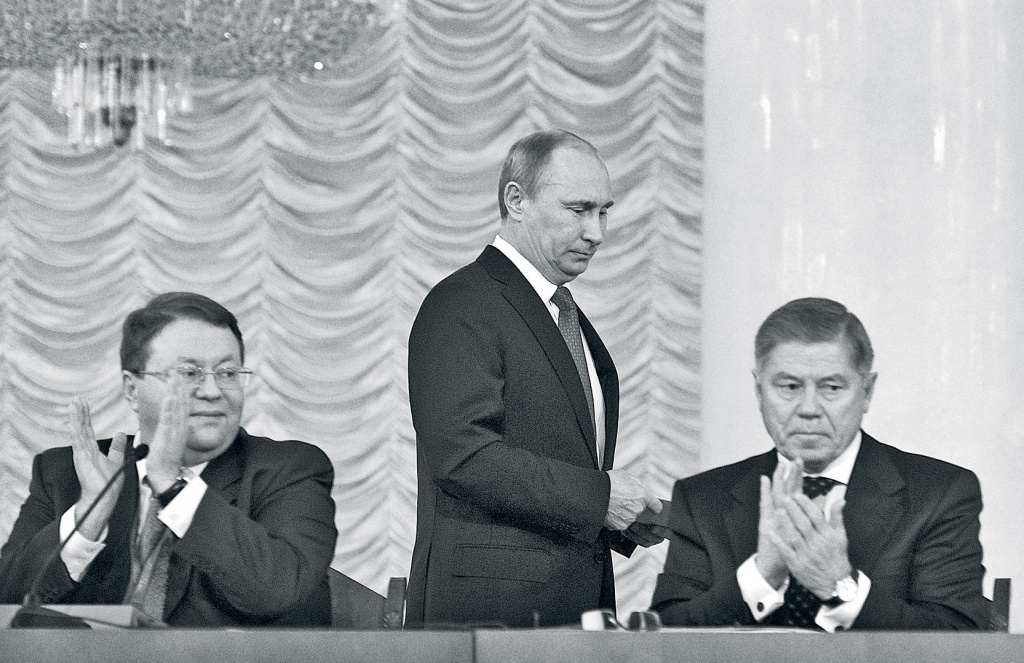
For the unification of Anton Ivanov (left) with Vyacheslav Lebedev (right) Vladimir Putin is ready to even correct the Constitution
Bomb exploded around 15.30 on Friday, June 21, when Putin’s speech at the plenary meeting of the St. Petersburg Economic Forum was already nearing the end. “In order to ensure uniform approaches to resolving disputes involving both citizens and organizations ... I propose to unite the Supreme Court of the Russian Federation and the Supreme Arbitration Court, for which it will be necessary to amend the Constitution of Russia,” the president said calmly. The corresponding bill will be submitted to the State Duma “in the near future” and should be considered at the autumn session.
When the Kremlin at the end of 2008 for the first time ruled the Constitution intended before for this, for the sake of extending the terms of powers of the president and the State Duma, the then head of state Dmitry Medvedev swore that there would be no other changes. “The constitution is effective, it works, and its basic provisions should remain unshakable for many years to come,” he said in November 2008 in the message to the Federal Assembly, especially highlighting among these provisions “Principles of the Organization of the Judicial power”. The promised "inviolability" ended in less than five years.
In uniting courts, the presidential initiative was extremely reluctant. The press service of the Supreme Court (Armed Forces) The New Times reported that the situation has not yet been commented, but are ready to fulfill any instructions of the president. The chairman of the Supreme Arbitration Court (you) Anton Ivanov was also concise in the commentary for The New Times: “As the president noted, there is a great serious job during the implementation of this task, and the Supreme Arbitration Court will take an active part in it.” Although just a day before, on June 20, in an interview with Kommersant, Ivanov spoke about then a hypothetical single court quite harshly: “The influence of such a super -fate on judicial practice in the regions will decrease sharply. You are now reviewing up to 5% of incoming complaints, Sun - 0.1%. That is, in fact, the practice of courts of general jurisdiction is formed by regional courts, and we have the highest arbitration court ... If we also take into account the number of cases, instances and the existing system of remuneration of courts of general jurisdiction, a single higher court is unlikely to be effective. ”
"
A single court could also be required so that Dmitry Medvedev was where to leave the post of prime minister
"
With the technical implementation of the initiative, everything is extremely clear. For this, as Mikhail Krasnov, an expert on constitutional law, explained the New Times, you need to change three articles of the Constitution at once (125th, 126th and 128th), which mention the Supreme Court and you, and cancel another 127th, which describes the powers of you. Moreover, all four articles belong to chapter 7, the changes to which are made in the usual procedure: the amendments must be adopted by two thirds of votes in the State Duma, three quarters of the vote in the Federation Council and then approved by at least two thirds of regional parliaments. The Kremlin’s resources are quite enough: the necessary majority “United Russia” does not have only in the State Duma (it has 238 votes there with 300 necessary), but it will easily receive missing voices from the accommodating Duma “opposition”.
Another question is - what will such a reform lead to? Here the opinions of the New Times of experts are diverge.
“The idea to have a single judicial body at the head of the entire judicial system itself is correct,” says lawyer Konstantin Rivkin. “But I am very afraid that, brought to Russian soil, it at least paralyzes the judicial system, and at the maximum - the scatter and span will begin.”
“A single court is better than the unity of law enforcement practice,” agrees Mikhail Krasnov. “But there is one“ but ”: if the courts are obedient when it comes to the interests of the powers that be, then the unity of practice will only work for the worse.” In addition, the expert adds, the arbitration system in recent years has become more advanced in law enforcement than the courts of general jurisdiction, which "have remained in many ways to be committed to Soviet stereotypes." And the “Soviet” judges, who are more than arbitration, after unification can simply “absorb” their advanced colleagues.
There is another important question: why is Putin need all this?
“There are no legal grounds for this reform. And there are purely political and managerial, ”said retired federal judge Sergei Pashin. “From a single center, they say, it’s easier to manage.”
However, Pashin adds, a single court could also be required so that Dmitry Medvedev would have where to leave the post of prime minister. After all, many experts are subject to the current government to resign either the next winter, after the Sochi Olympics, or already in the next fall.
| *Cm. The New Times No. 18 dated May 27, 2013 |
It is noteworthy, by the way, that at the end of his speech at the forum, Putin instructed the State Duma in the next two weeks to accept the draft amnesty on economic articles of the Criminal Code , which he only called raw a month ago*. The list of amnestied, however, will be limited by those who were convicted for the first time and also compensated for the damage. But Vladimir Putin still took the first step towards a certain likeness of liberalization. Well, why did he need a former “main liberal” Medvedev then? Let it really really sit in court.
How the courts work abroad
France . The highest judicial authority of the country is the cassation court, which is in charge of all cases within the framework of the civil and criminal codes, with the exception of processes and complaints against state bodies. For such cases, the highest judicial body is the State Council.
USA . Each of the US states has its own system of vessels, which consists of two or three steps and on the top of which the state -based or appeal court is usually located. At the head of the American judicial system as a whole is the US Supreme Court - the only judicial authorities mentioned in the Constitution.
Great Britain . There is no single judicial system here, it is divided into three jurisdictions: England and Wales, Northern Ireland, Scotland. However, in the framework of the 2005 constitutional reform, the UK Supreme Court was created, which became the last instance of all appeals under the legislation of England and Wales, Northern Ireland, as well as on cases relating to the Civil Code of Scotland (the highest criminal court of the Supreme Court of Scotland remained here).
Germany . The highest judicial body is the Federal Supreme Court, considering the appeal of civil, commercial and criminal cases. The country also has a system of arbitration consideration of cases in accordance with the regulations of the German Institute of Arbitration Production. The decisions of the arbitration commissions are equated with court decisions, but permission to enforce the application of certain measures is issued at the request of the applicant by the relevant state court, which may also reformulate arbitration decisions.
Photo: Dmitry Dukhanin/Kommersant