
Translated material
Castled amnesty
On July 2, the State Duma plans to declare an amnesty on economic crimes. What remains of the initial plan and why much fewer businessmen will be released than previously expected, ”the New Times found out
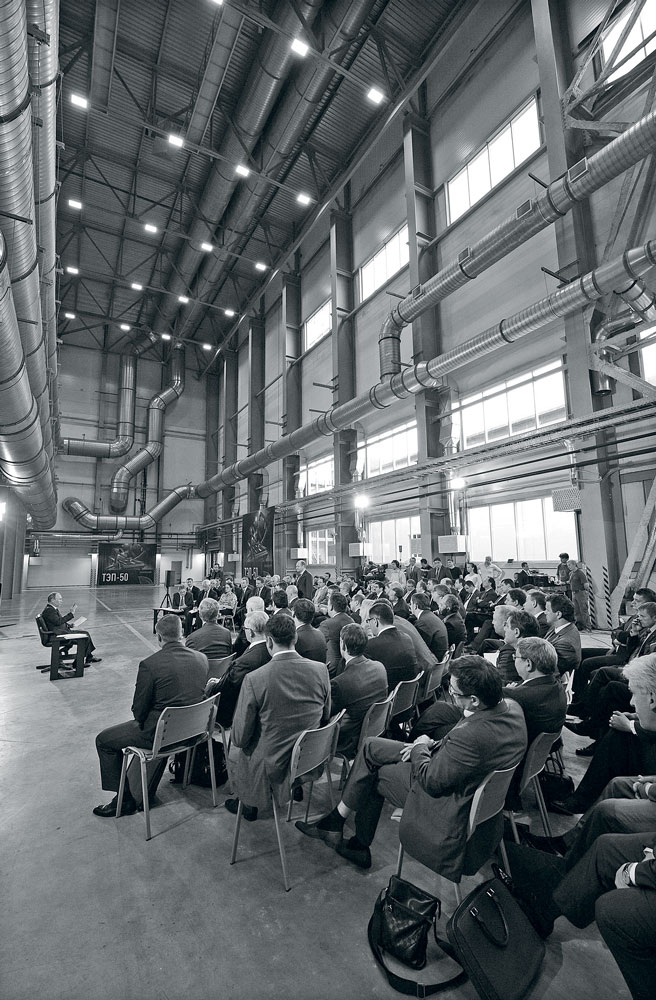 |
| Vladimir Putin (in the background) listened to the opinion of entrepreneurs about the amnesty, but did everything in his own way |
“Well, imagine: a person who does not know how to sing suddenly announces that Lensky will be performed now. But instead, excuse me, it farts loudly, ” - so the lawyer Konstantin Rivkin appreciated the project of the long -awaited amnesty for entrepreneurs in an interview with The New Times. Rather, what remains of him as a result of the creative processing of the Kremlin specialists of a document prepared on the initiative of Boris Titov, an authorized by the President of the Russian Federation to protect the rights of entrepreneurs.
What was removed
The initial project of the amnesty, as already wrote The New Times, Vladimir Putin called the raw at a meeting with entrepreneurs in Voronezh on May 23 and suggested "along with experts, along with the General Prosecutor's Office to see, draw conclusions and then make a balanced decision." And already on June 21, speaking at a plenary meeting of the St. Petersburg Economic Forum, the president said that the updated document was ready, after which he personally entered it to the State Duma.
During this incomplete month, experts with the prosecutors who joined them worked at a shock: a list of articles on which amnesty is announced almost doubled (from 53 to 27) and overgrown with a number of additional conditions. So, only convicts will be released from the punishment for the first time and only if the damage is shared within six months. In addition, the amnesty will not apply to those who are convicted by the totality of several articles, and those who committed economic crimes with the use of violence.
But the main and unpleasant surprise for entrepreneurs is a surprise of a new document is the absence in it of Art. 159 (fraud), according to which, according to the estimates of the Ombudsman himself, most businessmen are sitting. Although earlier Titov has repeatedly publicly said that compromises are impossible here, since "it makes no sense to conduct an amnesty without the 159th article."
So why did this key article nevertheless disappeared from the final text? The authors of the project answer this question very evasively.
| *"Fraud in the field of lending." ** "Fraud in the field of entrepreneurial activity." |
“The 159th was removed, because it is not clear how to separate real scammers from those who performed the actions that fall under this article in their entrepreneurial activity,” explained Andrei Nazarov, vice president of business Russia, “Business Russia, vice president,” explained The New Times. -But convicts on the 159th can apply in the supervision of the retraining of their case on Art. 159.1 *or 159.4 **. And if the court admits that their crime was committed in the entrepreneurial sector, these articles will fall under an amnesty. ” The same considerations, that is, the desire to separate real scammers from “fictitious”, according to Nazarov, explains the removal of other articles from the project.
"
Art. 160 (appropriation or embezzlement). It is on her that Mikhail Khodorkovsky is sitting now, and in Kirov they judge Alexei Navalny
"
People who protect businessmen from raiders and “custom -made cases” do not suit such an explanation.
| *** Speaking about persons who fell under the initial version of the amnesty, Vladimir Putin said: “There are also so -called counterfeiters, there are people who were convicted of criminal export of double -use materials, which can be used in the production of weapons and even weapons of mass destruction.” |
“In Voronezh, Putin pointed out some exotic articles on weapons trade ***, but for some reason the article on fraud fell,” is perplexed by Yana Yakovlev, the leader of the public organization Business Solder. “I think that she became a stumbling block with the coordination of this project: probably, someone said somewhere that if there is a 159th article, then there is no amnesty.”
However, who and where, it is not difficult to guess: according to Andrei Nazarov, the preparation of the final edition of the project took place "at the level of the state legal department of the president." Moreover, at the very last stage, after the presentation in St. Petersburg, as it were, the final project, three more articles disappeared from it, including the 160th (appropriation or embezzlement). And this can no longer but suggest that in this way, from under the action of the amnesty, specific persons deliberately bring out. Indeed, according to a “completely accidental” coincidence, it is according to Art. 160 is now sitting in Karelia Mikhail Khodorkovsky (the second article from his second sentence, the 174th, falls under an amnesty), and in Kirov they judge Alexei Navalny. Yes, and the work of the "main subscription", where the accused are listed Alexey and Oleg Navalny, is also aroused according to the amnesty of Art. 159. Andrei Nazarov, however, resolutely refuted this version, assuring The New Times that "this has nothing to do with personalities."
On the other hand, there are questions to those articles that remained in the project, for example, to the Art. 159.4. As Yakovlev emphasizes, “there is no law enforcement on it yet, there are no convicts, there is no practice yet”. “Strange: the legislator has just changed the article, why then immediately declare an amnesty on it?” -the leader of the "business salt" is surprised.
What they added
Another extremely unpleasant surprise for businessmen is a clause on compensation for damage, which is an indispensable condition for exemption from punishment.
“This amnesty was originally conceived for entrepreneurs who became a victim of raider seizures and who have already taken money, business or real estate,” recalls lawyer Marina Andreeva, who conducts cases under economic articles of the Criminal Code. - Moreover, when a person sits, as a rule, arrest is imposed on his property. And that means that he cannot compensate for the damage from his property. ”
“Putin in St. Petersburg said that those who have extinguished the damage or agree to do it under an amnesty. But only the first option was included in the text, ”Yana Yakovleva draws the attention. - But the difference here is cardinal. If a person writes that he agrees to repay the damage, and after that he is released, then many will agree to this, even though the repayment of the damage is interpreted as a plead of guilt. ” Those who are under investigation will have problems. “I am afraid that this harden with damage can be used by law enforcers precisely in order to do nothing (to use an amnesty),” says Yana Yakovleva. - They will say: but he did not extinguish the damage that we will let him go, let him pay first. But how can you compensate for the damage at the investigation stage when it has not even been proven? "
"
Those who “ordered” businessmen will benefit from the amnesty: both the business has squeezed out and “compensation for damage” will receive
"
The developers of amnesty with their critics do not agree, although they admit that the requirement to compensate for damage will seriously complicate the process of release.
“Of course, I would like people to go out without this condition,” Andrei Nazarov admits. - But this norm was introduced to avoid the discontent of people who suffered from the actions of entrepreneurs. This, of course, significantly narrows the circle of falling under an amnesty, because, unfortunately, not everyone will be able to compensate for the damage, and some do not agree with this fundamentally. But still, this is a politically compromise solution-so that the amnesty generally takes place. ” As for the sources from which prisoners can compensate for the damage, they, according to Nazarov, still have the most sitting entrepreneurs-from income from the business remaining in the will to the opportunity to simply borrow.
In the meantime, it can be stated that those who once “ordered” now sitting businessmen have ever won from such an amnesty: they have already squeezed out business, and now they will also receive “compensation for damage”.
What will happen
How many businessmen will fall under this truncated and limited amnesty? Experts have no consensus in this matter yet.
According to the initial project, more than 110 thousand people were planned to amnesty - including those who are investigated and those who were sentenced to imprisonment. And in the places of imprisonment at the beginning of 2013 there were 13.6 thousand people convicted on economic articles, about two -thirds of which, according to amnesty developers, were entrepreneurs. It is clear that after the “improvement” of the project, the number of amnestied will significantly decrease, but how far it is still unclear.
“It is impossible to name the exact figure, because it is not known who has already extinguished or will have time to pay off the damage in six months,” says Andrei Nazarov. “Besides, we don’t know how the 159th article will be re-qualified. But in general, under the amnesty, according to our estimates, several tens of thousands of people will fall, and several thousand of them will come out of places of imprisonment. We believed that 100 thousand could be gained, although, according to the estimates of the State Duma deputies, it will be 20-30 thousand. ”
Yana Yakovleva is much more pessimistic: in her opinion, only those whose affairs are at the stage of investigation and who can count on their retraining at Art. 159.4. “Those who have already been convicted of the 159th have no chance,” the human rights activist is sure. -Because the courts have already developed in the courts when the judges refuse to considerate the petitions for retraining, referring to the fact that since the article has not disappeared from the Criminal Code, then nothing has changed in general. And or not, the entrepreneur does not want to understand, the courts do not want to: they say, there was already a judicial investigation, there was a sentence, and now we don’t even have your things, so you go forest. ”
| **** In May 2010, the Khamovnican Court of Moscow, and then the Moscow City Court considered that the amendments to Art. 108 of the Code of Criminal Procedure prohibiting the detention of accused of economic crimes cannot be applied to Khodorkovsky, since the crimes incriminated to him “do not belong to the field of entrepreneurial activity in the sense that the legislator provided for in Art. 108 Code of Criminal Procedure. " |
It will be extremely difficult to achieve re -qualification, Marina Andreeva agrees. “Here it is also necessary to keep in mind that judges have a biased opinion about entrepreneurial activity. For example, Khodorkovsky is not an entrepreneur ****, ”the lawyer recalls. - Therefore, I think these conversations are that “even if one comes out, it will be very good,” is all from the same opera as “freedom is better than not free.” Of course, it is better, but I think this is just a spit in the face. ”
Photo: ITAR-TASS