
Translated material
An attempt to escape
How the uprising was crushed in Berlin 60 years ago
60 years ago, in June 1953, in Berlin there were massive performances of workers, who in the West called the "popular uprising", and in the territory of the GDR - an attempt to "fascist rebellion". The unrest was quickly suppressed, the Berlin uprising ended with a cruel defeat. On July 1, 1953, martial law was canceled in Berlin. Soviet troops were withdrawn from the capital and other cities of East Germany
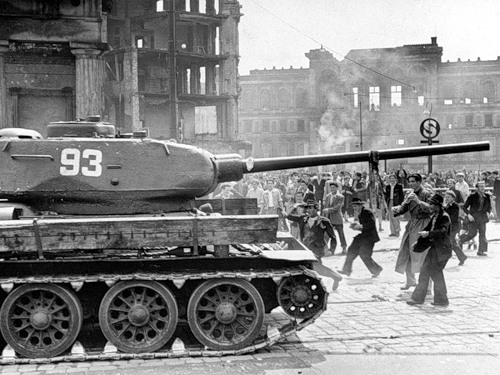
The protests were brutally depressed by the military, it is reliably known about 125 victims among the rebels
By the summer of 1953, the GDR developed an extremely unstable situation. By this time, 40 percent of industrial capacities were dismantled and taken out of the Soviet occupation zone. But the main problem was different - socialism was planted in an intense pace: they were strangled by taxes and administrative measures of small owners, private trade, and massively nationalized medium and even small enterprises, peasants drove into agricultural cooperatives, analogues of Soviet collective farms. Almost all goods were distributed by cards. From all this, people fled massively to West Germany (from June 1952 to May 1953 about 312 thousand people left the country - twice as much as a year earlier; only in March 1953 the GDR left 50 thousand inhabitants). First of all, highly qualified personnel fled.
In April 1953, two months before the June events, prices for clothes, shoes, bread, alcohol, public transport, meat, meat and, most of all outraged the Germans, the traditional jam, without which the German breakfast was most unraeling. And on May 14, 1953, the Plenum of the Central Committee of the SUPG adopted a decision to increase the norms of production. As usual, the Jesuit: “The Government of the German Democratic Republic welcomes the initiative of workers to increase the norms of development. It thanks all employees who have increased their norms for their great patriotic business. At the same time, it responds to the wish of workers to revise and increase the norms. ”
Insurrection
It is generally accepted that working protests in Germany began precisely in the East and precisely in 1953. But the precedent was: back in 1947, residents of the English zone of occupation rebelled. The riots began in March and continued, according to Soviet intelligence, for three months. These were mainly attacks on officer and soldiers' canteens: the Germans took food and took him home. There were clashes with English troops.
In the GDR, protests began in the spring of 1953. At the Major Plaw Plant in Mansfeld - April 17. At the artificial fiber factory in the premises - April 28. On Verkziegmashinenfabrik (Berlin) - May 6. At the armor shields in Khemnitsa - June 3.
In Berlin, excitement broke out on June 16 on the construction of facilities on Stalin Alley. At first, the workers protested against raising norms. 10 thousand people came to the house of the ministries and handed a letter in the name of Prime Minister Otto Grothevol.
The frightened government urgently abolished the increase in norms. But the people were no longer stopped. New slogans appeared: the resignation of the country's leadership and free elections. Several police officers were beaten. In the top secret report of the representative of the Ministry of Internal Affairs of the USSR, it was correctly reported: “According to the observations of agents during the day and evening of June 16, p. G. from the striking were not put forward a single slogan against the Soviet Union. All attacks are directed exclusively against the Government of the GDR and SEPG ... According to reports, people from Western Berlin played an active role in the organization of demonstration. ”
However, the next day the situation has changed fundamentally. In addition to ordinary economic slogans, calls for unification of Germany appeared and, for example, this: "Ivan, get home." About 150 thousand people advanced to government institutions. The leadership of the GDR hastened to hide in the Soviet fortified camp in the Berlin district of Karlshorst. Events got out of control.
The crowd defeated the border signs and structures on the boundaries of the Soviet and Western sectors of the city. The rebels destroyed the symbols of communist power - flags, posters, portraits, including portraits of Stalin. The 22-year-old driver Horst Valentine climbed with a friend at the Brandenburg gate, took off his red flag and hoisted another-with a bear, a symbol of Berlin.
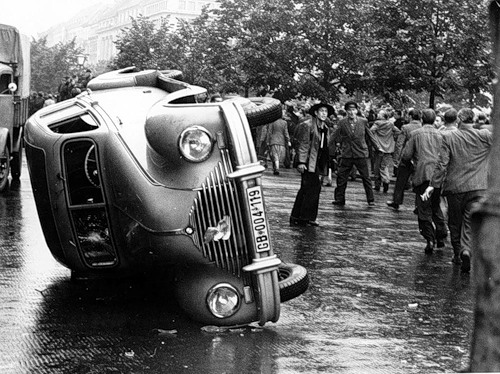
The riots continued, although the government made concessions
Police barracks were besieged; Of the 12 prisons, 1,400 political prisoners were released. The unrest spread throughout East Germany. In industrial centers spontaneously arose strike committees and advice of workers, who took power in their hands in factories and factories. In Dresden, the participants in the mass unrest captured the radio station, in Galla the rebels came to the newspaper’s editorial office, in Bitterfeld the strike committee sent a telegram to Berlin demanding “form a“ form of the revolutionary workers ”. According to recent studies, unrest was at least 701 in the village of Germany. The official authorities of the GDR assessed the number of traffic participants at 300 thousand in other sources The number of striking workers is estimated at about 500 thousand at 110 large enterprises, and the total number of participants in the demonstrations is 3-4 million (out of 18 million people).
In total, 250 (according to other sources - 160) of government and party buildings was subjected to siege and assault. The rebels were employed by 11 buildings of the district councils, 14 office of the burgomaster, 7 district and 1 district SUPG committee; 9 prisons, 2 buildings of the Ministry of State Security and 12 police institutions (districts and plots) were captured. According to official figures, 17 were killed and 166 SPG functionaries were injured. But here is the frank recognition of the then head of the foreign intelligence of the GDR Marcus Wolf, which he made in his book “Game of Alien Field: Thirty years at the head of the intelligence”: “These days, when they were assaulted, and sometimes the buildings of party committees and state institutions were set on fire, when Soviet tanks in which the youth threw the stones when the first killed or the first killed or the first killed or the first killed or appeared. The wounded ... It became clear to me that the conversations of our leadership about the "fascist adventure" and the "counter -revolutionary coup" were pure water excuses. "
Suppression
On June 17, at 13 o’clock, the Soviet military commandant of Berlin Peter Dibrov introduced a state of emergency. It is forbidden to conduct any demonstrations, not to get together more than three, do not go out at night, violators will be punished according to the laws of wartime. Lavrenty Beria urgently flew to Berlin.
Based on the documents declassified in 1990, we can conclude at least 125 dead. In particular, the Soviet authorities were sentenced to death 29 people. Here is a characteristic notice: “The announcement of the military commandant of the city of Magdeburg. I inform the present that the citizens of Darch Alfred and Strauh Herbert were sentenced by the court of the military tribunal to the death penalty through the execution for active provocative actions on June 17, 1953, directed against the established order, as well as for participation in gang actions. The verdict is carried out on June 18, 1953. The military commandant of the city of Magdeburg. "
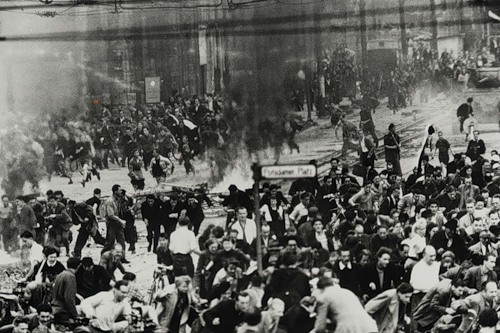
Participants in protests were declared provocateurs and bandits, in total about 20 thousand people were arrested
Subsequently, 100 people were convicted by Soviet courts of 3 to 25 years, about fifth of them were sent to Soviet camps, the rest were kept in prisons of the GDR. In total, about 20 thousand people were arrested, of which by the German courts were convicted - at least 1526 (apparently, this is an incomplete figure), including 2 to death, 3 to a lifelong conclusion, 13 for 10-15 years, 99 for 5-10 years. From the authorities there were 5 killed, 46 policemen were injured, 14 of them are hard. In the West, the number of victims was greatly exaggerated - for example, the number 507 killed. Modern German researchers Joseph Landau and Tobias Zander note the “relative moderation” manifested by the Soviet authorities when suppressing the unrest: “Contrary to everything, the Soviet occupation power is not as unceremonious and bloodthirsty, as the Western world claimed. With such behavior of the rebels, there could be much more victims ”, given that about 25 thousand fighters and 300 tanks participated in the rally only in Berlin.
After the uprising
The crisis and the arrest of Beria allowed Ulbricht to clean the party from his opponents. On July 15, 1953, the Minister of Justice of the German Democratic Republic Max Fekhter, due to “anti -party and anti -state behavior”, was expelled from the party, removed from his post and arrested. Three days later, the Politburo of the Central Committee of the SUPG decided to withdraw the Minister of State Security and the editor -in -chief of the newspaper Neyes Deutsland. For its part, in August 1953, the GDR freed the GDR from paying the remaining 2.5 billion dollars of reparations and transferred the last 33 enterprises under Soviet administration. In addition, the Soviet side was provided with a loan and additional supplies of goods were made.
The result of the uprising was also the termination of the regime of occupation in 1954 and the acquisition of the GDR of sovereignty. The Stasi iron wing spread over East Germany. There were no more protests.