
Translated material
Live a rocket fall
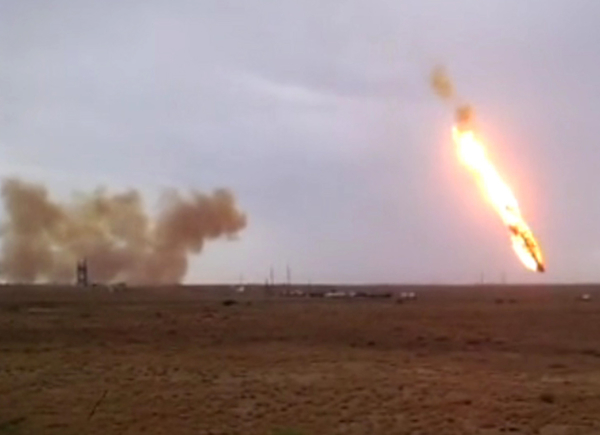
During the fall of the Chelyabinsk meteorite, the number of eyewitnesses who became reporters “on occasion” ( Random Act of Journalism ) was so great that the Internet delivered the most interesting faster media. For the first time in a hundred years after the Tunguska meteorite, the media remained out of work when covering such an event.
The launch of the "Proton" was a planned event. Here, professional media had an advantage over amateurs, because their cameras were already at the right time in the right place. The start was shown on the air of the Russian-24 information television channel.
From the point of view of the media, the collapse of something on the air is a great luck. We must throw the rest of the topics and spin this one. And what?
The television journalist Katerina Gordeeva wrote on her Facebook : “It is amazing, of course, that where we are bashfully clinging the beat and in bewilderment get out of the air, in any normal case it would be just the beginning of the hot work. Well, it happened to you in the direct one, well, work already. In general, or something, professional instincts were grinding. ”
I must say that the weak reflex of the professional reflex nevertheless slipped. Here is the leader’s orders: “But something seems to go wrong. Something is wrong ... It seems that it will be a disaster. And now the rocket goes to the ground. And breaks up in the air. And the explosion ... ”And then the professional breaks through:“ So, right on the air, the unsuccessful launch of the Proton-M missile took place ... Clubs of black smoke are soared into the air. ” And all.
In general, professional logic tried to take her (the presenter also emphasized that everything happened live), but could not. Next went other stories according to plan.
You can discuss how exactly a journalist or media should work out such an event if it suddenly happened live. But somehow they owe it. Express emotions or anxiety about people on the launch pad, ask the questions “Take a lot?”, “Who is to blame?” And "What to do?" - As you like. How many films with textbook subjects are there, when a secondary journalist or television channel breaks the jackpot at a random sensation. Here is a chance! But no, the most important (this is immediately obvious) The topic of the day is simply closing.
Because it is still not clear how to illuminate it. The administrative reflex is triggered earlier than professional. The main task is not to express your opinion, but to guess the right one. But for this you must first navigate.
This does not mean that the title media do not cover the fall of the rocket at all. They illuminate, but then, when the sanction is understood and tonality is developed. Because such media are the press service. They work on the side of the supplier, not the consumer. Without touching hot topics, the media lose their Internet; Following the topics, the audience also goes. (Therefore, by the way, the supplier himself turns out to be the consumer.)
A lot of examples when an acute topic does not fall into the media at all or is covered in the right perspective. But the most remarkable stories are when the acute theme still penetrated the media-by chance, against their will. And they begin to bite.
On December 7 last year, Prime Minister Dmitry Medvedev gave an interview to several television channels, including the first and Russia. After the ether, as if responding to the request of his imaginary reference group, he spoke to the investigators who came to the opposition with a search early in the morning: “Everything will be fine there, you do not worry. The goats are that at eight in the morning they come ... ”But it turned out that the equipment was not turned off. The recording was on the Internet, a scandal erupted .
A randomly recorded sharp statement of a major politician is a real luck for a journalist. And what? The television channels organized the air, one after another, were reopened from the sensational record. One colleague noted: "It is a great pleasure to observe how three television channels are in a hurry to assure that each of them is not involved in the spread of socially significant information."
Of course, on the surface lies a kind of maxim of public structure, in which the media turned into a division of the administration. The maxim is justified, but if you look into this abyss deeper, then you can find the second bottom there.
In November 2011, when accelerating OCCUPY WALL STREET, the New York police detained several reporters, including from the Associated Press . Other journalists AR threw a message about the arrest of colleagues on Twitter. The next day, the management of the AR sent the employees a warning: “We have employees who tweeted the message about the arrest of colleagues before this news fell into the tape ...” (the phrase is allocated by the registry in the New York Magazine note, which was the first to write about this circular AR . Details described by the old OpenSpace. RU .)
A discussion flared up in the American media test: is the publisher the publisher has the right to ban on reporters to report socially significant news in social networks, that is, in fact, independently? (There are similar restrictions in other agencies.) AP was then justified by the fact that she was worried about the safety of journalists. But in fact, everyone understands that if a journalist immediately merges the important news on Twitter, then he thereby reduces the value of the agency’s news feed. Because he should supply news not to society, but to his company. And she will dispose. But journalists, like society, think that journalists inform society, not a company. There is such a useful stereotype.
All the same questions: mission or position? Professional reflex or administrative? It turned out that even the media, perceived as a guardian of democracy, protect something else - access to information.
Funny thing: with all the difference in public structure, the largest American and Russian media are in approximately the same way. They would like to limit the spread of important information. The Americans are for financial reasons, ours are political (well, or also in a sense in terms of financial).
It turns out that the value of the media is formed not at all with information, but by its absence from the audience. Media proclaims themselves with a filter, but serve as a valve. The valve opens for the consumer money (in the case of AP ) or the supplier (in our case). In American discussion, this dilemma is formulated as follows: media does not want to be a gate ( Gate ), they want to be a gatekeeper . For some reason, I recall Ostap Bender, who sold tickets for failure.
Business media for four hundred years was built on the sale of a shortage. But if there is no deficit now, then do not try to create it artificially? Actually, the construction of the artificial Paywall 'A, if you think about it, is something that directly contradicts the spirit of journalism in its social dimension. The need is clear, but the mission is corrupt.
The difference between journalism and media is becoming more and more obvious. Journalism reports, media is sold (Xia). Journalism - activity, media - Institute with its interests.
At the same time, the media, which interrupts the live broadcast after the fall of the rocket, retires from the political sensation or forbids reporters to drain important news on Twitter, still remains media - in the literal sense of the word: a remedy, an intermediary. This is just an insufficient description. It must be supplemented all the time: a means for what? Intermediary between whom and by whom?