
Translated material
Posthumous-and-point sentence
The court in absentia sentenced Bruder to 9 years in the colony, and found Magnitsky guilty
On July 11, the Tver District Court recognized the lawyer of the Hermitage Capital Foundation Sergei Magnitsky guilty of tax evasion and terminated the case in connection with his death. The court sentenced the head of Hermitage Capital William Brower in absentia to 9 years in a general regime colony. 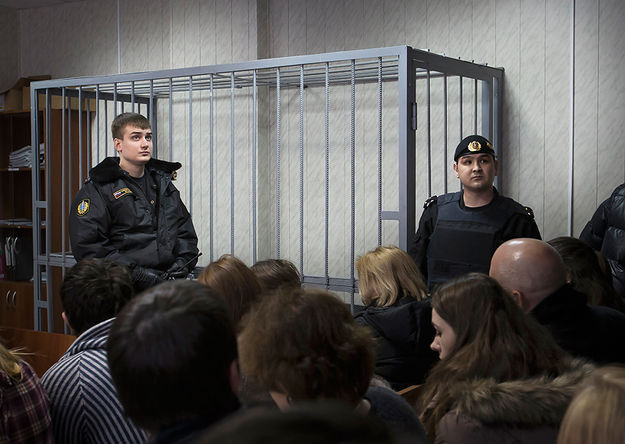
The hall where Magnitsky suffered to announce the verdict in the case of Sergey Magnitsky chose the largest room in the Tver district court - hall No. 20 on the third floor. This is the hall in which Judge Elena Stashin usually listens. The one that extended the Magnitsky preventive measure on October 13, 2009, three days before his death in the Sailor Silence pre -trial detention center. The same judge Stashin, who refused to listen to Magnitsky’s complaints about the unbearable conditions of his maintenance in prison and did not pay attention to requests to let him go on their own recognizance: Magnitsky and his lawyers complained to Stashina that all Magnitsky’s diseases were aggravated, and prison doctors refused him the necessary medical care.
Judge Elena Stashin is included in the so -called “official list of Magnitsky” of 18 Russian investigators, judges and officials whom Magnitsky’s colleagues and relatives consider him involved in his death and who are prohibited from entering the United States. There is her surname in an expanded list of 60 Russians , which, as it became known this week, closed the entrance of Great Britain.
The trial of a dead man is the verdict to Sergey Magnitsky and William Brauder was announced by Judge Igor Alisov. His name, by the way, appeared in the large “McGovern list” , which was not eventually adopted by the US Senate.
The posthumous process in the Magnitsky case began several months ago. He took place in another hall - on the ground floor of the court. Most of the room was occupied by a huge cage for the defendants. She was empty and this attracted the increased attention of photographers. In this process, it would seem, all legal norms were observed: witnesses, prosecutors performed, lawyers were present. True, the lawyers at the process were present, but, in fact, they did not participate in it. The family of Sergei Magnitsky refused to attend the court, saying that the resumption of a criminal case against a deceased person is illegal: this is possible only for the purpose of his rehabilitation, and the investigation and the subsequent court are clearly tuned to the indictment. William Brauder was also against the beginning process. Therefore, the interests of the accused at the court were represented by lawyers from legal advice No. 25 appointed by the state. As the lawyer of Magnitsky Nikolai Gerasimov told The New Times, he could not refuse to participate in this process: he was afraid that he could be deprived of a lawyer status.
In the debate, the prosecutor asked for William Brauder 9 years in a general regime colony. Sergei Magnitsky prosecutor asked to find him guilty and terminated the case in connection with his death.
Judge Alisov exactly fulfilled both wishes.
The expected finale from the hall No. 20 took almost all the shops. About two dozen television cameras were sent to Judge Alisov. Two prosecutors in blue uniforms with impenetrable faces looked right in front of them. Next to them is a representative of the victim, an employee of the Federal Tax Service Anastasia Gerasimova - in a white lace dress and a white jacket.
Immediately nearby - the lawyers of the defendants who were inexpensive "for good reason". And an empty cage. Four dozen bailiffs, hands at the seams, ready at any moment to rush into the hall, guarded Judge Alisov from the public. It seems that they began to appear on resonant processes since the Meshchan court listened to the first case of Mikhail Khodorkovsky and Platon Lebedev. In the same way, the bailiffs guarded the public judge Viktor Danilkin in the Khamovniki court and Judge Marina Syrov, when she announced the verdict in the Pussy Riot case.
The presence in the hall of people in military uniforms, people who went through hot spots and are ready at any moment for aggression against the public, gives any process a sense of horror. From whom the bailiffs guard the judge, what is he afraid of? Are we not present in court, where justice is performing on behalf of the state? Or is the judge not sure that he judges by the law, and is afraid of the anger of the public?
Judge Alisov read the verdict for an hour and a half, but the sensation of absurdity and longing did not pass. Despite the numerous protests of the Magnitsky family, the statements of human rights organizations, dozens of articles in the Russian and Western media, finally, despite the decision of the Constitutional Court of the Russian Federation that the trial of a deceased is possible only with the permission of relatives and only for rehabilitation - despite all this, the posthumous process over the person who was tortured in prison took place.
The absurdity continued when the judge, announcing the verdict, read out the words of Magnitsky, he said during the investigation: "He does not admit his guilt even all the transactions of the companies" Saturn "and" Far steppe "with the disabled who were hired were legal."
The absurdity intensified when the judge announced that the punishment in the 9th years of the general regime William Brauder should be “calculated from the moment of arrest”: the head of Hermitage Capital was arrested only by the absentee decision of the same Tver court, but was not even put on the international wanted list.
When Judge Alisov finished reading the verdict and closed Red Daddy with the emblem of Russia, the bailiffs began to push the press to the exit from the hall.
On the street, television people crowded. They really wanted anyone to comment on what happened on July 11 in the hall No. 20. But the lawyers of the convicts refused to comment, but there were no relatives of the convicts in the hall.
When all the participants in the process dispersed, one of the journalists sadly remarked that everything is possible in the Russian court: processes without defendants, courts over the dead. And the main characters are not judges, but the bailiffs who behave like on the battlefield: they hate the audience, journalists and at any moment are ready to free the hall from the audience. Someday, this will probably happen, and then the absurdity of the trial, similar to the “Magnitsky case”, will reach the climax: the judge will read the verdict to the prosecutors and the lawyers appointed by the state-in the absence of the defendants and the public.
Photo: Alexander Zemlianichenko/AP