
Translated material
Classic jazz
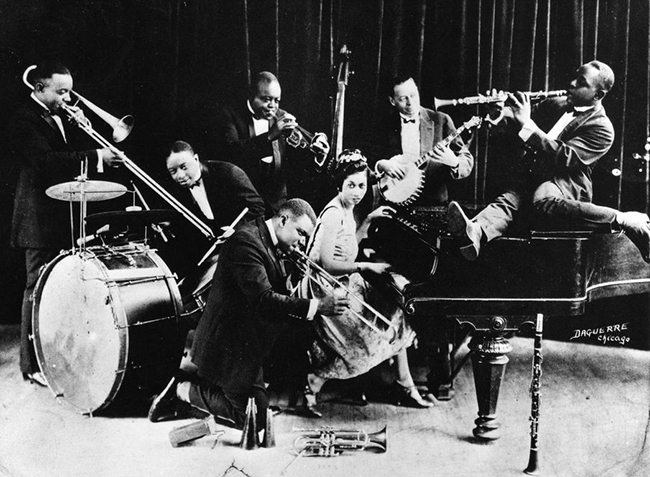
1. Regham. 1880-1910s
Ragteim originated among Negro pianists-amateur. The peak of the popularity of reghads falls on the first decade of the 20th century, but they appeared twenty years earlier. The popularity of regai at the beginning of the 20th century was largely associated with a massive request for dance music. The phonograph was not yet common, and the masses of ordinary Americans danced under the piano. The dance character of the regaym, in contrast to the “melodic” popular music, which has vocal roots, determined the rhythmic innovation of this genre.
Scott Joplin - "Maple Leaf Rag"
Pianist, teacher
Classic European dances were mostly the destiny of aristocrats. In order to dance them, it was necessary to learn various PA and their combinations, sometimes quite difficult, and people who formed their position with a lower rank, simply did not want to be bored. Despite the ease and simplicity of rhythm, the regime played in exotic African pentatonic frets and using some tricks that were not familiar with white musicians. This combination of simple and new and gave birth to an amazing dejection type of musical, which is called reg.
Regham is not a rape of leaf, not a shopkene concert, not the 5th Beethoven concert, not Mozart and not a bang. This is not the type of complexity, not technological and not compositional complexity - it is a stylistic complexity. For academic musicians at the beginning of the 20th century, such stylistics was quite difficult: these syncopes were not familiar to the hearing of Europeans. Therefore, when in 1918 the early jazz first fell on the European shores, he received the nickname “Crazy Syncopes” - “Crazy Syncopes”.
Syncope-in European music, a sound starting on a weak fraction of the tact and continuing on a strong one, which is why there is a displacement of rhythmic accents, the separation of the melody from the accompaniment.
Ragteim is not a jazz, it is played evenly, it is a pure water Polka, which any composer could write, who wants to write not quite classical music. “Ragtaym's father” Scott Joplin brought several blasting elements - for example, “3 versus 4” - and some exotic intervals for that time, such as sextons. In this case, another type of rhythm is characteristic. In the reg, the rhythm is counted from the second and fourth states of the tact, plus a separate strong accent on the last, fourth, share every two tacts. A separate syncoping of the melody is imposed on these off-bit accents.
Off-bit is a principle in which rhythmic accents are shifted from the “strong” fractions of the tact-1st and 3rd-to the “weak”-the 2nd and 4th.
“3 versus 4” is the main type of cross-rhythm, characteristic of West African music. Inside one metric unit (tact), two rhythmic schemes sound in parallel, contrasting with each other. One of them, the main one, consists of four equal rhythmic units, the second, sounding on top of it, consists of three equal units.
2. Traditional jazz: New Orleans style and dixiled. 1910-1920
By the beginning of the 20th century, several dozens of marching orchestras and ensembles of dance music - mainly Negro and Creolean, existed in the New Orleans. The music that they played was created under the influence of rugai, blues, marches, Negro warc-components. A significant influence on them was made by the musical culture of Creole, originally close to European home music. Later, when the Creole of the southern states were equalized in rights with Negro, the Negro and Creole cultures became close, which contributed to the emergence of new synthetic forms. After the end of the US-Spanish war, a large number of instruments from military orchestras appeared in the city, which contributed to the creation of amateur musical groups, whose musicians were not familiar with a musical diploma. How exactly the music sounded in New Orleans at this time, one can only guess - according to the game of imitators of the New Orleans style on the first records that appeared only in 1917. At first, the concept of “dixiland” was an analogue of the concept of “jazz”, invented among white musicians in the conditional name of the Southern States of the United States. Later, the Dixyland style was associated with the "white" ensembles of the early jazz, although often the New Orleans style and dixiland are understood as synonyms. After the release of the first jazz plate of a group of white musicians Original Dixieland Jass Band in 1917, jazz as a new form of folklore playing playing the era of Art Nouveau begins to spread throughout the country.
Original Dixieland Jass Band - "Tiger Rag"
Drummer, member of the Trio "GTC" (Ganelin - Tarasov - Chekasin)
It is amazing to hear from the musicians that Swing appeared after Dixieland. It turns out that dixiland is not jazz. In Dixyland, swing as much as you like. Just listen to the syncopted game of the bandjo and a small drum. Later, in the 1930-1940s, when new twigs sprouted from this tree, including white ones, much changed in language, and with it a feeling of swing.
Swing is the nature of the execution of a soloist or ensemble, based on constant deviations from the supporting rhythm and creating the effect of “swinging” the entire sound mass. Swing is characteristic of different styles and periods in the history of jazz. In the 1930s, this term began to be called the popular style of jazz in the era of the spread of the beigs.
King Oliver's Creole Jazz Band - "Dippermouth Blues"
Clarinetist, saxophonist, leader of the classic jazz ensemble
New Orleans is a specific city, it was called "Paris of the New World." A port city at the mouth of Mississippi, in which there were a lot of business, many visitors. There were picnics, parades, processions, so the musicians in New Orleans constantly had a lot of work. If a solid man died, then he was ordered a funeral with an orchestra - this was also a job for musicians. There, almost everyone was self -taught, did not know the notes, played by hearing, and King Oliver (the legend of the New Orleans style, in the orchestra of which young Louis Armstrong began to play. - Ed. ) Was a self -taught. Some confuse dixiland and the New Orleans style. New Orleans is a blues manner, they did not beat dominants, reduced septaccord, as later in Dixyland.
The New Orleans Rhythm Kings - "She's Crying for Me"
Composer, arranger, teacher
The improvisational beginning in jazz never lost its role. The basic textured principle of the New Orleans style was spontaneous polyphony. This polyphonic principle was based on the simultaneous improvisation of several solo-dodes (pipe, thrombone and clarinet). In addition, simple chords sounded in a completely new way thanks to the blues fret. On top of the continuous bit of rhythm sections, soloists could allow rhythmic freedom in improvisation. All these features led to the fact that Jazz began to be perceived by the public as something new and unprecedented, which led to its rapid spread in the world. Jazz was originally programmed for rapid development. The prospect of this development was determined by a combination of two elements: folklore (blues) principles and the use of instruments of the symphonic orchestra, including a piano.
Polyphony is the principle of building a musical work (warehouse), in which individual melodic voices equal in their function sound in parallel. It is contrasted with a homophone warehouse in which the upper voice performs the function of the melody, and the rest of the voices support it harmoniously.
3. Chicago style. 1920s
In the 20s, important social changes took place. This era went down in history under the name "Jealing Twenties." Writer Francis Scott Fitzgerald in his famous stories expressed differently - “The Age of Jazz”. In the early 30s, he wrote: “The word“ jazz ”, which no one now considers indecent, meant sex first, then the style of dance and, finally, music. When they talk about jazz, they mean a state of nervous plaque, about the same as it reigns in large cities when the front lines approach them. ” In the 20s, jazz begins to move to restaurants and dunxing, becoming an important part of mass culture. The essence of jazz is expressed in the manner of execution itself, which cannot be recorded on paper, and thanks to the development of the recording industry, the jazz begins to replicate on a massive scale, well illustrating the thesis of Walter Benjamin about the “work of art in the era of its technical reproduction” . In the 1920s, the migration of jazz musicians in the northern industrial cities, the center of which is the Chicago, intensified. At this time, Jam Sessions also gained free performances in taverns after midnight for a small audience of connoisseurs based on spontaneous improvisation of several soloists. The complication of the arrangements and the contrast of a separate soloist to the whole ensemble begins.
Louis Armstrong - "West End Blues"
Daniil Kramer
The jazz ensemble was built in a completely different principle than dixiled. Dixylend is built on the principle of two lines, when a rhythm-section plays in the background-bass, bandjo and shock tools. And the front are the polyphonic lines, say, from the pipe, thrombone and clarinet. And these polyphonic lines are continuously intertwined, one of them is the main one, and the rest framed it. At the same time, the rhythmic basis is off-bit, the harmonic principle is much simpler. In the jazz ensemble, the rhythmic basis is already Four-bit, not off-bit. If there are several soloists, then they do not frame the main line, but improvise each on their own. And, finally, much more difficult to build arranging jazz plays. A jazz sensation is a sensation of stretched onions. This rhythmic component, called a drive, an unstoppable rhythmic stream, is still present at Bach, already to a slightly lesser extent in Mozart and begins to get lost with romantics. Jazz musicians brought this drive to a new level. I realized where he came from when I was in Africa and saw how village African musicians play: they have it in their blood.
Four-bit is a type of rhythm in which all four fractions of the tact are evenly focused-strong and weak.
Of the dixilands and early jazz ensembles, I would single out the ensembles of Louis Armstrong - Hot Five and Hot Seven . Personally, the drive of Armstrong is closer to the drive King Oliver or Bix Baderbek. Such a drive - very hard and at the same time beautiful - no, perhaps, no one at that time.
Bix Baderbek - "Singin 'The Blues"
Oleg Grymov
Clarinetist, saxophonist, Oleg Lundstrem orchestra
In early Jazz, Swing was different, more grotesque, both white and black musicians. And later, at Hawkins, Leicester Yang, he has already become more smooth. Bix Baderbek is a great cornetist, but if you listen to his swing, it is clear that the corners are slightly more pointed. This early swing was more like a rugtime.
I come to the conclusion that the great artists became the older, the more they strove for simplicity. It’s just that many did not live, like Young or Parker, went on take -off. Armstrong lived for a long time, but as he began with this simplicity, he finished it. Moreover, in this simplicity there was a depth that needed intellectuals. It seems to me that the main thing is naturalness. If this complexity is not tricked, then it must exist, if simplicity is not a gaping emptiness, then let it be. Armstrong was the quintessence of his time. This is Johann Sebastian Bach Jazz. Too much coincided in this person. There were many very good musicians of the time in whom everything did not coincide as he had. The less famous musician is Sydney Beshe. Blahe was a very passionate nature, it is enough to listen to his notes to make sure. He was a man of extremes, and everything he did was as passionate as his game. As his student Bob Wilber recalls him, it could be very kind and caring, but if he felt some neglect in your words, he could be very evil and vengeful. If it had not been, it was not known, we would have learned about John Hodge (the famous alt-saxophonist from the orchestra Duke Ellington.- Ed. ), Because Hodges listened to Beeshe all his life and even took several lessons from him. This is heard, such a New Orleans approach to the instrument. Beshe has a very bright, original sound, a very frequent vibrato that is difficult to copy. Perhaps the most famous composition in his performance is Summertime George Gershwin. For many sopopophonists, she has become a template for execution. I personally really love Black Stick Blues , where he plays on a clarinet - he started like a clarinetist. The Swiss conductor Ernest Aeserme said about him that there is such a musician from the Southern Syncopated Orchestra orchestra is a genuine genius. Then he played on the clarinet.
Sydney Beshe - "Summertime"
Vibrato is a fast pulsation of one sound with a periodic change in its height less than half -ton. The result is a continuous wave -like line.
Jack Teagarden and His Orchestra - "Basin Street Blues"
thrombonist, composer, New York Art Quartet
Dixieland is the music on which I studied. I heard her in the 40s and 50s, when I was young. What attracted me the most in it is a collective improvisation. She was very open. There was a clear structure, but in this structure people created music, listening to each other. It struck me then and is still amazing. I think that collective improvisation is that my twenty-year-old peers returned to jazz in the 60s. When we first appeared before the public, we included a collective improvisation in our game. It was natural for me, because I left Dixieland, and I had a feeling of how to play in relation to someone else-the improvisational “question-answer”. Groups of Charles Mingus, Cecil Taylor; San Ra - all of them were engaged in collective improvisation and did it very beautifully. These people revived old music and at the same time created something modern.
Responor technique (question-answer) is a fundamental compositional principle, in which all elements of the musical form are built into complementary pairs, where the first element, unstable and incomplete, implies the presence of an subsequent, logically completing element.
Jack Tigarden is our American monument; He is like Jay Johnson (the legendary thrombonist of the Bibop era. - Ed. ). It personifies a certain style of play on a thrombone - very clean, fresh and assertive. I like Tigarden's earlier music when he was more as an experimenter. In my youth, I heard a lot of his late things during live performances, and it was beautiful. But I lacked his "mistakes."
All jazz is “free”, not only free jazz. It all depends on which musicians you are talking about. Jazz is, in essence, the first music. It can be found around the world, because when people improvise, this is the first music. Dixieland, collective improvisation is the most avant -garde form that you can achieve, and if you do it well, put a real feeling in it and not overdo it with intellectualism - then you get great music. Free jazz, new music, free improvisation-all this means the same thing for me, all this is just music. Collective improvisation is the basis of what I do. You can analyze certain periods and styles-the Congo-Square (a terrain near the New Orleans, where in the 18th-early 19th centuries the black population was allowed to gather for trade, singing and dancing.- Ed. ), New Orleans, Kanzas City, New York, West-Kost, etc. Or the great initiators of the styles - Louis Armstrong, Coleman Hawkins, Pi Vi Russell, John Birx Gillespi, Charlie Parker, Koleman Ornett, etc. But each of them is distinguished by a unique way of improvisation, and when it occurs collectively, it turns out free “symphonic” music. I call it Dixyland.
Bad Freeman - "Theel"
Oleg Grymov
Bad Freeman is a wonderful musician. He was such a dumb, always looked very stylish and played just as beautifully. Many critics believe that he influenced Leicester Yang. Indeed, at concerts of the late 1960s, if you close your eyes, it seems that Lester Young. Lester, in my opinion, denied this, but he spoke very highly of Freeman. Freeman worked a lot with Benny Gudman, Tommy Dorsi. He is a typical representative of the swing, but also played with Dixieland musicians. He has many notes on which he plays in dixilend compositions, where, it seems, there should be thrombone, and there is playing a bada friman tenor-saxophone, a completely different sound is obtained, more mobile, less bonding. He was born and died in Chicago. At this time, many great musicians lived there - for example, Jimmy Nun. I hear in the records of the 30s the obvious influence of Nuna. It is quite obvious that they went to each other for performances, took something, borrowed. So everything was mixed up: Freeman find Jimmy Nuna, you find Freeman and Frankie Tumbauer at Lester. This is such a mixed soil, from which beautiful flowers then grow. In general - with all the dominant role of black musicians - it is not known how it would have happened if there were no new Orleans, where there were huge French and Spanish colonies. Creole - illegitimate children of French and Spanish colonists from their slaves. In early jazz, it was customary to use small vibrato on wind instruments, especially by the end of the phrase. Самый экстремальный пример — Беше, в котором текла французская кровь. Мне кажется, даже в этом проявилось какое-то генетическое французское влияние: если взять пение французских шансонье, это слышно.
4. Эра свинга, эпоха биг-бендов. 1930-е
Набирающий популярность джаз породил спрос на большие оркестры танцевальной музыки. Это, в свою очередь, потребовало более слаженной, организованной игры и усложненных аранжировок. Манера хот-джаза становится привычной для широкой публики и начинает переходить в мейнстрим. Особенно важным становится то, как «свингует» целый оркестр.
Фэтс Уоллер — «Honeysuckle Rose»
Даниил Крамер
Свинг — это естественное синкопирование на основе непрерывного ритмического потока, называемого драйвом, в сочетании с различным переменным соотношением реального и ощущаемого ритмов, что, по некоторым мнениям, в том числе и по моему, является одним из значений термина «бит» (другое значение — удар, способ внутритактового акцентирования). Когда существуют в комплексе три компонента — бит, драйв и естественное синкопирование, тогда, собственно говоря, начинается джаз. У Фэтса Уоллера уже в полной мере присутствуют и свинг, и сложившиеся джазовые гармонические комплексы. Один человек будет говорить с акцентом, другой будет произносить те же слова, но без акцента. Фэтс Уоллер уже говорит без акцента, там сложившийся язык. Уже наблюдается свинговый фоур-бит. В джазовой музыке солист играет либо вместе с ритмом, либо слегка сзади, но никогда не спереди. Триоль в джазовой музыке свингуется внутри себя, ритм отсчитывается от слабой, третьей доли триоли и спускается на сильную, первую, как с волны.
Триоль — способ группировки трех равных по длительности нот, которые и в сумме длятся столько же, сколько две ноты той же длительности.
Fletcher Henderson and His Orchestra — «Copenhagen»
Валерий Киселев
Флетчер Хендерсон принадлежал к тому негритянскому кругу, который выбился в высшие слои, и очень этим гордился. Они очень дорожили своим положением, не разрешали своим детям играть с чернокожими детьми: когда нахулиганит белый — это одно, а когда черный — все уже по-другому. Флетчер получил хорошее образование. Он фактически считается основателем современного биг-бенда. В ансамбле диксиленда труба ведет основную мелодию, кларнет играет так называемое облигато, тромбон ведет гармонический голос. Четыре-пять инструментов, дальше получится какофония — расширять уже некуда. Когда оркестры начали играть в солидных домах, где нужно было побольше музыкантов, как-то надо было организовать по-новому. И тогда Флетчер Хендерсон со своим соратником Доном Редменом придумал сопоставить группы — три саксофона и три медных инструмента, как правило, это были две трубы и тромбон. Постоянное сопоставление, саксы играют тему, бэкграунд играет медь, потом медь перехватывает мелодию, саксофоны — аккомпанемент. Это уже первые признаки биг-бенда, соревнование секций инструментов.
Биг-бенд — джазовый ансамбль, по количеству участников превышающий десять человек. Для биг-бенда характерны более тщательная аранжировка, усложненная фактура и усиление роли руководителя ансамбля.
Glenn Miller Orchestra — «In the Mood»
саксофонист, композитор, лидер «Круглого бенда»
Для меня период джазовой музыки, звучавшей до бибопа, долгое время был загадочным. Скажу честно, нечасто слушаю эту музыку и сейчас, когда обращаюсь, например, к записям 30-х годов прошлого века, кажется немного странным не слышать в игре свинговых музыкантов типичных боповских опеваний, клише, альтераций. Но, углубляясь в изучение этого стиля, манеры игры музыкантов, их языковые особенности, гармонию, импровизации, понимаешь — это необыкновенный художественный пласт, огромное направление, без которого невозможен был новый шаг. Мир «эры свинга» — это, я бы сказал, особое миросозерцание. Игра музыкантов как бы выплескивается потоком эмоций, порою даже неоформленных, нереализованных идей в виде различных мелодических построений, иногда даже спорящих, перебивающих друг друга, с яркими контрастными образами, у духовиков, например, вмещающими в себя или пассажный элемент, или долгий хрип на одной ноте. Возможно, это влияние хот-джаза, при котором музыканты пытались добиться большей свободы и выразительности в соло, в чем можно услышать африканские истоки.
Хот-джаз — разновидность джаза, характеризующаяся усиленным импровизационным началом, главенством интонационной и ритмической выразительности над композицией. «Горячий» с самого зарождения джаза означал «аутентичный», в противоположность имитации новоорлеанского стиля белыми музыкантами и коммерческому варианту джаза, использовавшему лишь некоторые характерные элементы джазового языка. В то время как в 1920-х годах резко противопоставлялись хот-джаз и коммерческий вариант джаза — свит-джаз, в 1930-х хот-джаз в виде свинга становится коммерчески успешной популярной музыкой и переходит в мейнстрим.
Но при этом в эпоху свинга, в 30-е годы, у музыкантов при экспрессии и выразительности идей есть основательная, местами даже и рациональная игра, в которой всегда слышна четкая ритмическая организация, и неотъемлемый свинг с присущей этому периоду джаза особой ритмической задержкой. Складывается ощущение, что музыканты будто бы пытаются договорить с помощью своих инструментов то, что не могут сказать словами. Но и при этом в их игре слышна четкая устойчивость, верность своему стилю, манере, языку, мелодии, метроритму. Кстати, по поводу ритма — отдельный разговор. Ведь, допустим, если говорить о добоповском периоде вообще, ритмическая организация строилась и воспринималась музыкантами по-разному. Допустим, бенды Каунта Бейси, Гленна Миллера, Дюка Эллингтона, Бенни Гудмана — это не только разные мелодические, импровизационные концепции, но и разные подходы к метроритмическому решению.
Count Basie Orchestra — «Swingin' the Blues»
Vladimir Tarasov
У нас, джазменов, знаменитое высказывание, пародирующее партийцев, звучало так: говорим «джаз», подразумеваем «свинг» — и наоборот. До сих пор так никто конкретно и не смог описать, что же такое свинг. Что это за специальная раскачивающаяся манера звукоизвлечения с синкопированием. Я когда-то упростил и сделал для себя вывод, что если исполняется просто восьмыми, то для меня это не джаз, а если музыкальные фразы строятся через восьмую с точкой и шестнадцатую, тогда джаз. Причем совсем не обязательно на регулярном темпе. Раньше музыканты в России почему-то упорно считали, что свинг — это когда нужно играть чуть спереди или чуть сзади, тогда все и получится. Сегодня, к счастью, много музыкантов, умеющих играть со свингом. Я также знаю и многих исполнителей классической музыки, обладающих, на мой взгляд, отличным свингом.
Benny Goodman — «Sing, Sing, Sing»
Валерий Киселев
Мое знакомство с джазом произошло в 1963 году, когда я учился в 7-м классе. Мой старший товарищ пригласил меня в районный Дом культуры, там показывали фильм «Серенада солнечной долины» с Гленном Миллером. С этим фильмом в меня вошел джаз, биг-бенд, свинг. В 30-х годах свинговый джаз имел большое значение. Это, выражаясь современным языком, была единственная «попса». В 30-е годы в Нью-Йорке было более ста биг-бендов с известными именами. К концу 30-х годов Америка была покрыта сетью радиостанций, и люди с утра до вечера могли слушать джаз, танцевать, развлекаться. До начала войны выпускалось огромное количество грампластинок. С помощью пластинок оркестры получали известность, ездили на гастроли, люди покупали их пластинки и шли на танцы. Когда в Советском Союзе появились видеомагнитофоны и мы увидели эти оркестры живьем, мы были поражены: как же, такие звезды — и играют на танцах! Вообще было не принято покупать билеты, садиться в кресло и слушать джаз. Джаз играл там, где люди выпивали, закусывали, танцевали.
Линди-хоп — главный танец «эры свинга».
Все музыканты эпохи свинга ходили на танцы. Когда я научился этим танцам, я понял по-настоящему, что такое свинг. Нетанцующий человек воспринимает музыку ушами, а свинговые танцы основаны на баунсе, на колыхании тела. Только в январе 1938 года был впервые организован джазовый концерт оркестра Бенни Гудмана в Карнеги-холле, где обычно игралась симфоническая музыка. Эта музыка вышла из низов и должна была пройти свой путь до концертного зала.
Баунс — исполнение в умеренно быстром темпе с «упругой» ритмической подачей, характерное для свинга. Также разновидность свингового танца.
«Савой» был первым танцевальным залом, где разрешалось танцевать смешанным парам — черным с белыми. Как правило, в таких залах было два оркестра — один свой, другой приглашенный; между ними шло соревнование. Когда Бенни Гудман создал свой оркестр, у него была проблема: как тогда выражались, у него не было своего «портфеля» — репертуара. Ему посоветовали обратиться за аранжировками к Флетчеру Хендерсону, который недавно распустил свой оркестр. Флетчер Хендерсон уже тогда отдал свои произведения Чику Уэббу. И два оркестра играли по одним и тем же нотам. Кому-то пришла идея устроить соревнование — белого и черного оркестра. Запись этого концерта сохранилась. Я никогда не верил, что черные оркестры лучше свингуют, но, играя по тем же нотам, оркестр Бенни Гудмана выглядел намного слабее. Я бы не разделял белую и черную культуру в Америке. Они все выросли в этой культуре — просто нужно жить в Америке.
Было много очень похожих оркестров, проходных вещей для танцев. Но много было и ярких оркестров, аранжировщиков, солистов. Кто-то был больше, выражаясь современным языком, раскручен, кто-то меньше. Бенни Гудман был великим кларнетистом, но еще и великим бизнесменом. Один критик сказал про двух друзей, которые вместе работали у Бена Поллака в молодости, Бенни Гудмана и Гленна Миллера: если бы эти два парня занялись любым другим бизнесом, у них бы это получилось. Гленн Миллер каждую копейку считал. Не особенно талантливый музыкант, он собрал оркестр, аранжировщиков и стал великим.
В 30-е годы солисты играли меньшую роль. Пьеса должна была уместиться в какие-то три минуты. Поэтому солисты никогда не играли полный квадрат в 32 такта. Все солисты играли соло по кусочкам, делили квадрат на части. Поэтому солисты не могли себя проявить, как в бибопе.
Квадрат — гармоническая сетка (последовательность аккордов), длящаяся определенное количество тактов (чаще всего 32), лежащая в основе главной темы, на которую при повторении накладывается импровизация. Джазовая композиция чаще всего состоит из серии таких квадратов.
Дюк Эллингтон — «Take the A Train»
Vladimir Tarasov
Эпоха биг-бендов была замечательна. Я сам начинал с биг-бенда и обожал оркестры Дюка Эллингтона, Каунта Бейси, Дона Эллиса, Гила Эванса, который сформировал композиционное мышление Майлза Дэвиса. Для биг-бенда важны грамотная работа аранжировщика и талант руководителя, дирижера. Оркестр Дюка Эллингтона я слушал двенадцать концертов. Они вообще почти не импровизировали в общепринятом понимании этого слова, играли одну и ту же программу, но каждый концерт был разный. В этом и мастерство музыканта заключается — здесь и сейчас, в данном времени и пространстве. Они играли совершенно потрясающе. Дюк Эллингтон сам звучал и был частью того, что он играл. Харизма художника, лидера «заводила» оркестр. Когда Эллингтон ушел в иной мир, я слышал буквально через месяц, как этот оркестр играл с тем же самым составом, только дирижировал его сын Мерсер Эллингтон. Была та же самая программа, те же музыканты, но совершенно другая музыка. В искусстве все-таки существуют три градации — аматер, профессионал и мастер. Дюк Эллингтон был великим мастером. Профессионалов сегодня в России много, а мастеров единицы. Дело не в технике. Мы все умеем читать ноты, книги, но мы еще должны понимать смысл текста. Вот для чего нужны хорошие руководители оркестров (и не только джазовых) — они раскрывают нам «историю», заложенную в звуке.
5. Джаз в академической музыке и саксофонисты 30-х годов
«Porgy and Bess»
трубач, флюгельгорнист, композитор, лидер ансамбля «Каданс»
Шостакович был на премьере «Порги и Бесс» в Ленинграде. Моя мама была с ним знакома, она узнала, как он отзывался об опере: «Тридцать процентов хорошей музыки». Сто процентов я бы тоже не дал — там есть некоторые слабости, нельзя сказать, что это безукоризненный шедевр. Но тридцать процентов — это очень мало. Конечно, там больше половины хорошей музыки. Это музыка, которая содержит в себе элементы джазового искусства. Гершвин относился к джазу с симпатией, это совершенно очевидно. Если бы это было не так, джазмены не играли бы его темы. Они чувствовали в этом что-то родное — по ладу, по ритму, по эстетике. Но он рвался к симфонизму, масштаб джаза ему казался мелким.
Коулмен Хокинс — «Body and Soul»
Олег Грымов
Хокинс исповедовал гармонический подход к импровизации. Он вскапывал каждый квадратный сантиметр музыкальной ткани, пытался раскрыть все грани джазовой гармонии. До него мало кто играл на тенор-саксофоне так мастерски.
Лестер Янг — «Way down Yonder in New Orleans»
Alexey Kruglov
Среди музыкантов, раскрывшихся в 1930-х, мне как саксофонисту особенно интересна личность Лестера Янга. Это удивительный музыкант, который, полностью находясь в стилистике свингового импровизационного направления, все же значительно отличается от других саксофонистов свинга, в частности — Бена Уэбстера и Коулмена Хокинса. Это во многом всеобъемлющая личность. Во-первых, он явно не тяготел к «горячей» игре, у него часто слышны куловые интонации, чем он, возможно, предвосхитил появление кула как стиля. Лестер Янг порой использует альтерации, обыгрывания, которые встали во главу угла у боперов. Конечно, этот момент не был его основной линией, часто его соло строятся по обычному септаккордовому ряду с использованием блюзовых оборотов, но тем не менее создание гармонического напряжения, обусловленного использованием частичного боповского хода с альтерацией, вкупе с холодной игрой производит уникальное впечатление.
Альтерация — повышение или понижение высоты звука без изменения его названия.
Думаю, не только Лестер Янг пусть и невольно, но выходил за пределы своего стиля. Данный вопрос еще стоит изучить, так как тема исполнительского мастерства в этом направлении лишь только кажется на первый взгляд легкой задачей. Ведь джазмен — особое мировоззрение, а уж тем более — в добоповском периоде, где каждый музыкант не пытался походить на кого-то, а шел по своему оригинальному пути.
To be continued