
Translated material
There was a paper soldier
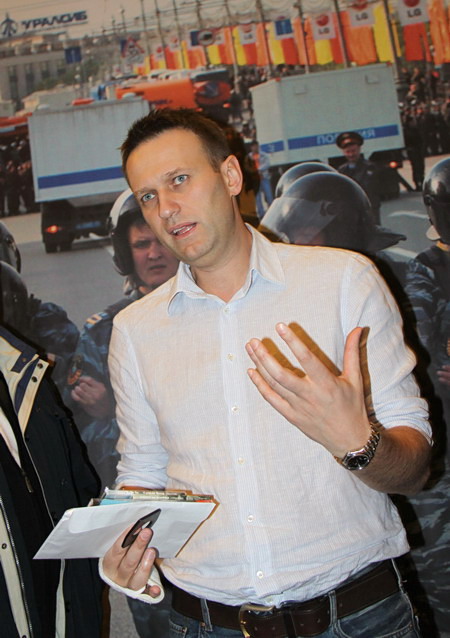
Alexey Navalny committed an act of self -immolation. The probability of being arrested and convicted, expelled or killed, if you are gaining popularity as a potential political leader in Russia, is the probability of being burnt if you seduce yourself with gasoline and struck a match. The laws of political survival work in the same way as the laws of physics. Optimism is inappropriate.
The verdict in the case of Alexei Navalny will not affect the course of historical events in Russia. Unless a few dozen people will decide on emigration. Alexey Navalny cannot become the president of Russia. He cannot become the mayor of Moscow either. The recent arrest of the only opposition mayor in Russia in Yaroslavl proves this.
Alexei is another brave man, a romantic and idealist who overcame fear and for the sake of self -realization went to death. He is a person, but his advantages and disadvantages, just as his views and beliefs, now do not matter, since Alexei Navalny will not affect the fate of Russia. At the human level, it is necessary to remember about him. At the political level, he is irrelevant. Tactical prosecutorial concession - a subscription about a non -departure instead of detention - only a temporary whim of power. Navalny, as well as Pavel Officers, who fell into the same meat grinder, is a historical accident, and interest in him is fleeting. But in the context of the end of the political career of Navalny, it is necessary to realize something else: it does not matter either from a historical or political point of view, how many people came to the rally in support of Navalny or against the sentence to him. As a percentage of the electorate of 100 people and 100,000 people are equal and are within the statistical error. In a democratic society there is a game of numbers, and in an authoritarian society the number of man-units does not matter. The rally would be significant, even if at least one person went out into the street. The fact of an open statement of disagreement is important. The history of protest and reforms in Russia is not a history of numbers, it is a history of personalities, and more often the effect is achieved by units. Never mass. And to change any political system from outside, power structures are needed, which human rights activists do not have access to Russia.
To date, the key question is: what are they strive for disagreements and what effect do they want to achieve? Now it is not visible and it is not clear what their ultimate goal is - the goal realized, not utopian. To formulate the goal, it is necessary to first determine how the foreseeable, not the illusory future of Russia can take shape. What is really possible in Russia? Without an answer to this question, the human rights movement turns into a process for the process. The opposition goes to rallies, hopes that there will be more people, and at the same time, he tries to understand what she goes to them for. In this, and not in the feud, the existential problem of the Russian opposition. All calls to power in Russia and the subsequent reaction show that power in Russia is not capable of reform. And it makes no sense to appeal to her. The framework of the possible in Russia is very narrow. This is not connected with the President’s personality, with his beliefs, political views or the correspondence of his position. This is due to the fact that, how absolutely correctly formulated Koma Ivanov, Russia still passes through the period of instability, which began in 1917.
Over the next ten, but rather twenty years, the President of Russia can only be an exclusively native of law enforcement agencies. Not so long ago, a man dedicated to the secrets of the Moscow court told me a bike. Allegedly shortly before the murder of Vyacheslav Ivankov, the deceased grandfather Hassan came to the audience with the president and said approximately the following: “Vladimir Vladimirovich, Japanchik must be returned back from America. I'm worried. Star I became. When I die, lawlessness in Russia will begin. No one, except him, will keep thieves in his hands. ” One of the most controversial people of the era was bothered by the question that an ordinary citizen, even with a high level of intelligence, simply does not occur to him. There are a countless such questions.
An enlightened Czech Republic can be controlled by a playwright for some time, who came to power in the wake of a surge of positive emotions that captured the whole people; Judging Poland can control the ship electrician during the transition from martial law to independence from his older brother; And in the multinational, at the fear of nurtured Russia with its 83 constituent entities of the federation, institutions of state power are necessary for management. Not a single person will pull himself. The word "bureaucracy" is not in honor today, but the consistent "anti -positivist" Max Weber in the work "Politics as a calling" emphasized that only by bureaucratic methods can be controlled by complex state systems. Such institutions, with a clear hierarchy, the distribution of powers and functionality, rules, regulations, in Russia there are - these are power ministries and services, far from effective, but the only ones. And only a person who can control the power structures can manage Russia - a native of them or a person with them for many years working hand in hand, soul in the soul or back to the back. Any stranger will poison or poke a knife in the back. This is not the political position of the author - this is a logical conclusion.
The stability of the United States largely depends not only on a clearly built constitutional system, but also on the fact that thousands of people work in all federal departments who remain in their places and continue to work regardless of which party sends its political appointment to the department this year. The US state machine can also work in the absence of the president and congress. There are institutions of power. In Russia, they have not yet been built, and construction has not yet been even at the level of a strategic plan.
It is impossible to rationally support the candidacy of Alexei Navalny for the post of President of the Russian Federation and believe that he will become president. The support “against whom, and not for anyone”, which Navalny received in certain circles, is exclusively social, and not political and, accordingly, have no practical consequences. From this, its significance in no case is reduced. It is very important for the existing small community of progressive like -minded people, whose life is done warmer thanks to each new joined. They can also affect the political system of Russia as much as in its cold winter - but they can bask in each other's kitchens, and sometimes, when they want to feel freshness, dive into the hole of the rally. Dreaming at the same time about the thaw. For them, the number of people who have come to Manezhnaya Square is urgent - this knowledge helps to overcome loneliness and confront the “sovereign tyranny”, which they cannot overthrow.
Solidarity even in the form of a secret handshake is power. But you should not call this unity the opposition, because the opposition implies organized and unified opposition to a certain directional movement. When there is no movement - there is no ideology, there is no strategy, there is no position, no platform, no action - there can be no opposition. The brave and humane actions of individuals in Russia are possible, and the opposition in today's Russia is logically impossible. The opposition’s paper soldiers, honest, creative, educated people, have a soul hurt, not only because they are going on around, but also because they cannot change this in any way.
The role of the intelligentsia is the role of the keeper of culture and values, the role of the educator of the following generations, the role of the chronicler, the role of the judge without the momentary possibility of bringing the sentence, but the trial of history. It is difficult to imagine yourself with modern Plutarch, but without it the history of Western civilization and the characters of those in power would see us different. Therefore, maintaining their own dignity, supporting the fallen and fallen, conducting educational work, the intelligentsia does exactly what he should. Gasparov in the “Historical Note” accurately formulated that the intelligentsia is “a layer of society, brought up for participation in the management of society, but in the absence of vacancies, who remained with his education was out of business.” Do not be in power. Oliver Wendell Holmes, the greatest American lawyer said: “The law sodes all that it it it its all that it can” (“The law does everything that it does when it does everything that can”). These words can be attributed to each person in particular. No need to demand the impossible from yourself.
Little is possible in Russia. There is no place for human rights defenders. There is no point in fighting for her. The only constructive alternative is the creation of apolitical structures, professional and educational, the intellectual activity of which will prepare the ground for change.
The day will come when the next colonel or general, who has come to power through elections, political intrigues or putsch, will turn out to be an enlightened person and will begin to create institutions of public administration in Russia. And if he is a talented organizer and will live long, then this will be able to change the course of Russian history.
Photo by Maria Olendskaya / Hedgehog