
Translated material
Army of smokers
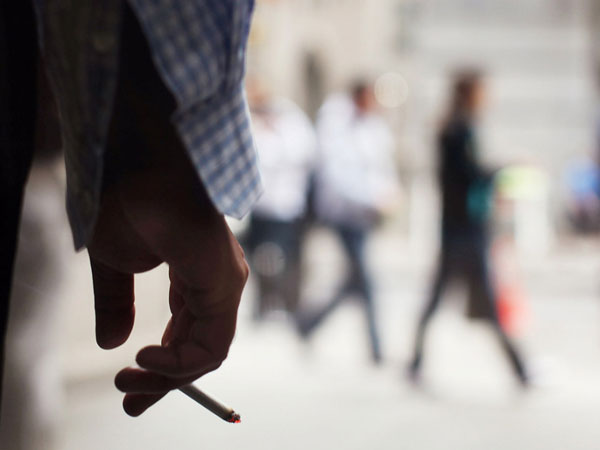
The Ministry of Health has prepared and published amendments to the law "On the Protection of the Health of Citizens from the influence of the surrounding tobacco smoke and the consequences of tobacco consumption." If the document is accepted in a constant form of excise taxes on cigarettes in the next two years will be sharply increased.
Now the manufacturer pays 800 rubles from a thousand cigarettes plus 8.5 percent of their maximum retail price. Thus, from a regular pack of cigarettes for 40 rubles in the form of excise taxes, the state depart 19 rubles 60 kopecks. Since 2015, an increase in excise taxes is provided: it will be necessary to pay 960 rubles per thousand cigarettes plus 9 percent of the maximum retail price of the pack. Thus, 22 rubles 80 kopecks will be paid from a pack for 40 rubles in the form of excise taxes.
The Ministry of Health is sure that in 2014 it is necessary to raise an excise tax to 1200 rubles per thousand cigarettes plus 10 percent of the price of a pack, and in 2015 - up to 2050 rubles per thousand cigarettes and 10 percent of the price of a pack. Thus, in the case of the approval of the bill, only an excise tax for twenty cigarettes - the usual volume of a pack - will be 41 rubles. A whole pack, excluding all related taxes, will cost at least 70 rubles, but most likely the price will be selected to 100 rubles.
So far, the State Duma has approved in the first reading a slightly softer option for increasing excise taxes: 800 rubles per thousand pieces plus 8.5 percent of the price in 2014, 960 rubles per thousand and 9 percent in 2015 and 1200 rubles per thousand cigarettes and 9.5 percent of the price of a pack in 2016.
Other ministries and departments have not yet given their conclusions for the bill, so it is possible that it can reach the Duma in a very modified form, and may not reach at all.

Against the initiatives of the Ministry of Health on an accelerated increase in excise taxes, as a rule, is the Ministry of Finance, which is afraid to increase the burden on business and smokers too sharply. On the other hand, the Ministry of Finance never objected to an increase in excise taxes, but only insisted on phasing.
In May 2013, the Ministry of Finance proposed by 2020 to bring the average excise tax on a pack of cigarettes to the average European level of 60 rubles.
In addition, now Russia must coordinate the increase in excise taxes with the countries of the Customs Union - Kazakhstan and Belarus. If this is not done, then an increase in excise tax will result in a simple import of tobacco products from neighboring countries, as occurred in April of this year, when the import of cigarettes from Belarus sharply increased, where excise taxes are not so high.
The Russian authorities recently began to seriously fight smoking. In recent years, excise taxes on tobacco have increased markedly - only in 2013 it grew by 41 percent. An anti -tobacco law was also adopted, which limited smoking at workplaces, in public institutions and transport.
It is believed that an increase in the cost of cigarettes, as well as a ban on smoking in some places leads to a reduction in the number of smokers, or at least inhibits their growth.
The World Health Organization in June 2013 recommended that Russia by 2020 increase the excise tax on tobacco seven times, to 90 euros per thousand pieces. Then a pack of cigarettes will cost, on average, 238 rubles.
The World Health Organization suggests that the growth of excise taxes will lead to a reduction in cigarette sales - from 15.7 billion to 6.6 billion packs per year, as well as to reduce smokers - from 40 to 28 million people
Gennady Onishchenko adheres to about the same principle when he offers a bottle of strong alcohol to sell in stores no cheaper than 300 rubles.
Legislators are still more condescending to alcohol lovers. The State Duma in the first reading approved a bill, which provides for 2016 an increase in excise taxes on strong alcohol to 660 rubles per liter of alcohol - that is, in a regular bottle of vodka, there will be 132 rubles.
Another argument for raising excise taxes on tobacco is a concern for the budget. So, according to WHO calculations, if the Russian government agrees to such a strong increase in excise taxes on tobacco, then by 2020 the federal budget will receive 709 billion rubles from smokers instead of 182 billion in 2012.
Excise taxes are quite simply administered: they are collected not from millions of citizens, but from several dozen manufacturers who are always in sight.
It is interesting that if the excise taxes on tobacco go to the federal budget, then the excise taxes on alcohol are divided. Gathering from alcohol with a fortress of less than 9% go to the regional budgets, money received due to the sale of stronger ones, alcohol goes 60% to the federal budget, and 40% to regional ones.
It is characteristic, in response to the request of Kabardino-Balkaria, to give most of the excise tax to the regions, the federal government said that "the current distribution of alcoholic excise taxes is associated with the law" On the Police ", which financial support for the police, including socialist Ministry of Internal Affairs and members of their families, was transferred to the federal level." Thus, it turns out that the federal government pays social guarantees to the Russian police officers from the pocket of drinking Russians.
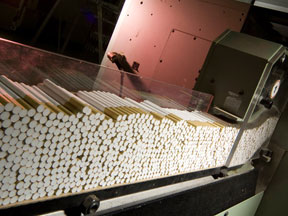
Tobacco companies themselves warn that the growth of excise taxes does not lead to a reduction in the number of smokers, but to an increase in gray imports. So, in April 2013, the director of the Pogarsky cigarette-sugar factory warned the Federal Antimonopoly Service on the sharp growth of "gray imports" from Belarus and Kazakhstan.
If earlier the share of “gray import” of the cigarettes barely amounted to one percent of the entire sales volume, today, in the PSSF, in the border areas of Belarus, almost every sixth pack is sold without a Russian excise stamp. It turns out that the Belarusian cigarettes without a filter is half the cheaper than Russian analogues, and three times with the filter.
Industrialists calculated that the loss of the federal budget from the "gray import" in the first few months of 2013 exceeded two billion rubles.