
Translated material
Alexey Muravyov: Orthodox marketing
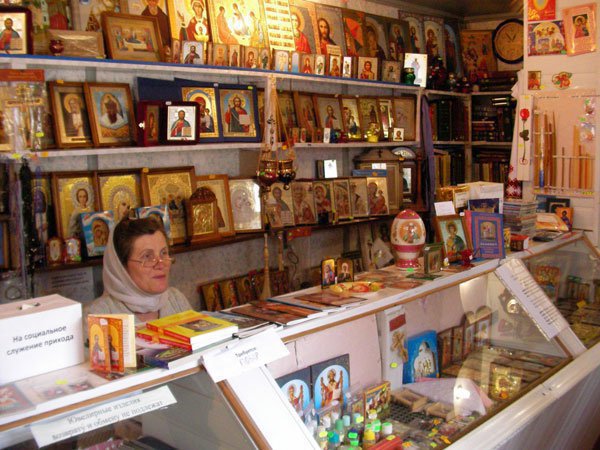
Alexey Muravyov 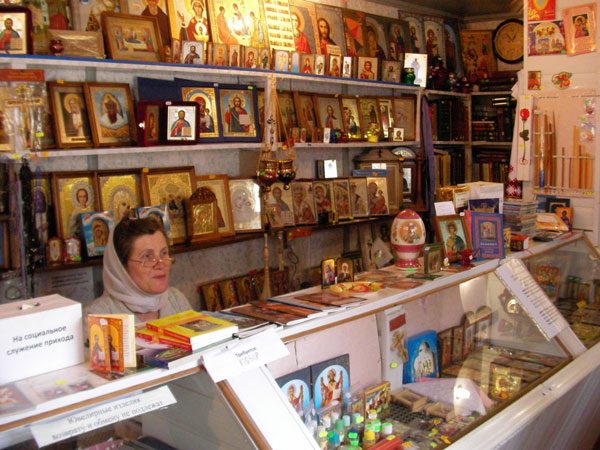 Church shop photo: uspenskij.prihod.ru
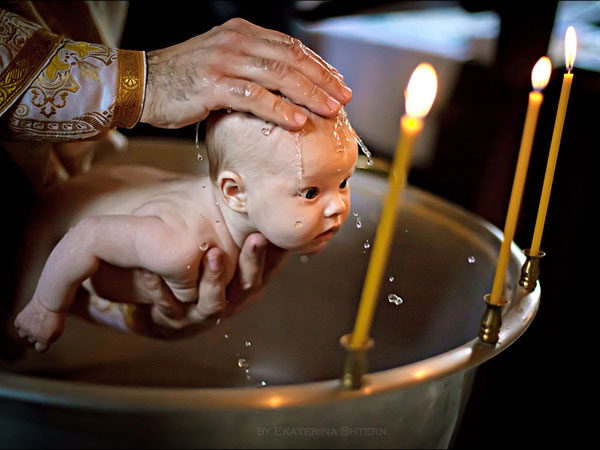 Baptism ceremony
 Church shop photo: uspenskij.prihod.ru
What is Orthodox marketing
We have long wanted to talk about difficult things. Nowadays, when many thousands of lines to relics are built, masses of people go to multi-kilometer pilgrimages, Orthodox pilgrims grow like yeast, and the parishes and dioceses are affiliated with whole segments of the tourist industry, the words “marketing”, “market”, “consumers” are increasingly sounding due to the church sphere. The very word "marketing", at first glance, is generally poorly suitable for the Sacred sphere. We roughly imagine that in the world there are also various types of exchange and interests around the sacred concepts and objects, however, inside something opens up to the use of the term, which largely determines the modern economy, to such an important and delicate area, directly closed to values. This is a whole range of plots that are difficult to talk about: there are a sacred ratio with a market, and a request for a feat, and a lot of things ... Let's start with Orthodox marketing.
Marketing, in fact, is in the field of church, and in the field of science, and in the field of family - that is, in our main sacred spheres. The problem is within the boundaries. Everywhere where there is a movement due to strong motivating stimuli, interest in these stimuli and control of them appears. After all, the structure of requests and interests of people involved in relations with sacred institutions is quite susceptible to structural analysis and in no way appears in itself as something inviolable and sacred. Entit matter to the truth, involvement in the eternal values in itself is also an interest that can be higher, below and which can be excited and regulated using market mechanisms. And people will change their lives, invest their time, money and energy, build connections.
Involvement as a product
We determine the subject of interest and goods that this interest can cover. To begin with, we confine ourselves to the church, for both family and science as institutions require a separate conversation. The church as an institution offers its services to communicate with God, to assess the affirmation of the truth, for the possibility of a cleansing or prophetic sacrifice, for psychological comfort and damping, and, finally, for the possibility of a variety of asceticism, which we will talk about separately. To implement this offer, there is a special archaic service layer, priests who should not only execute the service, but also develop the client base, and improve the provision of services.
Baptism ceremonyDoes the believers insult this marketing of their space? In principle, there is no, because they are used to it and consider it quite appropriate and permissible, like a candle box where candles, books and crosses, icon shop, boards for trembling (baptism, funeral, wedding) and other areas where exchange relations with the participation of a universal regulator (i.e. money) record symbolical actions are sold. The fact of their sale Church and the people formulate their relations , as partly economic. Here, for example, are trenches: when they crown, baptize, seal, there are always economic aspects: fees for burial rites, fees for wedding candles, for baptismal shirts, etc.
Of course, there is a counter-science-we will call it conditionally “Protestant”, who is trying to challenge these metabolic relations as “wicked” and unlawful, contrasting them with the ideal of complete abstraction of market mechanisms and almost an apostolic refusal of commodity-money relations. “They got it in vain - serve in vain”, they say. But we can’t do it like that. Because this method of subtracting the market from the sacred is not built on an archaic lining, but in the rational scheme of “return to the original simplicity”. And our archaic lining is so simply not pulled out.
The Andreevsky cross came to Russia, earlier than the belt of the Virgin, even earlier - the head of Alexy of God, we were visiting Athos and Athos. A secular man looks at it with a mixed sense of irritation and misunderstanding. At the level of intuition, the border is not built, it seems that they “sell the shrine”, although this is not so. The church as an archaic institution has a special task - the contact of people with the Absolute, with God. She correlates this task with objects at her disposal. These objects (symbolic intermediaries) appear as an offer and as a service, and this is already a market.
Orthodox marketing regulators
To understand how Orthodox marketing works, it must be remembered that the subject is not a shrine as such, but its symbolic (or “magical”) reflection in public life. The perfumes do not take money, but the archaic magi or the shaman is trading and takes. Forming the connection with the shrine, making it the subject of cottage and aspiration, the sacred “rushes” through the symbol, becoming inevitably part of the world and the subject of the economy. Participation in symbolic and symbols of involvement are market objects and actualization of practice.
Work with the interests and requests of people to the sacred - the subject of the so -called. “Developing” marketing, which, in accordance with the initiative nature of Christianity, creates the prerequisites for climbing a new stage of initiation. To take into account, to use and develop the interests of people is a good and useful business. In this case, you need to clearly hold the boundaries. The goods are symbolic involvement, the consumer is initiated, but the equivalent is not always money. The most important equivalent is the social relations that arise in the process of group compatibility and (b) a change in people's lives.
Such a story can serve as an illustration. One rural pop was very grieved - the people do not go to the church, the men drink home, and the women run after them with the battal or from the batog. Who like. In the evening, under the holiday in the temple, there are three old women. Pop estimated and realized what the request was. I ordered a huge icon "Unceppered Chalice". The icon of the Virgin, "Cup" this one has nothing to do with alcohol. But the people fell into the temple. The women dragged the men - maybe they sober up. And some people really quit thumping, began to go to church, to pray to God and build the household. We can say that this is magic. And this will partly be the truth, but this “magism” does not violate the boundaries, and in this sense, taking into account the desire of people and its use is not a violation of sacred, not deskalization, but normal Orthodox marketing.
In this marketing, of course, there is, of course, its trash, it is called in the language of marketing "Culhanting". This is when the proposal is searching for the most direct demand, the most “cool” (Cool) proposal methods. These are attempts to make a mix of Orthodoxy and rock music, conduct “ Orthodox FAQ ” and consecrate nuclear missiles (points of force). But such a kulhanting is not a good Orthodox marketing. This is love.
Earlier, in connection with totemization and magic, we explained how the sacred objects work in society - they perform a collecting and regulatory task. Becoming part of the social space, the spiritual requests of people, their desire for involvement and feat become the subject of a special market and, of course, special marketing. And the cross, and the belt, and the queues for them are described in the terms of this Orthodox marketing. There is also Catholic marketing, and even Islamic. It is enough to look at the organization of pilgrimages in Rome or compostel or the organization of the Meccan Hajj. Our Orthodox marketing is still loaded socially and politically. This comes from the fact that our borders are not drawn clearly, and the church is cast with politics and with other social institutions. But we have this by the Byzantine inheritance. We see a contradiction in the marketing assessment of Orthodox practices precisely from the fact that in theory it is spread, and in life is cast.
See also: Alexei Muravyov Cross of state importance Alexei Muravyov Patriarch offered the Russians “less fun” by Alexei Muravyov will the president’s divorce will be a step towards sacred power?