
Translated material
Nadezhda Tolokonnikova: “I came to this court in order to once again highlight the absurdity of oil and gas raw material justice”
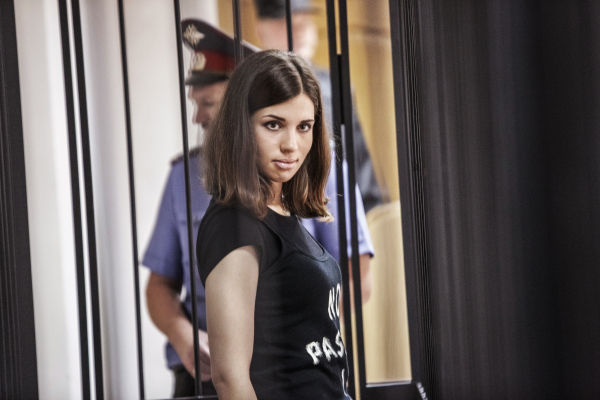
Nadezhda Tolokonnikova was personally present at the hearing
In what wonderful mood we left the building of the Supreme Court of the Republic of Mordovia. And what not to rejoice? The court passed quickly, the presiding judge was extremely and truly polite-and the varieties of false politeness Protecting Pussy Riot participants had enough: the courtesy of judges can be condescending, mocking, emphasized and formal. And most importantly: the judge gave Nadezhda Tolokonnikova the opportunity to make a speech three times. In fact, these were the first public oral speeches of the leader of the punk group since August last year, when she pronounced the last word in the Khamovnic Court of Moscow.
Stylistic disagreements
“I would like to talk about such a concept as correction,” Tolokonnikova began. Theoretically, it is about the correction that we are talking about when the issue of parole is being resolved-and this issue was resolved-there was a hearing of an appeal to refuse too. The prosecution and representatives of the colony claim that Tolokonnikova’s correction has not been achieved, and she does not have a desire to correct her.
“Once again I am convinced that if a true education is possible in Russia, then this is always self -education. You can’t teach yourself - no one will teach. And if they teach, then it is. ” This is an important topic for Tolokonnikova: at the age of 14, she wrote an article in the newspaper "Zapolyarny Pravda", in which she opposed the blindness of the school system; The article was published under the heading "Where is the world rolling?" At the age of 17, in the first year of the Faculty of Philosophy of Moscow State University, Nadezhda Tolokonnikova came to the conclusion that here it would not really be taught, developed a system of self -education - more precisely, continued to be started at school - and she would give herself what she would receive at the philosophical faculty of a good Western University (and what few have heard about at Moscow State University). The knowledge gained in this way was the intellectual basis of Pussy Riot shares. “I admit that with this power, with this aesthetics, with this ideology I have a crazy number of stylistic disagreements. Therefore, from the point of view of a state institution representing the aesthetics of power, my correction may seem non -evident. ” It is necessary, presumably, for most of the audience there was a quote from Andrei Sinyavsky (saying that he and the Soviet authorities have “stylistic disagreements”) and even more so - what was the relationship of the aesthetics of power has to criminal punishment. But Tolokonnikova did not appeal to the court, whose decision was expected, but to society.
“What can state bodies teach us? How can I educate me, and you are a channel, say, “Russia 1”? Joseph Brodsky in the Nobel lecture said: "The richer the aesthetic experience of the individual, the harder his taste, the more clearly his moral choice, the freer he is - although, perhaps, not happier." We again in Russia found ourselves in such circumstances that resistance, and not least aesthetic resistance, is our only moral choice and civic duty. ”
Putin regime
Further, Nadezhda Tolokonnikova gave a five-minute lecture on the sources of the aesthetics of the Putin regime (the Tsar-Minsk aesthetics plus “The badly understood aesthetics of socialist realism”) and how this aesthetics are expressed in the work of correctional institutions. At the first hearing about UDO, the representatives of the colony pointed out a number of signs indicating that Tolokonnikova did not embark on the path of correction: they did not participate in an amateur song, in the Miss Charm contest - also, which means that he does not take an active life position. “And I argue that my fundamental and carefully thought -out life position - feminist, anti -Patriarchal, aesthetically non -conformist - is manifested in the boycott“ Miss Charm ”. My position - and only mine, and not the protective position of the camp authorities - in the study of my books and magazines, the time for reading which I forcefully select from the colonist dulling of the day. " According to the official schedule of the day, the prisoners have two or three hours of free time after work and before the end, and at this time you can not only prepare food bought by relatives (edible, unlike the one that they give in the dining room) and engage in “personal hygiene” (the term that the current and the former decrypts, obviously, due to the maximum humiliation of the process), but also read. In fact, the lion's share of this time is often taken away by the camp authorities, which after work at work sends prisoners to work - drag building materials and the like.
“I demand to call a spade a spade,” Tolokonnikova continued. - Yes, I did not go through the colonist test for the loyalty of the protective system of values, but in an active life position I am simply ridiculous for me to refuse. The so -called penalties are no less ridiculous. ” Tolokonnikova received the penalty for: concealing notes about life in a pre -trial detention center; rejection of a walk in the pre -trial detention center (she preferred to prepare for the hearing); The fact that she did not say hello to one of the employees of the camp hospital when she was hospitalized; And, finally, for being in the colony club without the knowledge of the administration - and she came to choose a song to participate in the amateur competition, just after the comments received during the court session. In other words, all claims of the colony to Tolokonnikova are aesthetic. As, however, claims to Maria Alekhina, who received the last remark for working for a sewing machine without a scarf.
In this not the most logical place, the prosecutor interrupted the convicted person and asked her to say "the merits of the complaint, but not about the Putin regime." The judge partially agreed: “Continue, but let's get closer to business. It’s just that we have a few at the meeting. ”
“And I urge you to look wider,” Tolokonnikova answered and calmly continued to read the speech, which ended with the words: “I know that in Russia, which walks under Putin, I never get early liberation. But I came here to this court in order to once again highlight the absurdity of oil and gas raw material justice, condemning people to meaningless camp vegetation, referring to records and scarves. ”
Without surprises
The prosecutor, the lawyer and the judge quickly spread several replicas. There was a complete understanding between them: the judge demonstrated knowledge of the case file, did not refuse to join the documents, and there was nothing especially to argue with them. Therefore, soon the time for Tolokonnikova came up again.
“I am proud of everyone who is ready, sacrificing myself, to defend their principles. This is the only way that large political, value, aesthetic changes happen. I am proud of those who sacrificed their comfort and summer evening and July 18 (on the day the sentence was sentenced to Alexei Navalny - The New Times) went out into the streets to affirm his rights and protect his human dignity. I know that our symbolic power, growing from conviction and courage, is converted into something more. And then Putin and his henchmen will no longer become state power. ”
And she added: “I will be glad if they give me a call, and not as with Khodorkovsky, they will“ catch up ”, as they say in the colony ... The word“ correction ”stands in a series of words-translators characteristic of a totalitarian system, where freedom is called slavery.”
"On the call" of Tolokonnikova go out on March 3, 2014. Most likely, she will receive the next opportunity to speak with a public speech on this day.
In the meantime, everyone left the court in the elevated mood: the sun was on the street, the meeting took less than two hours, and such good speeches sounded.
Photo: RIA Novosti